
Fare Or Fair is a common English confusion because these two words sound similar but have completely different meanings. Many people mix them up while writing because they are homophones. The spelling changes the meaning and usage completely.
Fare usually relates to travel costs, prices, or how someone performs. Fair describes something reasonable, equal, honest, or related to appearance and events. Understanding the difference helps you avoid common grammar mistakes.
This guide explains Fare Or Fair with simple meanings, examples, comparison tables, memory tricks, and everyday sentences. Learn how to use both words correctly and improve your English writing skills.
Quick Answer
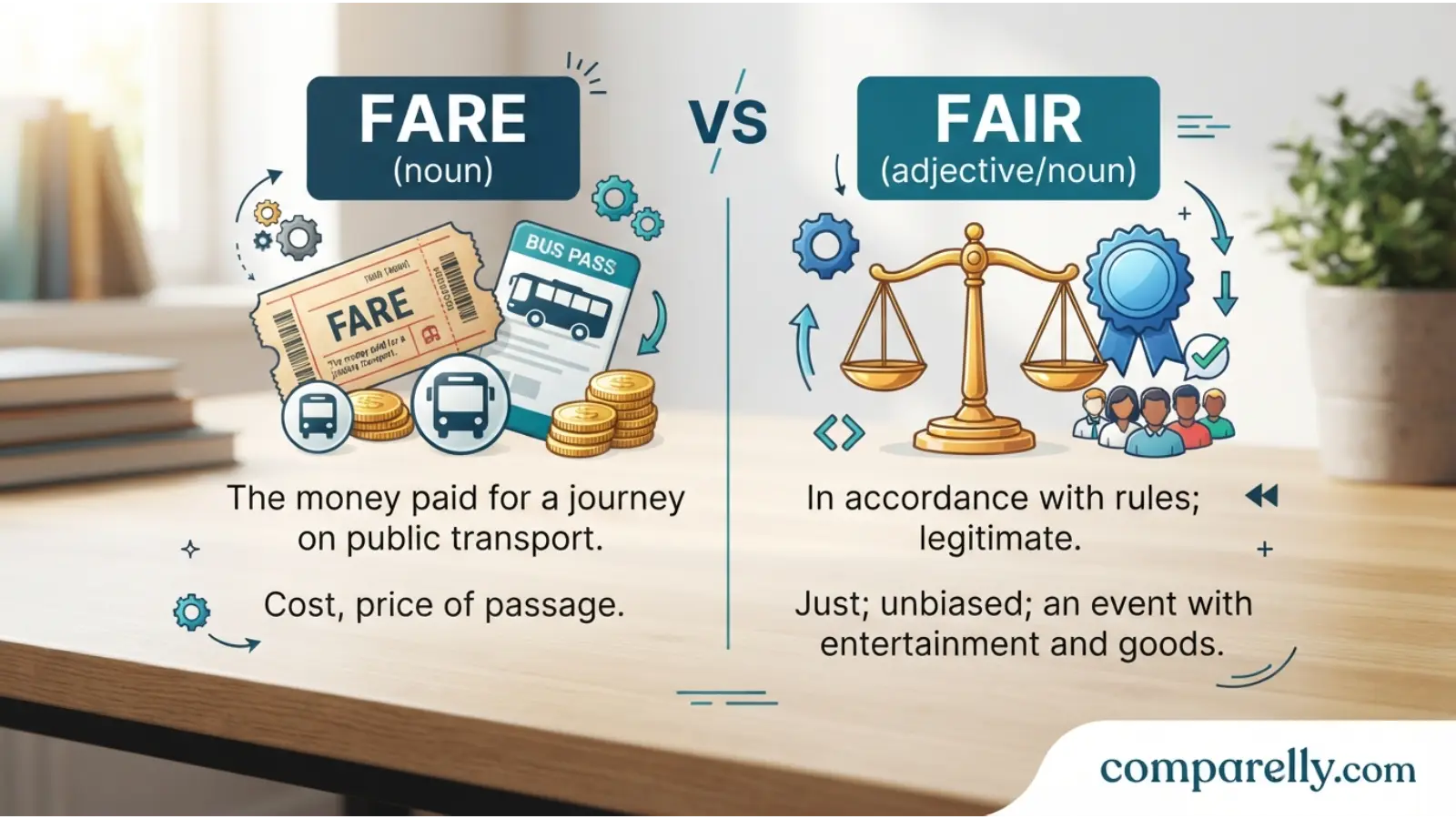
Fare means the money paid for transportation or a price charged for a service.
Fair means equal, reasonable, honest, or acceptable.
Example:
The bus fare was $5. The teacher gave a fair decision.
Meaning of Fare
Meaning of Fare
Fare is a noun that usually means the money you pay for a journey. It can also mean how someone performs in a situation.
Examples of Fare
- I paid the taxi fare before leaving.
- The airline increased its ticket fare.
Fare as Performance
Fare can describe someone’s progress or result.
Examples:
- She fared well in the competition.
- The new product did not fare well in the market.
Meaning of Fair
Meaning of Fair
Fair means equal, reasonable, honest, or free from unfair treatment. It can also describe light skin, hair, or weather.
Examples of Fair
- The judge made a fair decision.
- Everyone received a fair chance.
Fair as Appearance or Weather
Examples:
- She has fair hair.
- The weather is fair today.
Key Differences Between Fare Or Fair
| Feature | Fare | Fair |
|---|---|---|
| Meaning | Travel cost or performance | Equal, honest, reasonable |
| Tone | Practical and financial | Positive and ethical |
| Usage | Transport, prices, results | Rules, decisions, treatment |
| Popularity | Common in travel contexts | Very common in daily English |
Origin and History
The word fare comes from Old English faran, meaning “to travel.” It became connected with the cost of traveling.
The word fair comes from Old English fæger, meaning beautiful, pleasant, or attractive. Later, it developed meanings related to justice and equality.
Similar Word Examples
Fare related words:
- Ticket price
- Cost
- Fee
- Charge
Fair related words:
- Equal
- Honest
- Just
- Reasonable
British English vs American English Spelling
Both fare and fair are spelled the same in British and American English.
There is no spelling difference between the two versions.
The meaning depends on the context, not the country.
| Word | British English | American English |
|---|---|---|
| Fare | Same spelling | Same spelling |
| Fair | Same spelling | Same spelling |
When to Use Fare
Use fare when talking about travel costs or someone’s performance.

Examples
- The train fare is expensive.
- How much is the bus fare?
- He fared better than expected.
When to Use Fair
Use fair when describing equality, honesty, or reasonable treatment.

Examples
- The competition was fair.
- Everyone deserves a fair opportunity.
- The price seems fair.
Common Mistakes
Mistake 1
❌ The taxi fair was expensive.
✅ The taxi fare was expensive.
Mistake 2
❌ The decision was very fare.
✅ The decision was very fair.
Mistake 3
❌ Everyone got a fare chance.
✅ Everyone got a fair chance.
Mistake 4
❌ The bus fair increased this year.
✅ The bus fare increased this year.
Easy Trick to Remember
Use this simple trick:
Fare = Fare for a ride.
Think about transportation costs.
Fair = Fair treatment.
Think about equality and honesty.
Remember:
A fare takes you somewhere. A fair choice treats people equally.
Everyday Life Examples
1. Travel Example
The airport fare was higher during holidays.
2. Workplace Example
The manager made a fair decision for all employees.
3. Shopping Example
The store offered a fair price for the product.
4. School Example
The teacher gave every student a fair chance.
5. Transportation Example
The bus fare changed after the fuel price increase.
Related Keywords
- fare vs fair meaning
- difference between fare and fair
- fare and fair examples
- fair or fare correct spelling
- homophones in English
- common English mistakes
- confusing English words
Final Verdict
Fare and Fair are both correct words, but they have different meanings.
Use fare for travel costs, tickets, and performance results.
Use fair for equality, honesty, and reasonable situations.
The better word depends on the sentence. Neither word replaces the other.
Google Trends & Usage Data Insight
Search interest for Fare Or Fair appears across English-speaking and learning markets. The confusion is common because both words sound identical.
| Country | Usage Insight |
|---|---|
| USA | High interest due to English learning searches |
| UK | Common confusion among students |
| Australia | Regular grammar comparison searches |
| India | High demand from English learners |
| Pakistan | Frequently searched for spelling clarification |
Keyword Variation Comparison
| Keyword Variation | Search Intent |
|---|---|
| Fare Or Fair | Main comparison query |
| Difference between fare and fair | Educational search |
| Fair vs fare examples | Learning intent |
| Fare meaning | Definition search |
| Fair meaning | Definition search |
FAQs:
Is Fare Or Fair correct?
Yes, both words are correct. They have different meanings and uses.
What is the difference between fare and fair?
Fare means travel cost or performance. Fair means equal, honest, or reasonable.
Which word is more common, fare or fair?
Fair is more common in everyday conversations. Fare appears often in travel situations.
Is fare or fair used formally?
Both words are used in formal writing when they match the correct meaning.
Why does fare and fair cause confusion?
They sound the same, but their meanings and spellings are different.
Conclusion
Fare Or Fair can be confusing because both words have the same pronunciation. However, their meanings are completely different. Fare connects with transportation costs, ticket prices, and performance results. Fair connects with equality, honesty, and reasonable actions.
Learning this difference helps you write clearer sentences and avoid common English errors. Always check the context before choosing the word. If the sentence talks about travel money, use fare. If it talks about justice or equal treatment, use fair.

Daniel Foster is a comparison analyst and content strategist at Comparelly.com. He specializes in researching products, services, tools, and industry trends to create clear, unbiased comparison guides. With a focus on accuracy and practical insights, Daniel helps readers understand key differences and make informed decisions with confidence. His goal is to simplify complex choices through trustworthy, easy-to-understand content.