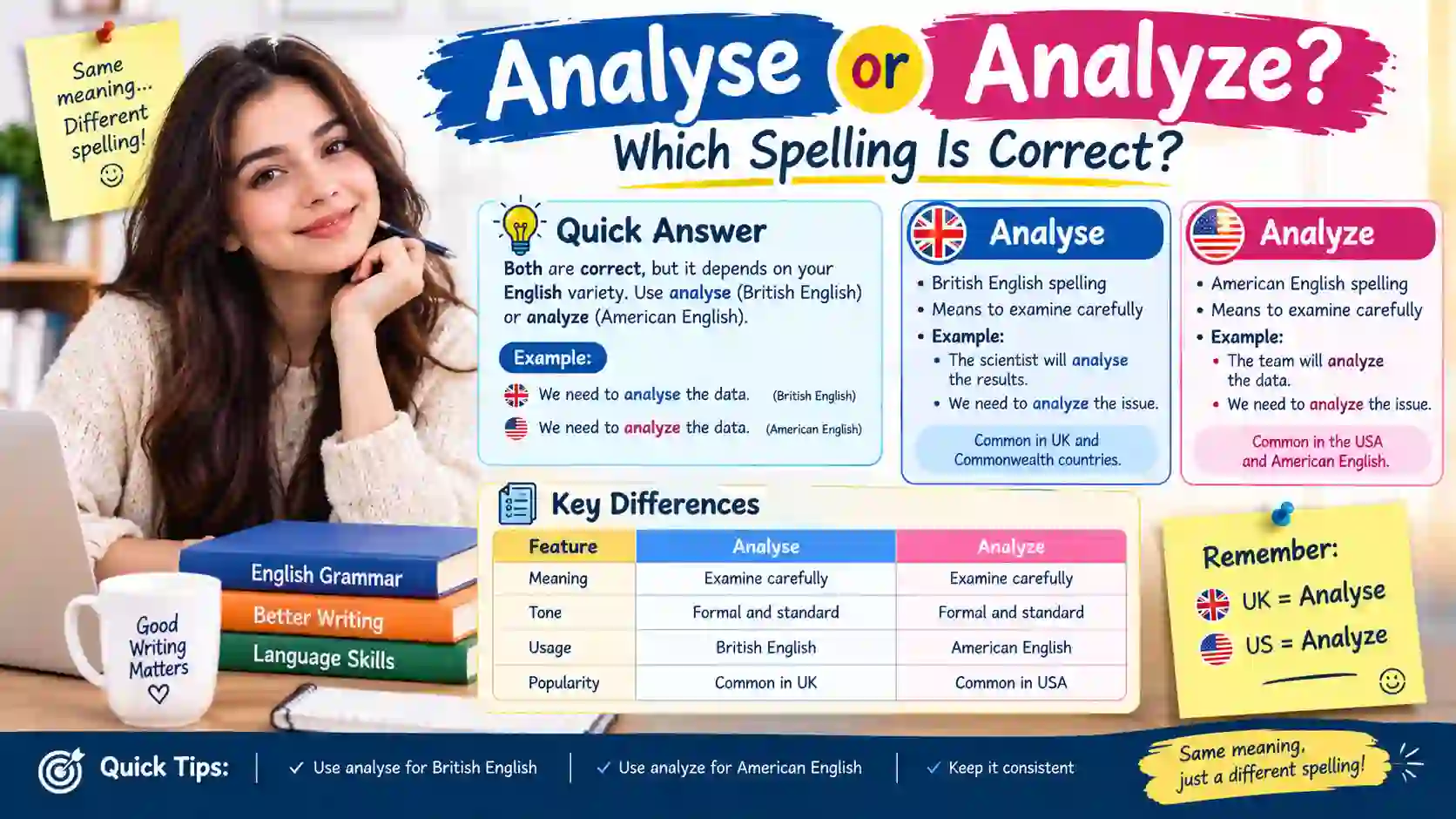
Analyse or analyze can both be correct spellings. The correct choice depends on the English variety you follow. Analyse is the standard British English spelling. Analyze is the standard American English spelling. Both words have the same meaning and pronunciation. They mean to examine something carefully and understand its parts or meaning.
This spelling difference often confuses students, writers, researchers, and professionals. The confusion becomes stronger when British and American English appear together online. For example, a UK writer may write, “We need to analyse the data.” An American writer may write, “We need to analyze the data.” Both sentences are correct in their regional styles. The main rule is simple: choose the spelling that matches your audience or style guide. Consistency is also important throughout your writing.
⭐ Quick Answer (for Google snippet)
Analyse is the British English spelling, while analyze is the American English spelling. Both mean “to examine or study something carefully.”
Example:
- 🇬🇧 UK: We need to analyse the results.
- 🇺🇸 US: We need to analyze the results.
📖 Meaning of Analyse
Analyse is a verb used mainly in British English. It means to examine something carefully. You may study its parts, structure, or meaning.
Examples of Analyse
- The researchers will analyse the survey results.
- We need to analyse the problem before choosing a solution.
The spelling analyse is common in British English and many Commonwealth English contexts.
📘 Meaning of Analyze
Analyze is the American English spelling of the same verb. It means to examine something carefully and systematically.
Examples of Analyze
- Scientists analyze samples in the laboratory.
- The team will analyze customer feedback.
The meaning does not change when the spelling changes from s to z.
📊 Key Differences Between Analyse and Analyze
| Feature | Analyse | Analyze |
|---|---|---|
| Meaning | Examine carefully | Examine carefully |
| Tone | Formal and standard | Formal and standard |
| Usage | British English | American English |
| Popularity | Strong in UK and Commonwealth usage | Strong in US usage |
| Spelling | Uses -yse | Uses -yze |
| Pronunciation | Same | Same |
| Past tense | analysed | analyzed |
| -ing form | analysing | analyzing |
Cambridge lists analyse as the UK spelling and analyze as the US spelling.
📜 Origin & History of Analyse and Analyze

The word has a long history connected to the Greek word analusis. Oxford traces the English word through French and Medieval Latin sources. The original idea relates to “unloosing” or breaking something apart.
Over time, English developed different spelling traditions. British English commonly retained analyse. American English developed the spelling analyze.
The same regional pattern appears in related words.
Similar Word Examples
| British English | American English |
|---|---|
| analyse | analyze |
| analysed | analyzed |
| analysing | analyzing |
| analyser | analyzer |
| catalyse | catalyze |
The noun analysis remains the same in both English varieties.
🇬🇧 British English vs American English Spelling
British English normally uses analyse with an s. American English normally uses analyze with a z. The meaning and pronunciation remain the same.
British vs American English Comparison
| Feature | 🇬🇧 British English | 🇺🇸 American English |
|---|---|---|
| Main spelling | analyse | analyze |
| Past tense | analysed | analyzed |
| -ing form | analysing | analyzing |
| Related noun | analysis | analysis |
| Pronunciation | Same | Same |
| Example | Analyse the evidence. | Analyze the evidence. |
Other Common Spelling Differences
| British English | American English |
|---|---|
| colour | color |
| centre | center |
| organise | organize |
| realise | realize |
| defence | defense |
| labour | labor |
| neighbour | neighbor |
| analyse | analyze |
Cambridge provides analyse/analyze as one example of British and American spelling differences.
✍️ When to Use Analyse
Use analyse when you follow British English spelling.
This choice works well for:
- UK websites
- British schools
- British universities
- UK newspapers
- Many Commonwealth publications
- Writing that follows a British style guide
Examples
- We will analyse the results tomorrow.
- The scientist needs to analyse the sample.
- She can analyse complex information quickly.
- The report will analyse recent market changes.
If your publication follows British English, keep related forms consistent.
British pattern:
analyse → analysed → analysing
🇺🇸 When to Use Analyze
Use analyze when you follow American English spelling.
This choice works well for:
- US websites
- American schools
- American universities
- US business writing
- American publications
- Writing that follows an American style guide
Examples
- We will analyze the results tomorrow.
- The scientist needs to analyze the sample.
- She can analyze complex information quickly.
- The report will analyze recent market changes.
The American pattern is:
analyze → analyzed → analyzing
❌ Common Mistakes with Analyse or Analyze
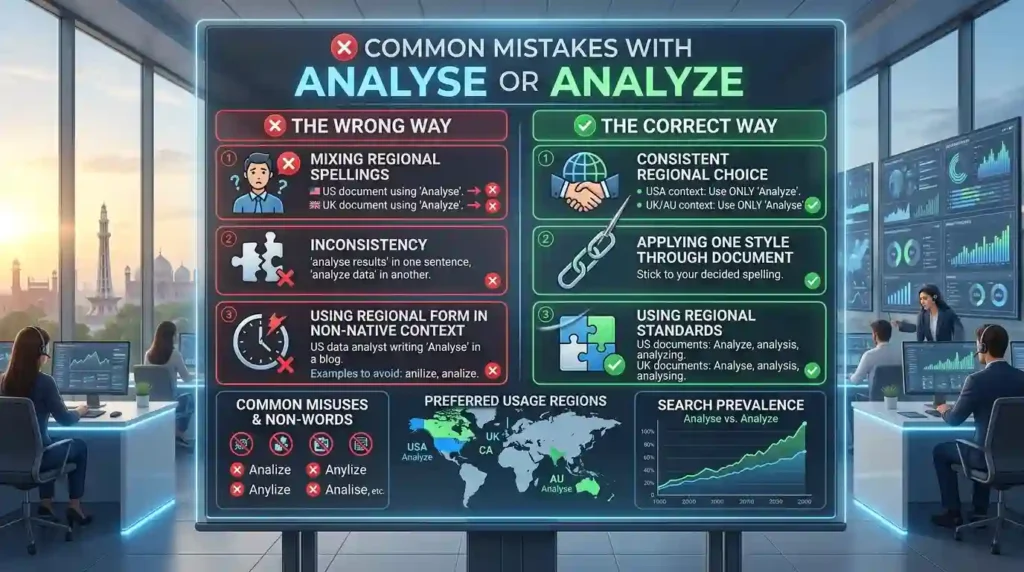
Understanding the spelling pattern helps prevent common mistakes.
Mistake 1: Using “analize”
❌ Incorrect: We need to analize the data.
✅ Correct: We need to analyze the data.
Analize is not the standard spelling.
Mistake 2: Mixing British and American Forms
❌ Incorrect style: The team analyzed the data and then analysed the report.
✅ Better British style: The team analysed the data and then analysed the report.
✅ Better American style: The team analyzed the data and then analyzed the report.
Mixing styles can make formal writing look inconsistent.
Mistake 3: Writing “analysing” in American Style
❌ American style: She is analysing the results.
✅ American style: She is analyzing the results.
British English uses analysing.
American English uses analyzing.
Mistake 4: Writing “analyzed” in a British Style
❌ British style: The researchers analyzed the evidence.
✅ British style: The researchers analysed the evidence.
Both forms have the same meaning.
The correct choice depends on your selected English variety.
Mistake 5: Changing the Noun “Analysis”
❌ Incorrect: The team completed an analyzis.
✅ Correct: The team completed an analysis.
The noun is analysis in both British and American English.
🧠 Easy Trick to Remember Analyse or Analyze
Use this simple memory trick:
🇬🇧 British = S
Think of British and S together.
British → analyse
🇺🇸 American = Z
Think of the American spelling with Z.
American → analyze
Remember:
UK = analyse
US = analyze
The spelling changes, but the meaning does not.
🌍 Everyday Life Examples of Analyse or Analyze
1. 📚 Academic Writing
Students often need to examine information carefully.
British English
The students will analyse the research findings.
American English
The students will analyze the research findings.
Both versions are correct within their regional styles.
2. 💼 Business Reports
Businesses regularly examine sales and customer information.
British English
Our team will analyse customer feedback.
American English
Our team will analyze customer feedback.
The word works naturally in reports and presentations.
3. 🔬 Science and Research
Scientists often examine samples and experimental results.
British English
Researchers will analyse the chemical sample.
American English
Researchers will analyze the chemical sample.
The meaning remains exactly the same.
4. 💻 Technology and Data
Technology companies frequently examine large amounts of data.
British English
The software can analyse website traffic.
American English
The software can analyze website traffic.
Both forms are widely understood.
5. 📰 News and Journalism
Journalists often examine events and evidence.
British English
Experts will analyse the latest survey.
American English
Experts will analyze the latest survey.
Choose the form that matches the publication’s style.
🔑 Related Keywords
Here are useful keyword variations for this topic:
- analyse or analyze spelling
- analyse vs analyze
- analyze or analyse British English
- analyse or analyze American English
- analyzed or analysed
- analyzing or analysing
- British vs American spelling of analyze
These variations can support related SEO content and internal links.
🏁 Final Verdict: Analyse or Analyze?
Analyse and analyze are both correct.
The difference is mainly regional spelling.
- Choose analyse for British English.
- Choose analyze for American English.
- Use related forms consistently.
- Follow your school’s, employer’s, or publisher’s style guide.
There is no universal need to replace one form with the other. Your target audience should guide your choice.
For example:
UK: The researcher will analyse the results.
US: The researcher will analyze the results.
Both sentences communicate the same idea.
📈 Google Trends & Usage Data: Analyse or Analyze

Search interest for these spellings follows the broader regional split between British and American English. Current dictionary references confirm analyse as the UK form and analyze as the US form.
Public search discussions also show strong regional differences. The exact Google Trends index changes with the selected period, location, and search term. Therefore, fixed numerical values should not be treated as permanent data.
🌎 Five-Country Usage Insight
- 🇺🇸 USA: Analyze is the standard American spelling.
- 🇬🇧 UK: Analyse is the standard British spelling.
- 🇦🇺 Australia: British-style spelling is commonly used, including analyse.
- 🇮🇳 India: British English has strong influence, so analyse is widely used.
- 🇵🇰 Pakistan: British English has strong educational influence, so analyse is commonly encountered.
The strongest SEO lesson is simple: match your spelling to your target audience. Consistent regional spelling also improves editorial quality.
Keyword Variations Comparison Table
| Keyword Variation | British English | American English |
|---|---|---|
| analyse / analyze | analyse | analyze |
| analysed / analyzed | analysed | analyzed |
| analysing / analyzing | analysing | analyzing |
| analyser / analyzer | analyser | analyzer |
| analysis | analysis | analysis |
| analyses | analyses | analyses |
The noun analysis does not change between the two varieties.
❓ FAQ’s: Analyse or Analyze
1. Is “analyse” correct?
Yes. Analyse is the standard British English spelling. It means to examine something carefully.
2. What is the difference between analyse and analyze?
The difference is spelling and regional usage. Analyse is British English. Analyze is American English. Their meaning is the same.
3. Which is more common, analyse or analyze?
Usage depends on the region. Analyze is standard in American English. Analyse is standard in British English and related Commonwealth usage.
4. Is analyse formal usage?
Yes. Analyse is appropriate for formal British English writing. It appears in academic, scientific, business, and professional contexts.
5. Why does analyse or analyze cause confusion?
English has different regional spelling systems. British English often uses -yse, while American English uses -yze. Both forms developed as accepted spelling conventions.
📝 Conclusion
The question analyse or analyze has a simple answer. Both spellings are correct, but they belong to different English varieties. Analyse is the standard British English form. Analyze is the standard American English form. Both words mean to examine or study something carefully. Their pronunciation and meaning are essentially the same.
The same regional difference appears in forms such as analysed/analyzed and analysing/analyzing. When writing for a specific audience, follow its usual spelling style. Most importantly, stay consistent throughout your article, report, essay, or website. If you write for British readers, choose analyse. If you write for American readers, choose analyze. Neither spelling is universally “wrong.

Daniel Foster is a comparison analyst and content strategist at Comparelly.com. He specializes in researching products, services, tools, and industry trends to create clear, unbiased comparison guides. With a focus on accuracy and practical insights, Daniel helps readers understand key differences and make informed decisions with confidence. His goal is to simplify complex choices through trustworthy, easy-to-understand content.