Looser or loser can be confusing because both words look and sound very similar. However, they have completely different meanings and grammatical roles. Loser is a noun for someone who loses a game, contest, or competition. It can also describe someone who is unsuccessful. Looser is a comparative adjective.
It means “more loose” or “less tight.” For example, you can say, “He was the loser of the race.” You can also say, “These jeans are looser than mine.” The extra o changes the meaning. This spelling mistake often happens because lose has one “o,” while loose has two. Understanding their base words makes the difference easy to remember. This guide explains looser or loser with clear definitions, examples, mistakes, usage tips, and a simple memory trick.
⭐ Quick Answer (for Google snippet)
Loser means a person who does not win. Looser means less tight or more relaxed.
Example: “He was the loser of the match.” / “This shirt is looser than mine.”
📖 Meaning of Loser
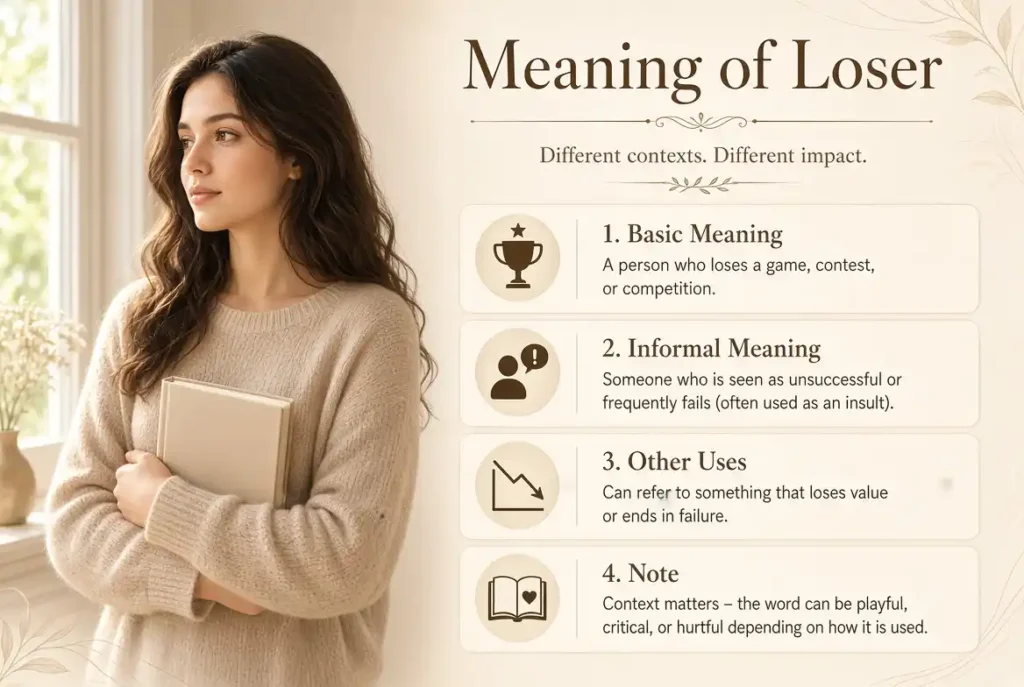
Loser is a noun. It describes someone who loses a competition, game, or contest. It can also describe someone who is unsuccessful.
Examples
- The loser congratulated the winner after the race.
- Nobody wants to be called a loser.
The word can sound insulting when used about a person. Use it carefully in formal or respectful situations.
📖 Meaning of Looser
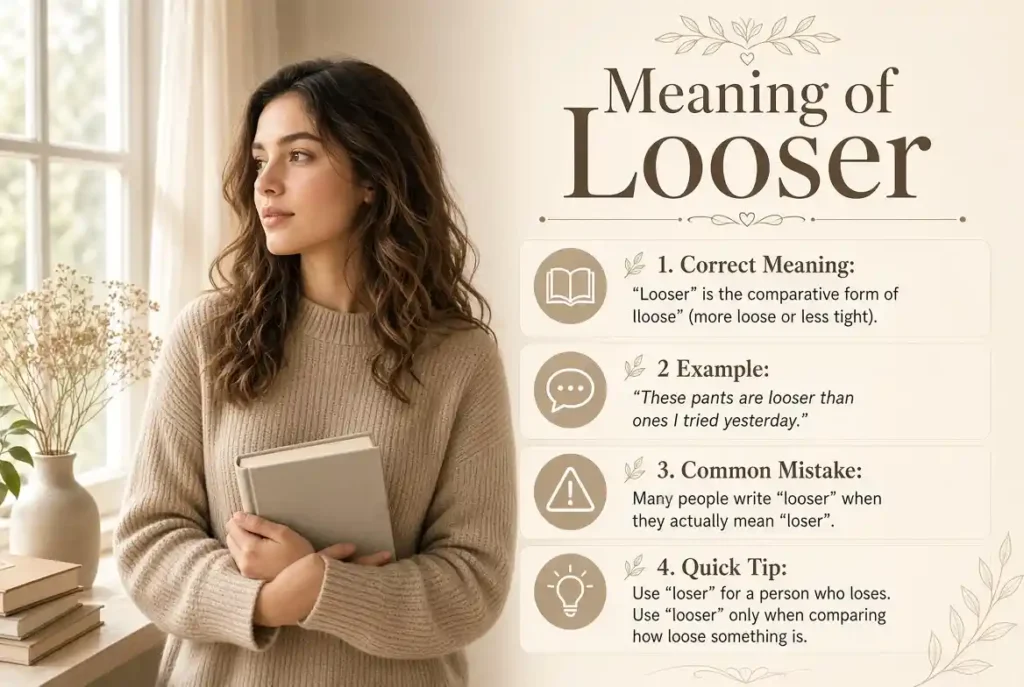
Looser is the comparative form of loose. It means less tight, less fixed, or less strict.
Examples
- These jeans are looser than my old pair.
- The new rules are looser than the previous rules.
Looser is a correct word. It is not automatically a spelling mistake.
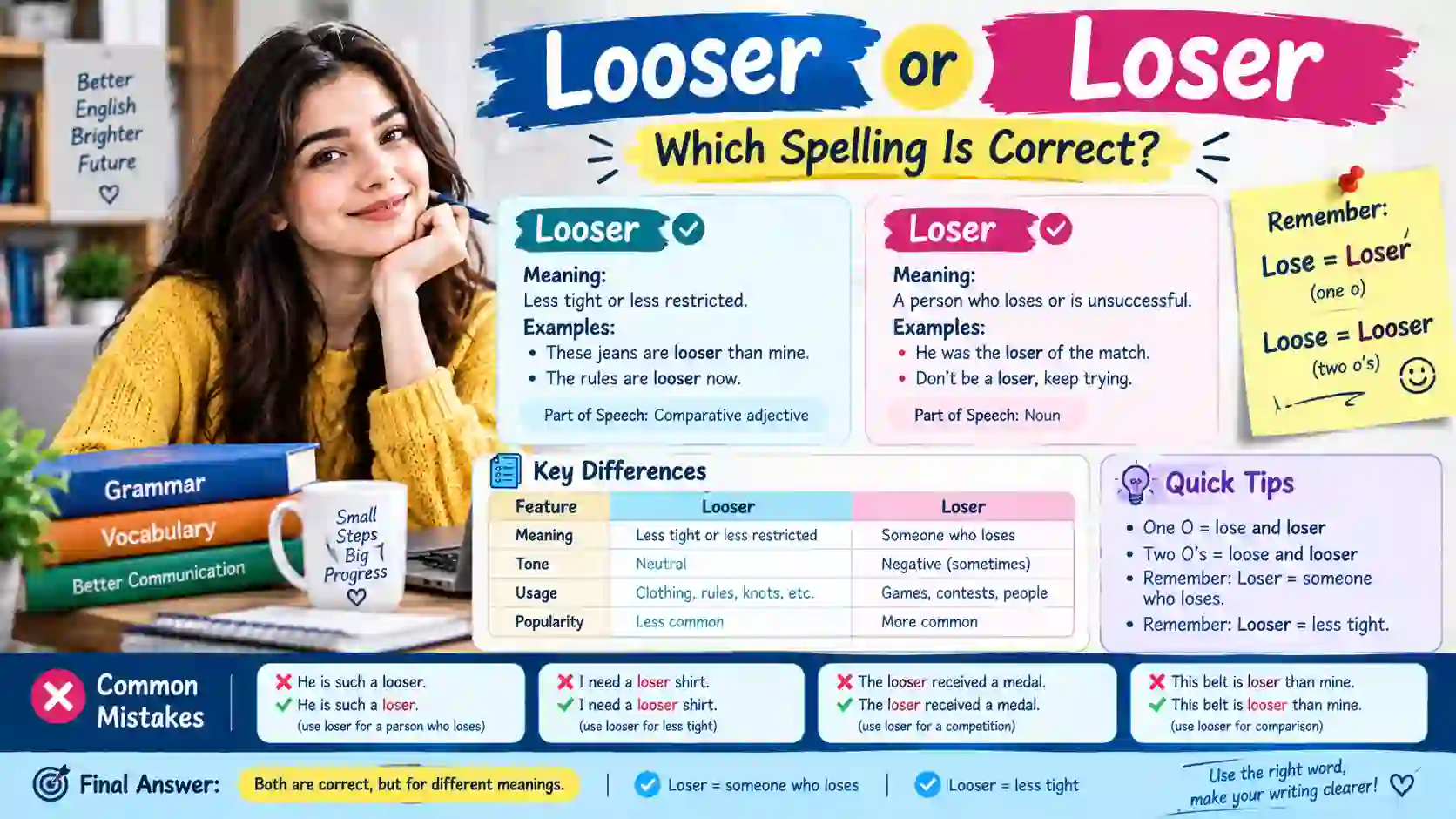
📊 Key Differences: Looser or Loser
| Feature | Looser | Loser |
|---|---|---|
| Meaning | Less tight or less strict | Someone who loses |
| Tone | Usually neutral | Can sound negative or insulting |
| Usage | Clothing, knots, rules, fitting | Games, contests, failure |
| Popularity | Less common | More common in general usage |
| Part of Speech | Comparative adjective | Noun |
| Base Word | Loose | Lose |
| Example | The belt is looser. | He was the loser. |
The key difference comes from their base words. Looser comes from loose, while loser comes from lose.
📜 Origin & History of Looser and Loser
Looser comes from loose + -er. The suffix -er creates a comparative form. Therefore, “looser” means “more loose” or “less tight.”
Loser comes from the verb lose. The ending -er creates a noun for someone who loses.
The two words developed from different base words. Their similar sounds create much of the modern spelling confusion.
Similar Word Examples
These related words can help you understand the pattern:
- lose → loser
- loose → looser
- lose → losing
- loose → loosen
- tight → tighter
- fast → faster
The important rule is simple:
Lose → loser
Loose → looser
🇬🇧 British English vs 🇺🇸 American English Spelling
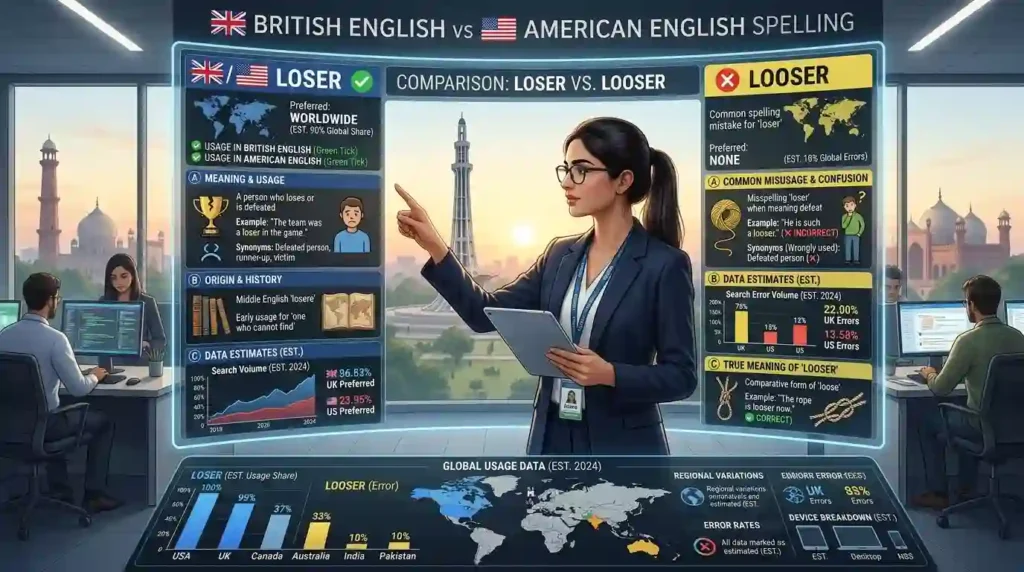
There is no British-versus-American spelling difference between loser and looser.
Both forms are spelled the same in British and American English.
The meaning also stays the same in both varieties of English.
British vs American English Comparison
| Word | British English | American English |
|---|---|---|
| Loser | loser | loser |
| Looser | looser | looser |
| Meaning of loser | Someone who loses | Someone who loses |
| Meaning of looser | Less tight | Less tight |
| Spelling difference | None | None |
So, you should not choose looser because you are writing British English.
🏆 When to Use Loser
Use loser when you mean someone or something that loses.
It commonly appears in competitions, games, contests, and discussions about success.
Examples
- The loser of the match left the field.
- The team became the loser after the final round.
- He was a gracious loser.
- Nobody likes being called a loser.
- The losing player accepted the result.
You can also use loser informally for someone viewed as unsuccessful. This use can sound offensive, so consider your audience.
👕 When to Use Looser
Use looser when something becomes less tight or less restricted.
It usually compares two levels of tightness or restriction.
Examples
- These shoes feel looser than yesterday.
- I need a looser shirt for summer.
- The knot became looser after several minutes.
- The company introduced looser rules.
- Her new schedule is looser and more flexible.
Remember that looser compares something with another condition.
❌ Common Mistakes with Looser or Loser
Mistake 1: Calling Someone a “Looser”
❌ Incorrect: He is such a looser.
✅ Correct: He is such a loser.
Use loser when describing someone who loses or is unsuccessful.
Mistake 2: Using “Loser” for Clothing
❌ Incorrect: I need a loser shirt.
✅ Correct: I need a looser shirt.
A shirt can be looser, but it cannot be a “loser” because of its fit.
Mistake 3: Writing “Looser” After a Competition
❌ Incorrect: The looser received a medal.
✅ Correct: The loser received a medal.
A person who does not win is the loser.
Mistake 4: Confusing Loose and Lose
❌ Incorrect: I might loose the game.
✅ Correct: I might lose the game.
Lose relates to losing something or failing to win.
Mistake 5: Confusing Loose and Looser
❌ Incorrect: This belt is loser than mine.
✅ Correct: This belt is looser than mine.
The comparative form of loose is looser.
🧠 Easy Trick to Remember Looser or Loser
Use this simple memory trick:
Lose Lost an O
Think of the word lose as having “lost” one o.
So:
Lose → Loser = one “o”
Loose → Looser = two “o”s
You can also connect the meanings:
- Loser → loses a competition.
- Looser → becomes less tight.
Quick Memory Rule
One O = lose and loser.
Two O’s = loose and looser.
This trick makes the spelling much easier.
🌎 Everyday Life Examples of Looser or Loser
1. Sports and Competitions
The team that does not win becomes the loser.
Example:
“The loser thanked the crowd after the final match.”
Here, loser is the correct word.
Secondary keyword: looser or loser difference
2. Clothes and Fashion
Clothing can become looser when you choose a larger size.
Example:
“I prefer looser jeans during hot weather.”
Here, looser describes the fit.
Secondary keyword: looser meaning
3. Games and Contests
A person who fails to win can be called a loser.
Example:
“The loser accepted the result with a smile.”
Here, loser refers to the person who did not win.
Secondary keyword: loser meaning
4. Belts, Knots, and Strings
A belt or knot can become looser when tension decreases.
Example:
“Make the knot looser so the child can move comfortably.”
Here, looser describes reduced tightness.
Secondary keyword: looser vs loser
5. Rules and Restrictions
Rules can become looser when restrictions decrease.
Example:
“The school introduced looser rules for weekend activities.”
Here, looser means less strict.
Secondary keyword: correct spelling of loser
🔎 Related Keywords
Use these related keywords naturally throughout your article:
- looser or loser
- loser or looser
- looser vs loser
- difference between looser and loser
- looser meaning
- loser meaning
- is looser a word
- correct spelling of loser
⚖️ Final Verdict: Looser or Loser?
Both looser and loser are correct words. They simply have different meanings.
Use loser for a person who loses a competition or fails to win.
Use looser when something becomes less tight, less restricted, or more relaxed.
Remember:
Loser = someone who loses.
Looser = something that is less tight.
So, neither word is always “better.” The correct choice depends on your sentence.
📈 Google Trends & Usage Data: USA, UK, AUS, IND, PAK

Search interest for looser or loser can change over time and by country. Google Trends also measures relative search interest rather than fixed word counts.
- USA: “Loser” is the standard choice when discussing someone who loses.
- UK: “Loser” and “looser” follow the same meanings and spellings.
- AUS: Australian English also uses “loser” for someone who loses.
- IND: English learners often search the pair because of the lose/loose spelling pattern.
- PAK: The same distinction applies, with “loser” meaning someone who loses.
💡 Insight
Across these English varieties, loser and looser are not alternative spellings. They are separate words with different meanings.
📊 Keyword Variations Comparison
| Keyword Variation | Main Search Intent | Correct Meaning |
|---|---|---|
| Looser or loser | Spelling confusion | Compare both words |
| Loser or looser | Spelling confusion | Compare both words |
| Looser vs loser | Grammar comparison | Explain the difference |
| Difference between looser and loser | Informational | Understand meanings |
| Looser meaning | Definition | Less tight |
| Loser meaning | Definition | Someone who loses |
| Is looser a word? | Spelling check | Yes, in the correct context |
❓ FAQ’s: Looser or Loser
1. Is “looser” a correct word?
Yes, looser is a correct word. It is the comparative form of loose. It means less tight or less strict.
2. What is the difference between looser and loser?
Loser means someone who loses. Looser means less tight or less restricted.
3. Which is more common, looser or loser?
Loser is generally more common in everyday English. It is widely used for people or teams that lose. Looser appears when comparing levels of tightness or restriction.
4. Which word is correct in formal writing?
Both words can be correct in formal writing. Choose the word that matches your meaning.
Use loser for someone who loses. Use looser for something that is less tight.
5. Why does the confusion between looser and loser exist?
The confusion comes from their similar spelling and pronunciation. Lose has one “o,” while loose has two. Their related forms create the same spelling challenge.
📝 Conclusion
The difference between looser or loser is simple once you understand their base words. Loser comes from lose and describes someone who does not win. Looser comes from loose and means less tight or less restricted. The extra o changes the meaning completely. You might call a player the loser of a match.
However, you might describe a shirt as looser than another shirt. Neither spelling replaces the other. Both words are correct in their proper contexts. Remember the easiest rule: lose has one o, so loser has one o. Loose has two o’s, so looser has two o’s. This simple trick can help you avoid one of English’s common spelling confusions.

Daniel Foster is a comparison analyst and content strategist at Comparelly.com. He specializes in researching products, services, tools, and industry trends to create clear, unbiased comparison guides. With a focus on accuracy and practical insights, Daniel helps readers understand key differences and make informed decisions with confidence. His goal is to simplify complex choices through trustworthy, easy-to-understand content.