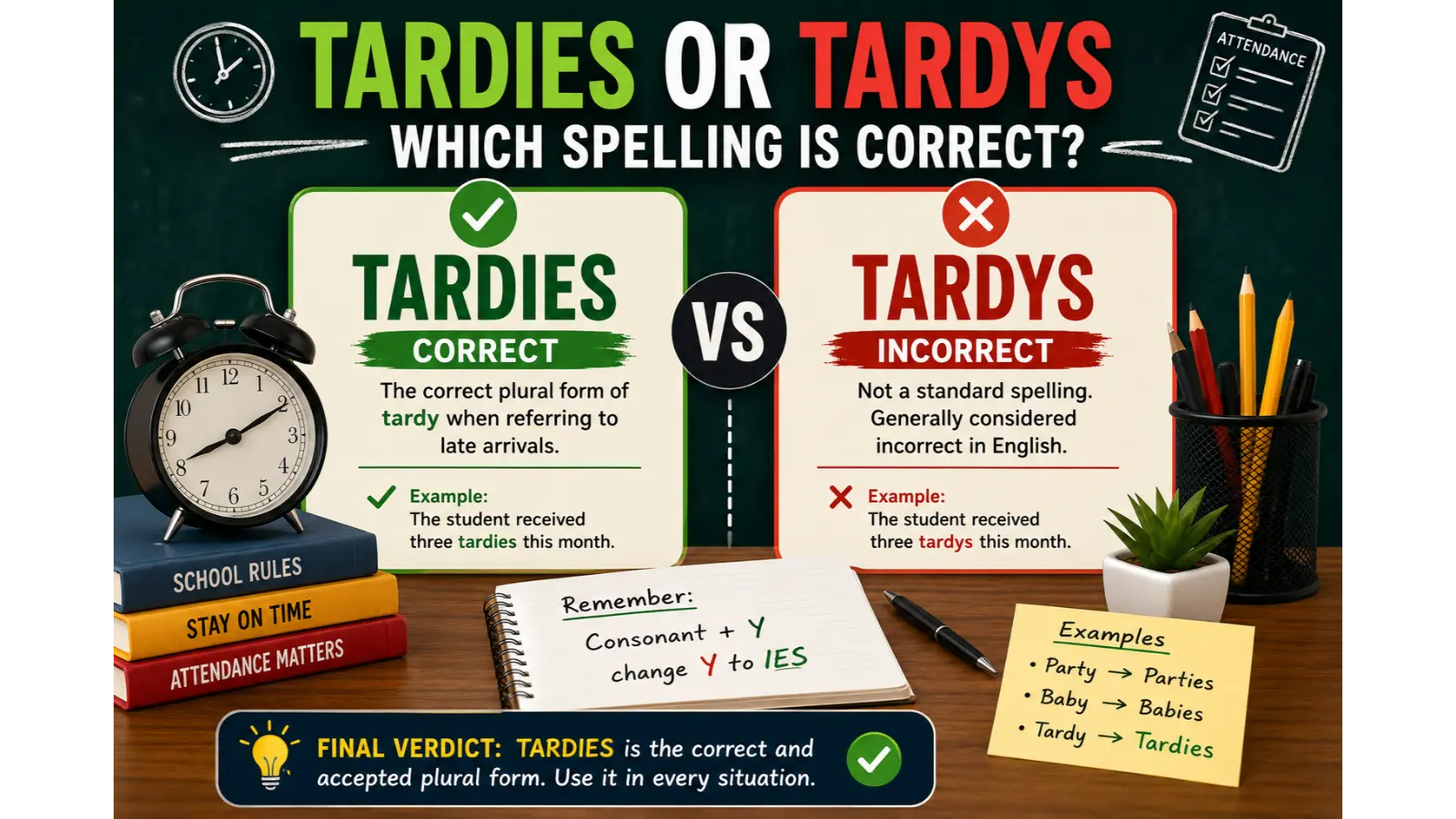
Tardies Or Tardys is a common spelling question, especially in schools and attendance records. Many people see both forms online and wonder which one is correct.
The confusion happens because words ending in y often change when made plural. Some people assume adding s is enough, while others follow standard English spelling rules. In school reports, teacher notes, and attendance systems, using the correct spelling matters. This guide explains the difference between tardies and tardys, shows the correct usage, and helps you avoid common mistakes.
Quick Answer
Tardies is the correct plural form of tardy when referring to late arrivals or attendance violations.
Tardys is generally considered incorrect in standard English.
Example:
✅ The student received three tardies this month.
❌ The student received three tardys this month.
Meaning of Tardies
Tardies is the plural form of tardy when used as a noun.
Definition: Multiple instances of being late, especially in school attendance records.
Examples
- The student had five tardies during the semester.
- Too many tardies may affect attendance grades.
Meaning of Tardys
Tardys is not considered a standard English spelling.
Definition: An incorrect plural form sometimes used by mistake.
Examples
- ❌ The report listed four tardys.
- ❌ Teachers track student tardys.
The correct spelling in both examples is tardies.
Key Differences Table

| Feature | Tardies | Tardys |
|---|---|---|
| Meaning | Multiple late arrivals | Incorrect spelling |
| Tone | Formal and correct | Informal and incorrect |
| Usage | Schools, reports, records | Rare and mistaken use |
| Popularity | Very common | Very uncommon |
| Dictionary Acceptance | Yes | No |
Origin & History
The word tardy comes from the Latin word tardus, meaning slow or late. Over time, English adopted the word to describe someone arriving after the expected time.
When forming the plural noun, English follows the common rule:
- Consonant + y → replace y with ies
Similar examples:
- Party → Parties
- Baby → Babies
- Lady → Ladies
- Tardy → Tardies
British English vs American English Spelling
There is no major spelling difference between British and American English for this word. Both varieties use tardy and its plural form tardies according to standard spelling rules.

Comparison Table: British vs American English
| English Type | Singular | Plural |
|---|---|---|
| American English | Tardy | Tardies |
| British English | Tardy | Tardies |
When to Use Tardies
Use tardies when referring to multiple cases of lateness.
Examples
- The school recorded six tardies this year.
- Repeated tardies may result in detention.
- Attendance reports showed several tardies.
When to Use Tardys
In standard English writing, you should not use tardys.
Examples
- ❌ She received two tardys.
- ❌ The teacher counted four tardys.
Correct Versions
- ✅ She received two tardies.
- ✅ The teacher counted four tardies.
Common Mistakes
Mistake 1
❌ Three tardys were reported.
✅ Three tardies were reported.
Mistake 2
❌ The student has many tardys.
✅ The student has many tardies.
Mistake 3
❌ Attendance records showed several tardys.
✅ Attendance records showed several tardies.
Mistake 4
❌ Too many tardys can affect grades.
✅ Too many tardies can affect grades.
Easy Trick to Remember
Remember this simple rule:
If a word ends with a consonant + y, change the y to ies when making it plural.
Examples:
- Baby → Babies
- Party → Parties
- Lady → Ladies
- Tardy → Tardies
If you remember party → parties, you will easily remember tardy → tardies.
Write 5 Examples
School Attendance Example
The student received three tardies in one month.
Teacher Report Example
The teacher documented several tardies during the semester.
Parent Meeting Example
Parents were informed about repeated tardies.
School Policy Example
Too many tardies can lead to disciplinary action.
Student Record Example
The attendance system automatically tracks tardies.
Related Keywords
- tardy meaning
- tardies meaning
- tardy plural form
- tardies spelling
- is tardys correct
- tardy vs late
- attendance tardies
Google Trends & Usage Data
Across the USA, UK, Australia, India, and Pakistan, tardies appears far more often than tardys. School attendance systems, educational websites, and official documents consistently use tardies.
The spelling tardys mainly appears due to typing errors or misunderstanding of plural rules. Search interest shows that users often look up the difference because they want the correct spelling for academic or professional writing.
Comparison Table: Keyword Variations
| Keyword Variation | Usage Level |
|---|---|
| Tardies | Very High |
| Tardy | Very High |
| Tardies Meaning | High |
| Tardy Plural | High |
| Tardys | Low |
| Tardy vs Tardies | Medium |
| Attendance Tardies | Medium |
Final Verdict
Tardies is the correct plural form of tardy and should be used in all formal and informal writing.
Tardys is not the standard spelling and should be avoided. If you are referring to multiple instances of lateness, always choose tardies.
Frequently Asked Questions
Is tardies correct?
Yes. Tardies is the correct plural form of tardy.
What is the difference between tardies and tardys?
Tardies is correct, while tardys is generally considered incorrect.
Which spelling is more common?
Tardies is overwhelmingly more common in schools and official records.
Is tardies suitable for formal writing?
Yes. It is the accepted spelling in formal and academic contexts.
Why does this confusion exist?
Many people incorrectly add s instead of changing y to ies when forming plurals.
Conclusion
The confusion between Tardies Or Tardys comes from English pluralization rules. The correct spelling is tardies, which is the plural form of tardy. Schools, teachers, attendance systems, and formal documents all use tardies. The spelling tardys does not follow standard English grammar and should be avoided.
A simple rule can help you remember the difference. When a word ends in a consonant followed by y, replace the y with ies to make it plural. Just like party becomes parties, tardy becomes tardies. Using the correct spelling improves clarity, professionalism, and accuracy in your writing.

Daniel Foster is a comparison analyst and content strategist at Comparelly.com. He specializes in researching products, services, tools, and industry trends to create clear, unbiased comparison guides. With a focus on accuracy and practical insights, Daniel helps readers understand key differences and make informed decisions with confidence. His goal is to simplify complex choices through trustworthy, easy-to-understand content.