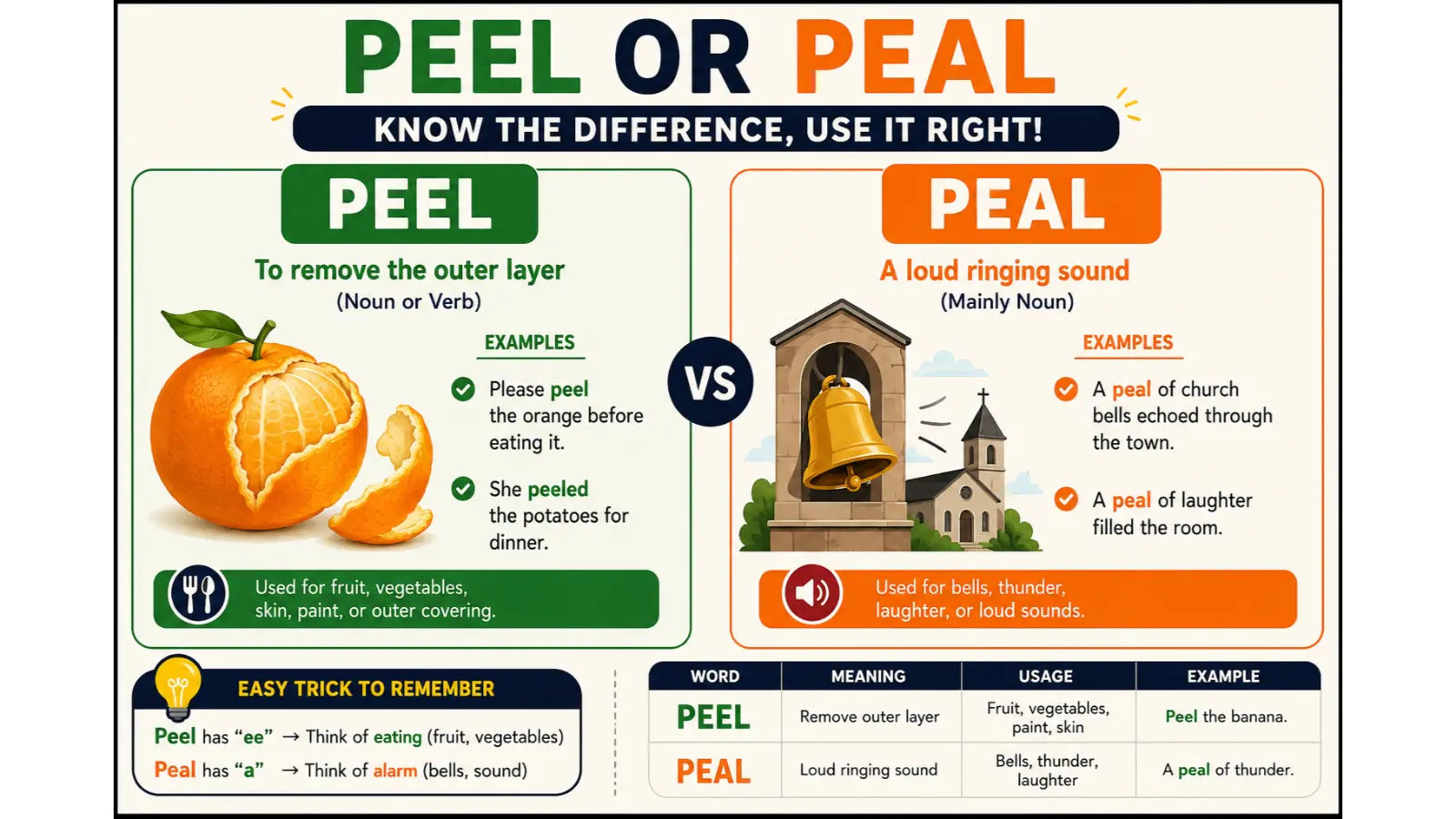
Peel Or Peal is a common word confusion because these two words sound exactly alike but have very different meanings. Many writers and English learners use one when they actually mean the other. Since both words are pronounced the same way, mistakes happen easily in speaking and writing.
Understanding the difference between peel and peal can improve your grammar, writing accuracy, and communication skills. In this guide, you’ll learn the meaning of each word, when to use them, common mistakes to avoid, and a simple trick to remember the difference forever.
Quick Answer
Peel means to remove the outer layer of something, such as a fruit or vegetable.
Peal means a loud ringing sound, especially from bells or laughter.
Example:
- Please peel the orange before eating it.
- A peal of church bells echoed through the town.
Meaning of Peel
Peel is a noun or verb related to removing an outer covering.
Examples:
- She will peel the potatoes for dinner.
- I like to peel apples before baking a pie.
Definition:
The outer skin or layer removed from fruit, vegetables, or similar objects.
Meaning of Peal
Peal is usually a noun and refers to a loud ringing sound.
Examples:
- A peal of thunder shook the house.
- We heard a peal of bells from the church.
Definition:
A loud, prolonged ringing or burst of sound.
Key Differences Between Peel and Peal

| Feature | Peel | Peal |
|---|---|---|
| Meaning | Remove outer layer | Loud ringing sound |
| Word Type | Noun and Verb | Mainly Noun |
| Usage | Food, fruit, vegetables | Bells, thunder, laughter |
| Tone | Practical | Sound related |
| Popularity | Very common | Less common |
| Context | Everyday actions | Literature and sound descriptions |
Origin & History
Peel
The word peel comes from Middle English and Old French roots related to skin, bark, or covering.
Peal
The word peal originated from Middle English and was linked to ringing bells and loud sounds.
Similar Word Examples
- Bale vs Bail
- Sole vs Soul
- Hear vs Here
- Brake vs Break
- Allowed vs Aloud
These pairs are homophones, just like peel and peal.
British English vs American English Spelling
There is no spelling difference between British English and American English for peel and peal. Both countries use the same spellings and meanings. The confusion comes from pronunciation because the words sound identical.

Comparison Table: British vs American English
| Word | British English | American English |
|---|---|---|
| Peel | Peel | Peel |
| Peal | Peal | Peal |
| Meaning Change | No | No |
| Spelling Change | No | No |
When to Use Peel
Use peel when talking about removing an outer layer.
Examples:
- Peel the banana before eating it.
- He peeled the paint from the wall.
- The orange peel smelled fresh.
Common Contexts:
When to Use Peal
Use peal when talking about a loud sound.
Examples:
- A peal of laughter filled the room.
- The peal of bells marked noon.
- Thunder came with a sudden peal.
Common Contexts:
Common Mistakes

Mistake 1
❌ I heard a peel of bells.
✅ I heard a peal of bells.
Mistake 2
❌ Please peal the orange.
✅ Please peel the orange.
Mistake 3
❌ A peel of laughter echoed around us.
✅ A peal of laughter echoed around us.
Mistake 4
❌ She pealed the potatoes.
✅ She peeled the potatoes.
Easy Trick to Remember
Remember This:
- Peel contains “ee”, which can remind you of eating fruits and vegetables.
- Peal contains “a”, which can remind you of alarm bells making a sound.
Quick Memory Rule:
Peel = Remove Skin
Peal = Ringing Sound
Write 5 Examples
Example 1: In the Kitchen
Please peel the potatoes before cooking dinner.
Example 2: Fruit Preparation
The banana peel was thrown into the compost bin.
Example 3: Church Event
A peal of bells welcomed visitors to the ceremony.
Example 4: Weather Report
A loud peal of thunder followed the lightning strike.
Example 5: Family Gathering
A peal of laughter filled the room while children played.
Related Keywords
- peel meaning
- peal meaning
- peel vs peal
- peel or peal difference
- homophones in English
- common spelling mistakes
- confusing English words
Google Trends & Usage Data
In the USA, UK, Australia, India, and Pakistan, the word peel receives significantly more searches than peal. This happens because people frequently use peel in cooking, food preparation, and daily life. The word peal appears less often and is mostly searched by writers, students, and language learners. Search trends show that confusion usually comes from their identical pronunciation.
Comparison Table: Keyword Variations
| Keyword Variation | Search Interest |
|---|---|
| Peel | Very High |
| Peal | Low |
| Peel Meaning | High |
| Peal Meaning | Medium |
| Peel vs Peal | Medium |
| Peel Or Peal | Medium |
| Difference Between Peel and Peal | Medium |
Final Verdict
Neither word is better than the other because they serve different purposes.
- Use peel when talking about removing an outer layer.
- Use peal when referring to a loud ringing sound or burst of laughter.
Choosing the correct word depends entirely on the meaning you want to express.
Frequently Asked Questions
1. Is peel or peal correct?
Both are correct words, but they have different meanings.
2. What is the difference between peel and peal?
Peel means removing an outer layer, while peal refers to a loud ringing sound.
3. Which is more common?
Peel is much more common in everyday English.
4. Is peal used in formal writing?
Yes. Peal is often used in literature, journalism, and descriptive writing.
5. Why does confusion exist?
The words are homophones. They sound the same but have different meanings and spellings
Conclusion
Peel Or Peal is a classic example of English homophones that can confuse even experienced writers. The easiest way to remember them is by focusing on their meanings. Peel relates to removing an outer layer from fruits, vegetables, paint, or other surfaces. Peal refers to a loud ringing sound, such as bells, thunder, or laughter. While peel appears far more often in daily conversations, peal remains important in descriptive and formal writing. Learning the difference helps you avoid common spelling mistakes and improves your communication skills. Whenever you encounter these words, think about the context. If it involves removing a covering, use peel. If it involves a loud sound, use peal.

Daniel Foster is a comparison analyst and content strategist at Comparelly.com. He specializes in researching products, services, tools, and industry trends to create clear, unbiased comparison guides. With a focus on accuracy and practical insights, Daniel helps readers understand key differences and make informed decisions with confidence. His goal is to simplify complex choices through trustworthy, easy-to-understand content.