Proove Or Prove is a common spelling confusion that many English learners and writers face. At first glance, both words may seem correct because many English words use double vowels. However, only one spelling is accepted in modern English.
If you have seen proove and prove online, in messages, or in older texts, you may wonder which one you should use. Understanding the difference is important for school assignments, professional writing, and everyday communication. This guide explains the meanings, history, correct usage, common mistakes, and practical examples. By the end, you will know exactly when to use prove and why proove is considered incorrect in modern English.
Quick Answer
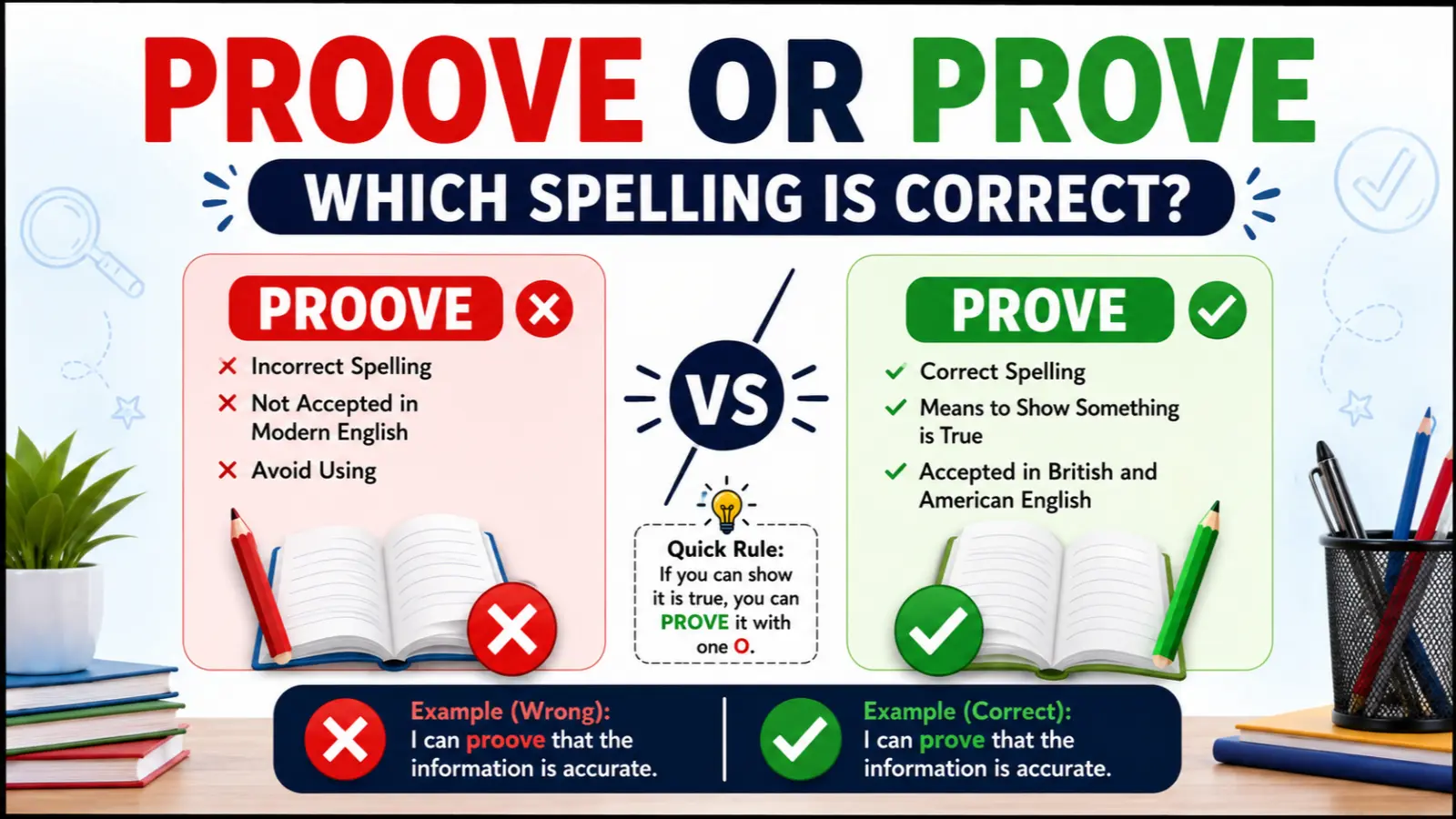
Prove is the correct spelling in modern English. Proove is an incorrect spelling and should not be used in formal or informal writing.
Example:
✅ I can prove that the information is accurate.
❌ I can proove that the information is accurate.
Meaning of Proove
Definition
Proove is an outdated or incorrect spelling of the word prove. It is not accepted in modern English dictionaries.
Examples
❌ I will proove my point.
❌ She wants to proove her skills.
Meaning of Prove
Definition
Prove means to show that something is true through evidence, facts, or actions.
Examples
✅ Scientists prove theories through research.
✅ She worked hard to prove her ability.
Key Differences Table
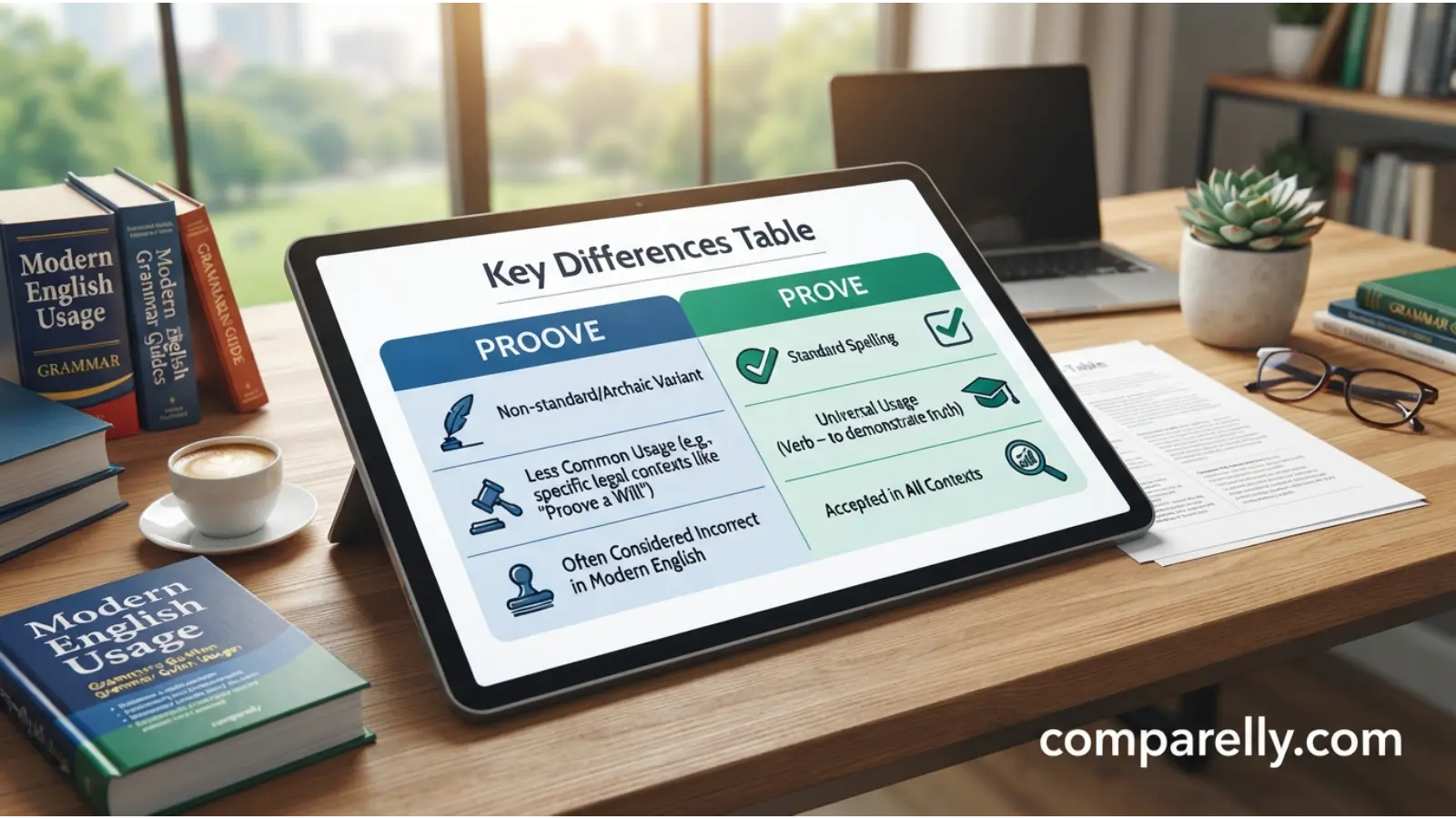
| Feature | Proove | Prove |
|---|---|---|
| Meaning | Incorrect spelling | Show something is true |
| Tone | Nonstandard | Standard English |
| Usage | Avoid using | Accepted everywhere |
| Popularity | Very low | Extremely common |
| Dictionary Status | Not recognized | Fully recognized |
| Formal Writing | Incorrect | Correct |
Origin & History
The word prove comes from the Old French word prover and the Latin word probare, meaning “to test” or “to demonstrate.”
Over time, English standardized the spelling as prove. While some historical texts may show spelling variations, modern English uses only prove.
Similar Word Examples
- Move
- Improve
- Approve
- Remove
- Reprove
These words may contain double vowels, which is one reason people mistakenly write proove.
British English vs American English Spelling
Unlike words such as colour/color or organise/organize, prove has the same spelling in both British and American English.
There is no accepted version where proove is correct. Both language varieties use prove in the same way.
Comparison Table: British vs American English
| English Variant | Correct Spelling |
|---|---|
| British English | Prove |
| American English | Prove |
| Australian English | Prove |
| Canadian English | Prove |
| New Zealand English | Prove |
When to Use Proove
Use of Proove
You should not use proove in modern writing.
Example
❌ I can proove my statement.
Correct version:
✅ I can prove my statement.
When to Use Prove
Use prove whenever you want to show evidence, confirm facts, or demonstrate ability.
Examples
1 The lawyer will prove the case.
2 Results prove the method works.
3 She wants to prove herself.
4 Data can prove the claim.
Common Mistakes
Mistake 1
❌ I can proove it.
✅ I can prove it.
Mistake 2
❌ The evidence will proove his innocence.
✅ The evidence will prove his innocence.
Mistake 3
❌ She prooved her point.
✅ She proved her point.
Mistake 4
❌ We need to proove the results.
✅ We need to prove the results.
Easy Trick to Remember
Think of these words:
- Move
- Love
- Give
- Prove
Notice that prove uses a single o.
Memory Tip:
“If you can show it is true, you can prove it with one O.”
Write 5 Examples
Example 1: School Assignment
The student used research to prove the answer was correct.
Example 2: Workplace Presentation
Sales numbers helped the manager prove the strategy worked.
Example 3: Court Case
The lawyer tried to prove the client’s innocence.
Example 4: Sports Competition
The athlete wanted to prove his skills during the match.
Example 5: Daily Conversation
You do not need to prove every opinion in a casual discussion.
Related Keywords
Google Trends & Usage Data
Across major English-speaking countries, prove receives overwhelmingly higher search interest than proove. Most searches for proove come from users checking spelling accuracy.
Countries such as the USA, UK, Australia, India, and Pakistan consistently show stronger usage of prove because it is the accepted standard spelling.

Insight:
People often search proove due to pronunciation confusion. Search data shows that users quickly switch to prove after learning the correct spelling.
Comparison Table: Keyword Variations
| Keyword Variation | Usage Popularity |
|---|---|
| Prove | Very High |
| Proove | Very Low |
| Prove Meaning | High |
| Prove Definition | Medium |
| Prove Synonym | Medium |
| Prove Examples | Medium |
| Prove Spelling | Medium |
Final Verdict
Prove is the correct spelling and should always be used in modern English.
Proove is considered a spelling mistake and should be avoided in academic, professional, and casual writing.
If you are unsure, remember that dictionaries, style guides, schools, and businesses all recognize prove as the standard form.
FAQs:
Is proove correct?
No. Proove is not considered correct in modern English.
What is the difference between proove and prove?
Prove is the correct spelling. Proove is a misspelling.
Which is more common, proove or prove?
Prove is far more common and accepted worldwide.
Is prove suitable for formal writing?
Yes. Prove is correct for academic, business, and professional writing.
Why does the confusion exist?
Many people assume the word should have a double “o” because of similar-looking words and pronunciation patterns.
Conclusion
Proove Or Prove is a spelling confusion that has a simple answer. The correct word is prove, which means to show that something is true through evidence, facts, or actions. The spelling proove is not accepted in modern English and should be avoided in all types of writing. Both British and American English use prove, making it the universal standard. Remember the simple memory trick: if you can demonstrate something is true, you prove it with one o. Using the correct spelling improves your writing, boosts credibility, and helps you communicate clearly in school, work, and daily life.

Daniel Foster is a comparison analyst and content strategist at Comparelly.com. He specializes in researching products, services, tools, and industry trends to create clear, unbiased comparison guides. With a focus on accuracy and practical insights, Daniel helps readers understand key differences and make informed decisions with confidence. His goal is to simplify complex choices through trustworthy, easy-to-understand content.