Parenthesis Or Parentheses is a common grammar question that confuses many writers. These two words look similar, but they do not mean exactly the same thing. Using the wrong term can make your writing less accurate, especially in academic, professional, or formal content.
The confusion usually happens because both words refer to the curved punctuation marks.However, one word is singular and the other is plural. Understanding the difference is simple once you learn the basic rule. This guide explains the meanings, usage, examples, common mistakes, history, and practical tips so you can use both words correctly every time.
Quick Answer
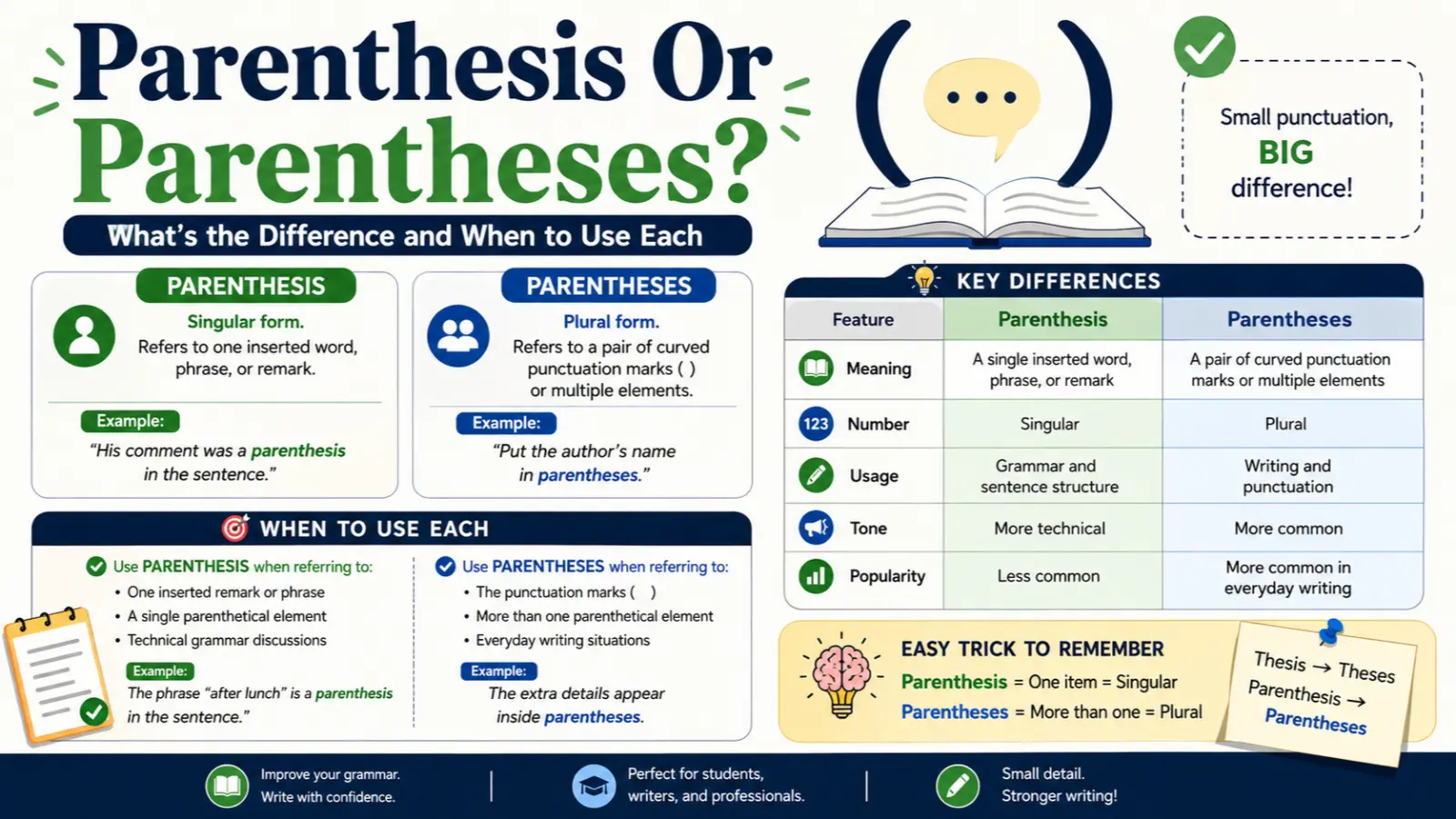
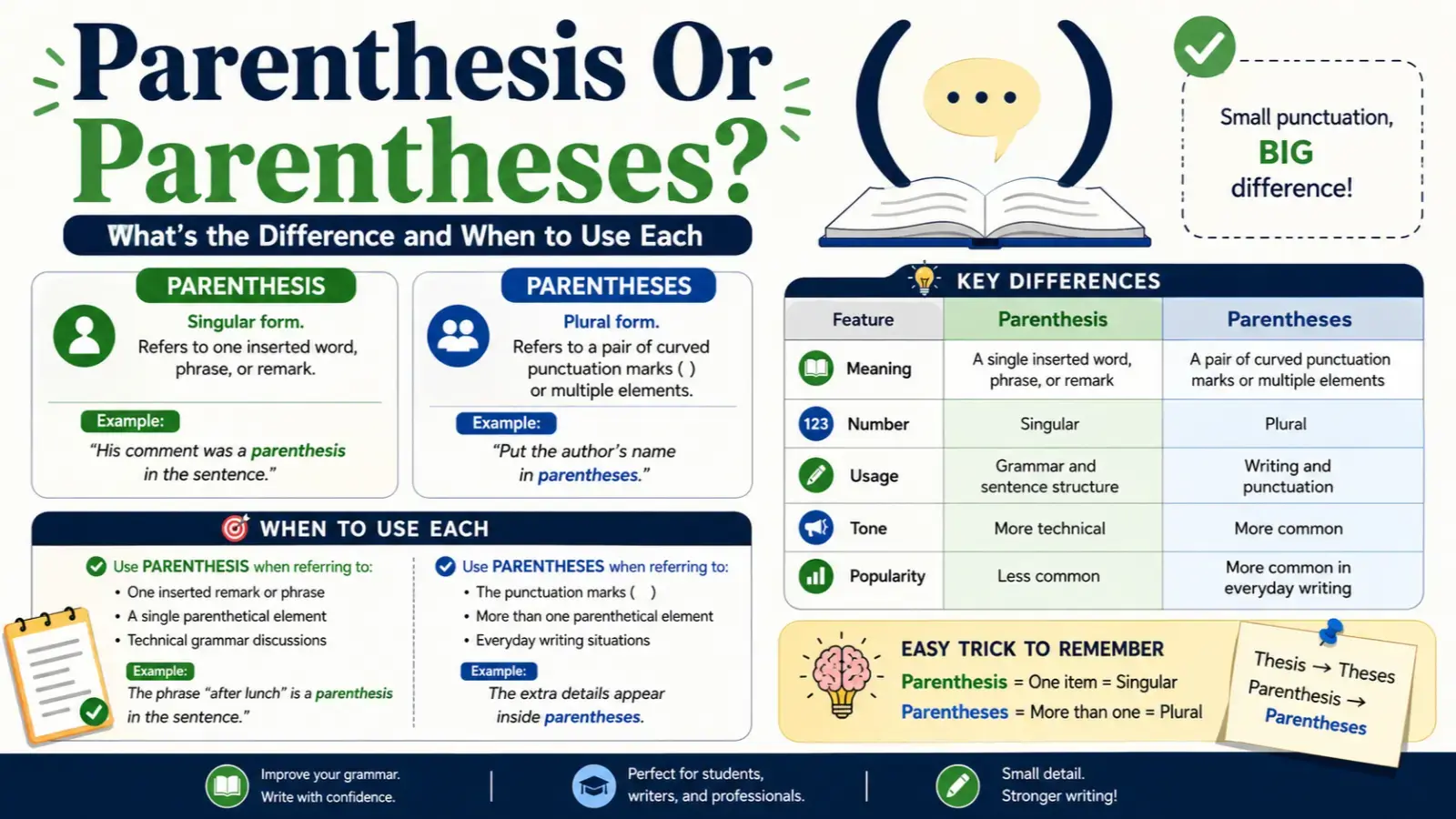
Parenthesis is the singular form and refers to one explanatory word, phrase, or punctuation mark.
Parentheses is the plural form and refers to a pair of curved punctuation marks ( ) or multiple parenthetical elements.
Example:
- Correct: Place the note inside the parentheses.
- Correct: The extra phrase is a parenthesis in the sentence.
Meaning of Parenthesis
Parenthesis is a singular noun. It refers to an inserted word, phrase, or statement that adds extra information to a sentence.

Examples:
- His comment was a parenthesis that interrupted the discussion.
- The phrase “after lunch” acts as a parenthesis in the sentence.
Meaning of Parentheses
Parentheses is the plural form of parenthesis. It commonly refers to the pair of curved punctuation marks ( ) used to enclose additional information.
Examples:
- Put the author’s name in parentheses.
- The instructions appeared inside parentheses.
Key Differences Table
| Feature | Parenthesis | Parentheses |
|---|---|---|
| Meaning | A single inserted word, phrase, or remark | A pair of curved punctuation marks or multiple parenthetical elements |
| Number | Singular | Plural |
| Usage | Grammar and sentence structure | Writing and punctuation |
| Tone | More technical | More common |
| Popularity | Less common | More common in everyday writing |
Origin & History
The word parenthesis comes from the Greek word parentithenai, meaning “to place beside.”
Over time, English adopted the term to describe words or phrases inserted into a sentence. Later, the plural form parentheses became widely used to describe the punctuation marks themselves.
Similar Word Examples
- Analysis → Analyses
- Thesis → Theses
- Hypothesis → Hypotheses
- Crisis → Crises
- Parenthesis → Parentheses
British English vs American English Spelling
There is no spelling difference between British English and American English for parenthesis and parentheses. Both countries use the same spellings and meanings.

Comparison Table
| Language Variant | Singular | Plural |
|---|---|---|
| British English | Parenthesis | Parentheses |
| American English | Parenthesis | Parentheses |
When to Use Parenthesis
Use parenthesis when referring to:
- One inserted remark
- A single parenthetical element
- Technical grammar discussions
Examples
- The author’s note is a parenthesis within the paragraph.
- That phrase acts as a parenthesis in the sentence.
When to Use Parentheses
Use parentheses when referring to:
- The punctuation marks ( )
- More than one parenthetical element
- Everyday writing situations
Examples
- Put the citation in parentheses.
- The extra details appear inside parentheses.
Common Mistakes
Mistake 1
❌ Put the reference in parenthesis.
✅ Put the reference in parentheses.
Mistake 2
❌ These parenthesis contain extra information.
✅ These parentheses contain extra information.
Mistake 3
❌ The inserted phrase is parentheses.
✅ The inserted phrase is a parenthesis.
Mistake 4
❌ Parentheses is a singular word.
✅ Parenthesis is singular.
Easy Trick to Remember
A simple memory tip:
- Parenthesis = One item = Singular.
- Parentheses = Ends with es = More than one = Plural.
Think of:
- Thesis → Theses
- Parenthesis → Parentheses
The pattern stays the same.
Write 5 Examples
Example 1: Academic Writing
The explanation appears in parentheses after the main statement.
Example 2: Business Reports
A short parenthesis may clarify a technical point.
Example 3: Emails
Dates are often written inside parentheses for clarity.
Example 4: School Assignments
Teachers use parentheses for additional instructions.
Example 5: Everyday Conversation
A quick side note can act as a parenthesis in speech.
Keywords
- parenthesis meaning
- parentheses meaning
- parenthesis vs parentheses
- grammar punctuation marks
- singular and plural grammar
- punctuation rules
- parentheses examples
Google Trends & Usage Data
United States 🇺🇸
Writers and students search parenthesis vs parentheses frequently because of grammar-related assignments and professional writing needs.
United Kingdom 🇬🇧
Usage follows the same pattern as the United States. Searches often focus on punctuation rules.
Australia 🇦🇺
Educational searches dominate, especially among students and content writers.
India 🇮🇳
Search volume is growing due to increasing interest in English grammar and competitive exams.
Pakistan 🇵🇰
Students, bloggers, and freelancers frequently search for the correct form and usage.
Insight
Across all five countries, parentheses receives more searches because it is the term people see most often in writing guides and punctuation discussions.
Comparison Table: Keyword Variations
| Keyword Variation | Search Intent |
|---|---|
| Parenthesis Or Parentheses | Comparison |
| Parenthesis vs Parentheses | Difference |
| Parenthesis Meaning | Definition |
| Parentheses Meaning | Definition |
| When to Use Parentheses | Usage |
| Grammar Parentheses Rules | Educational |
| Singular of Parentheses | Grammar |
Final Verdict
Parentheses is the correct choice when referring to the punctuation marks ( ), which is the most common situation.
Parenthesis is the singular form and is mainly used in grammar discussions when referring to one inserted remark or phrase.
For most writers, editors, students, and bloggers, parentheses will be the word used more often.
FAQs:
1. Is it correct to say parenthesis?
Yes. Parenthesis is the correct singular form.
2. What is the difference between parenthesis and parentheses?
Parenthesis is singular, while parentheses is plural.
3. Which is more common?
Parentheses is more common because it usually refers to the punctuation marks.
4. Which form should I use in formal writing?
Use parenthesis for singular references and parentheses for plural references.
5. Why does the confusion exist?
The words look very similar and come from Greek pluralization patterns that many English users do not encounter often.
Conclusion
Parenthesis Or Parentheses is a grammar distinction based on singular and plural forms. A parenthesis is one inserted remark, phrase, or grammatical element. Parentheses refers to the pair of punctuation marks ( ) or multiple parenthetical elements. The spellings remain the same in British and American English, making the rule easy to apply worldwide. Remember that if you are talking about punctuation marks in everyday writing, parentheses is usually the correct choice. If you are discussing one specific inserted phrase or remark, use parenthesis. Knowing this difference helps improve clarity, accuracy, and professionalism in your writing.

Daniel Foster is a comparison analyst and content strategist at Comparelly.com. He specializes in researching products, services, tools, and industry trends to create clear, unbiased comparison guides. With a focus on accuracy and practical insights, Daniel helps readers understand key differences and make informed decisions with confidence. His goal is to simplify complex choices through trustworthy, easy-to-understand content.