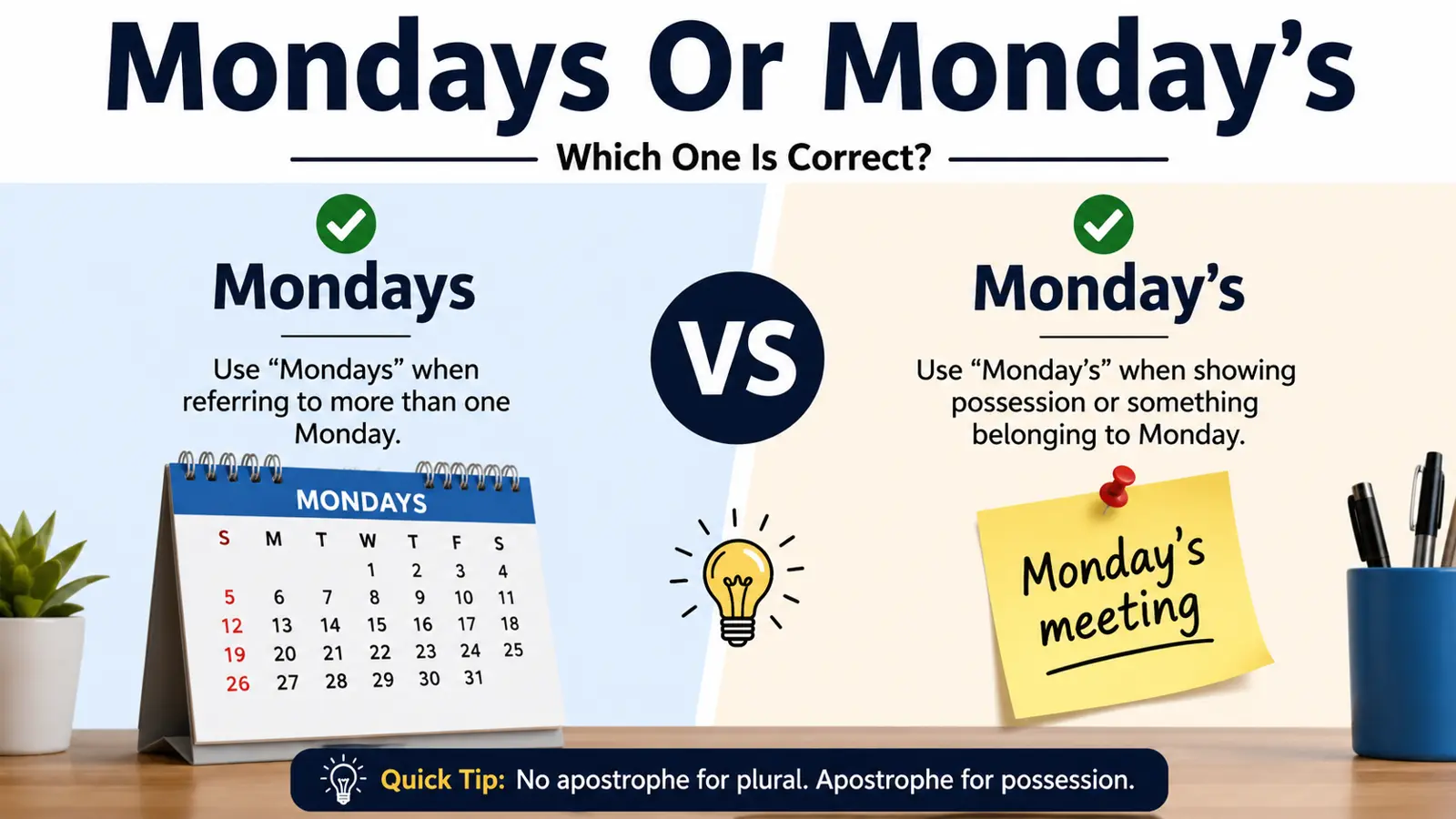
Mondays Or Monday’s is a common grammar question that confuses many English learners and writers. At first glance, both words look similar. However, they serve different purposes in a sentence.
The confusion happens because Mondays is a plural noun, while Monday’s is a possessive noun. A single apostrophe changes the meaning completely. Using the wrong form can make your writing look less professional. This guide explains the difference in simple terms. You will learn what each word means, when to use it, and how to avoid common mistakes. By the end, you will know exactly which form fits your sentence and why.
Quick Answer
Mondays is the plural form of Monday and refers to more than one Monday.
Monday’s is the possessive form of Monday and shows that something belongs to or relates to Monday.
Example
✅ I work late on Mondays.
✅ Monday’s meeting starts at 9 AM.
Meaning of Mondays
Mondays is the plural form of the day Monday.
It refers to multiple Mondays or Mondays in general.
Examples
- I go to the gym on Mondays.
- Most Mondays feel busy after the weekend.
Meaning of Monday’s
Monday’s is the possessive form of Monday.
It shows ownership, association, or something connected to Monday.
Examples
- Monday’s weather forecast looks sunny.
- We discussed Monday’s schedule during the meeting.
Key Differences Between Mondays and Monday’s

| Feature | Mondays | Monday’s |
|---|---|---|
| Meaning | More than one Monday | Something belonging to Monday |
| Grammar Type | Plural Noun | Possessive Noun |
| Tone | General Reference | Ownership or Association |
| Usage | Repeated Mondays | Events, schedules, forecasts |
| Popularity | Very common | Common in specific contexts |
Origin & History
The word Monday comes from Old English Monandæg, meaning “Moon’s Day.”
Over time, English developed rules for plurals and possession:
- Add s for plurals → Mondays
- Add ‘s for possession → Monday’s
Similar Examples
| Plural | Possessive |
|---|---|
| Tuesdays | Tuesday’s |
| Wednesdays | Wednesday’s |
| Fridays | Friday’s |
| Sundays | Sunday’s |
British English vs American English Spelling
There is no spelling difference between British and American English for Mondays and Monday’s.

Both countries follow the same grammar rules:
- Mondays = plural
- Monday’s = possessive
- Usage remains identical in formal and informal writing
Comparison Table
| Usage | British English | American English |
|---|---|---|
| Multiple Mondays | Mondays | Mondays |
| Belonging to Monday | Monday’s | Monday’s |
| Grammar Rule | Same | Same |
| Formal Writing | Same | Same |
When to Use Mondays
Use Mondays when discussing more than one Monday.
Examples
- I attend training sessions on Mondays.
- Schools often start earlier on Mondays.
- Traffic is heavier on Mondays.
When to Use Monday’s
Use Monday’s when something belongs to or is connected with Monday.
Examples
- Monday’s presentation was successful.
- We reviewed Monday’s sales report.
- Monday’s agenda includes three topics.
Common Mistakes

Mistake 1
❌ I work every Monday’s.
✅ I work every Monday.
Mistake 2
❌ I attend classes on Monday’s.
✅ I attend classes on Mondays.
Mistake 3
❌ Mondays meeting was postponed.
✅ Monday’s meeting was postponed.
Mistake 4
❌ We discussed Mondays schedule.
✅ We discussed Monday’s schedule.
Easy Trick to Remember
A simple memory trick:
- Mondays = Many Mondays
- Monday’s = Monday owns something
Think:
Apostrophe = ownership.
If something belongs to Monday, use Monday’s.
If you mean several Mondays, use Mondays.
Write 5 Examples
Example 1: Office Schedule
I attend team meetings on Mondays.
Monday’s meeting focuses on planning.
Example 2: School Routine
Students submit homework on Mondays.
Monday’s assignment is due by noon.
Example 3: Fitness Class
Yoga classes happen on Mondays.
Monday’s class is fully booked.
Example 4: Weather Updates
Rain often arrives on Mondays.
Monday’s forecast predicts storms.
Example 5: Business Reports
Managers review reports on Mondays.
Monday’s report showed growth.
Related Keywords
- Mondays vs Monday’s
- Mondays or Monday’s
- Monday apostrophe rules
- Monday possessive form
- plural of Monday
- Monday grammar rules
- days of the week possessive
Google Trends & Usage Data
Across the USA, UK, Australia, India, and Pakistan, searches for Mondays vs Monday’s increase during school and work seasons. Many users look for quick grammar answers while writing emails and reports.
The plural form Mondays appears more frequently because it is used in everyday schedules. The possessive form Monday’s remains popular in professional and academic writing. Search trends show that apostrophe-related grammar questions continue growing worldwide.
Comparison Table: Keyword Variations
| Keyword Variation | Search Intent |
|---|---|
| Mondays or Monday’s | Grammar confusion |
| Mondays vs Monday’s | Direct comparison |
| Monday possessive form | Grammar learning |
| Plural of Monday | Spelling question |
| Is Monday’s correct | Usage check |
| Monday apostrophe | Grammar rule |
| Monday grammar | Educational intent |
Final Verdict
Neither word is better. The correct choice depends on your meaning.
- Use Mondays when referring to multiple Mondays.
- Use Monday’s when showing possession or association.
If something belongs to Monday, add the apostrophe.
If you mean several Mondays, do not use an apostrophe.
Frequently Asked Questions
Is Mondays correct?
Yes. Mondays is the correct plural form of Monday.
Example
I work late on Mondays.
What is the difference between Mondays and Monday’s?
Mondays is plural.
Monday’s is possessive.
Which is more common?
Mondays is generally more common because people often discuss weekly routines.
Is Monday’s used in formal writing?
Yes. It is correct when showing possession.
Example
Monday’s report was approved.
Why does the confusion exist?
The confusion comes from the apostrophe. Many writers mistakenly use apostrophes to create plurals, which is incorrect.
Conclusion
Mondays Or Monday’s is a grammar question with a simple answer once you understand the rules. Mondays refers to more than one Monday and is used when discussing schedules, routines, or recurring events. Monday’s is possessive and shows that something belongs to or relates to Monday. The apostrophe is the key difference. Remember that plurals usually do not need apostrophes, while possession often does. Using the correct form improves clarity and professionalism in your writing. Whenever you feel unsure, ask yourself a simple question: am I talking about several Mondays or something connected to Monday? The answer will guide you to the correct choice every time.

Daniel Foster is a comparison analyst and content strategist at Comparelly.com. He specializes in researching products, services, tools, and industry trends to create clear, unbiased comparison guides. With a focus on accuracy and practical insights, Daniel helps readers understand key differences and make informed decisions with confidence. His goal is to simplify complex choices through trustworthy, easy-to-understand content.