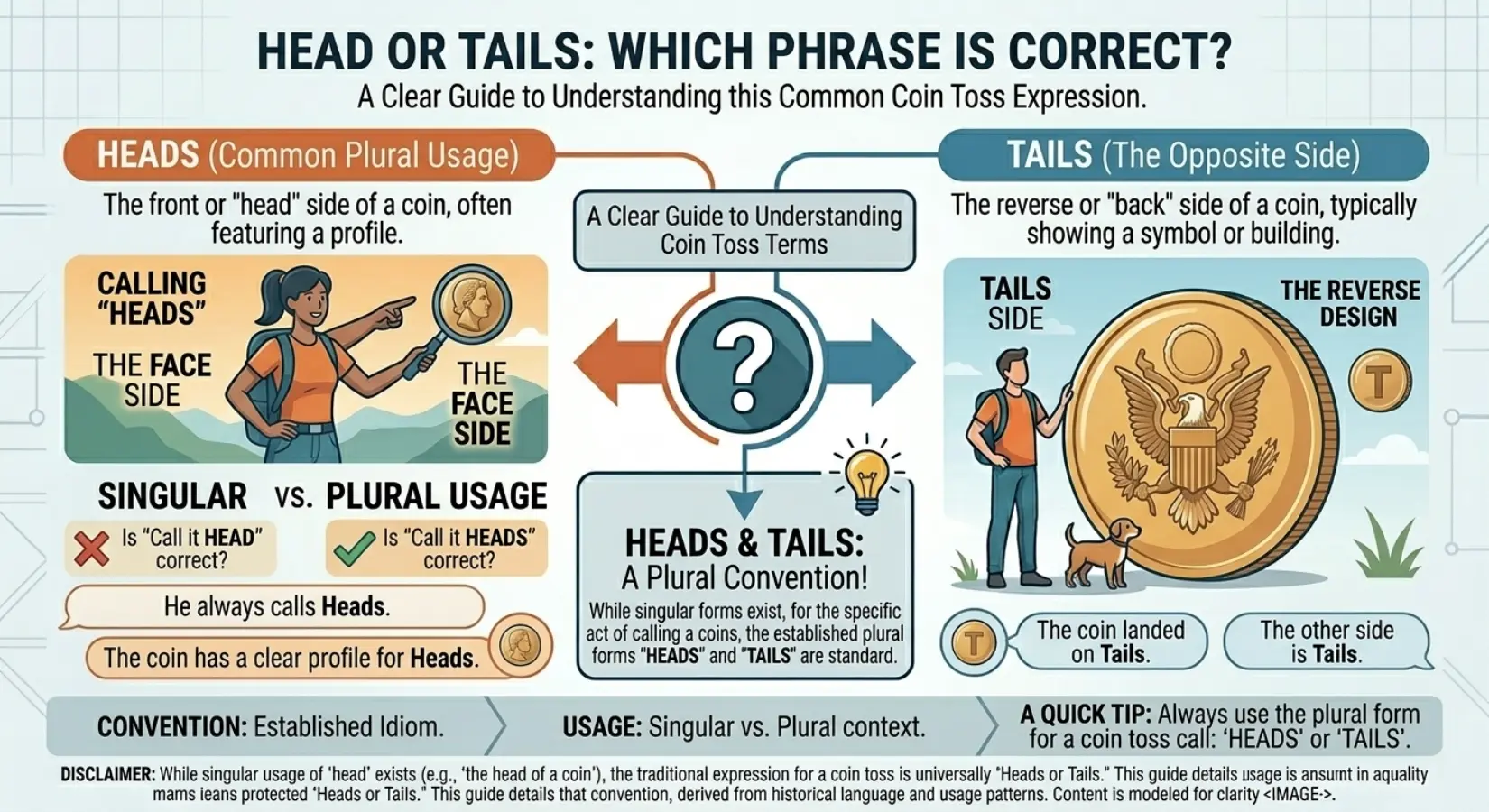
Head Or Tails is a common phrase used when people choose between the two sides of a coin. The standard phrase is “heads or tails,” not usually “head or tails.” It refers to the two sides of a coin used during a coin toss.
One side shows the head, face, or main image. The other side is called the tails side. People often say “heads or tails?” before flipping a coin. The phrase can also describe a simple choice between two possible outcomes.
You may hear it in sports, games, decisions, and everyday situations. Understanding this phrase helps you use it naturally. This guide explains head or tails, the correct form, its meaning, history, common mistakes, examples, and regional usage. It also explains why heads normally takes the plural form.
Quick Answer (for Google snippet)
The standard phrase is “heads or tails?” It asks someone to choose between the two sides of a coin before a coin toss.
Example: Heads or tails? I’ll call heads.
Meaning of Head
Head can mean the upper part of a person’s body.
It can also describe the face or portrait shown on one side of a coin.
In the phrase heads or tails, however, heads usually refers to the side of the coin showing a person’s head or portrait.
Examples
- The coin landed with the head facing upward.
- The head on the coin shows a national leader.
Important Point
When talking about the two sides of a coin, people normally say heads, not head.
So:
❌ Head or tails?
✅ Heads or tails?
Meaning of Tails
Tails refers to the opposite side of a coin.
This side usually does not show the main portrait or head.
The word tails traditionally describes the reverse side of a coin.
Examples
- She called tails before the coin was flipped.
- The coin landed on tails.
The phrase usually uses tails in the plural form.
Why “Tails”?
The word comes from the traditional contrast between the head side and the tail side.
It does not necessarily mean that every coin has an actual tail.
Key Differences: Head vs Tails
| Feature | Head | Tails |
|---|---|---|
| Basic meaning | Upper body part or coin portrait side | Opposite side of a coin |
| Coin phrase | Usually becomes “heads” | Usually “tails” |
| Number | Singular | Plural |
| Tone | Neutral | Neutral |
| Usage | Body, leadership, coin side | Coin toss, animal body |
| Popularity | Very common | Very common |
| Common phrase | Heads or tails | Heads or tails |
The Most Important Difference
The standard coin-toss phrase is:
Heads or tails?
It is not normally:
Head or tails?
The plural heads has become fixed in this traditional expression.
Origin & History
The phrase heads or tails developed from the traditional use of coins for random choices.
Coins commonly displayed a ruler, leader, or important figure on one side.
People began calling this side heads.
The opposite side became known as tails.
Coin tossing eventually became a simple way to settle disagreements or make random choices.
Similar Expressions
English contains several phrases with fixed forms.
Examples include:
- heads or tails
- give someone a heads-up
- two heads are better than one
- make heads or tails of something
- head over heels
- tails never fails
Some expressions keep unusual grammar because speakers have used them for generations.
🇬🇧 British English vs 🇺🇸 American English
The phrase “heads or tails?” is standard in both British and American English.
Both varieties use the same wording for a coin toss.
There is no major spelling difference between the two varieties.
British vs American English Comparison
| Feature | British English | American English |
|---|---|---|
| Standard phrase | Heads or tails? | Heads or tails? |
| Head side | Heads | Heads |
| Reverse side | Tails | Tails |
| Spelling | Same | Same |
| Meaning | Same | Same |
| Usage | Coin tosses and choices | Coin tosses and choices |
The phrase is also widely understood in other English-speaking countries.
When to Use Heads
Use heads when referring to the coin side with the head, portrait, or main figure.
It is also the standard word when asking someone to choose that side.
Examples
- I choose heads.
- She called heads before the flip.
- The coin landed on heads.
- He always picks heads.
- Let’s call heads this time.
Correct Question
✅ Heads or tails?
Less Natural Form
❌ Head or tails?
The phrase has a fixed traditional form.
When to Use Tails
Use tails when referring to the opposite side of a coin.
It commonly appears during coin tosses.
Examples
- I choose tails.
- He called tails before the flip.
- The coin landed on tails.
- She picked tails for the final round.
- Let’s go with tails.
Correct Question
✅ Heads or tails?
The two sides work together as a fixed phrase.
Common Mistakes
Mistake 1: Saying “Head or Tails?”
❌ Head or tails?
✅ Heads or tails?
Use the plural heads in the standard coin-toss expression.
Mistake 2: Writing “Head or Tail?”
❌ Head or tail?
✅ Heads or tails?
The traditional expression uses both words in plural form.
Mistake 3: Saying “I Choose Head”
❌ I choose head.
✅ I choose heads.
The coin-toss choice normally uses heads.
Mistake 4: Assuming Heads Means Several Heads
❌ Heads must mean many heads on the coin.
✅ Heads refers to the coin’s head side.
The plural form is part of the established expression.
Mistake 5: Confusing Tails With an Animal Tail
❌ The tails side must show an animal tail.
✅ Tails means the opposite side of the coin.
The term describes the coin side, not necessarily an actual tail.
Easy Trick to Remember
Use this simple trick:
Coins say “Heads or tails?”
Remember the phrase as one complete expression.
Heads → one side
Tails → the other side
Do not change heads to head.
Think:
Flip a coin? Ask “Heads or tails?”
This makes the correct form easy to remember.
Everyday Life Examples
1. Deciding Who Goes First
People often flip a coin to decide who starts.
Example:
Heads or tails? The winner goes first.
- Primary keyword: heads or tails
- Secondary keyword: coin toss
2. Choosing Between Two Options
A coin can help someone make a simple random choice.
Example:
I can’t decide, so let’s use heads or tails.
- Primary keyword: heads or tails
- Secondary keyword: random choice
3. Sports Coin Toss
Sports officials often use a coin toss before a game.
Example:
The referee asked the captain, “Heads or tails?”
- Primary keyword: heads or tails
- Secondary keyword: sports coin toss
4. Friendly Games
Friends can use a coin toss to settle small disagreements.
Example:
You pick heads or tails, and I’ll flip the coin.
- Primary keyword: heads or tails
- Secondary keyword: coin flip
5. Everyday Decisions
People sometimes use a coin when two choices seem equal.
Example:
Heads or tails? Let the coin decide where we eat.
- Primary keyword: heads or tails
- Secondary keyword: decision making
Related Keywords
Use these related keyword variations naturally:
- head or tails
- heads or tails
- heads or tails meaning
- heads or tails meaning
- heads or tails coin toss
- heads or tails phrase
- head or tail coin
- heads or tails question
- heads or tails game
- heads or tails coin flip
Google Trends & Usage Data
Search interest for heads or tails varies across countries and search contexts.
The phrase has strong relevance in sports, games, coin flips, and decision-making content.
Heads or tails is the natural search phrase for English-speaking audiences.
The single form head or tails generally reflects spelling confusion rather than standard usage.
Usage Insight by Country
| Country | Preferred Phrase | Usage Insight |
|---|---|---|
| 🇺🇸 USA | Heads or tails | Very common in games and sports |
| 🇬🇧 UK | Heads or tails | Standard coin-toss phrase |
| 🇦🇺 Australia | Heads or tails | Widely understood and used |
| 🇮🇳 India | Heads or tails | Common in everyday English |
| 🇵🇰 Pakistan | Heads or tails | Familiar in spoken and written English |
SEO Insight
Heads or tails should be the primary target keyword.
Head or tails works well as a secondary keyword because users search it when confused.
Content should explain the correct plural form clearly.
This approach captures both informational and spelling-related search intent.
Comparison Table: Keyword Variations
| Keyword Variation | Search Intent | Best Content Angle |
|---|---|---|
| head or tails | Spelling confusion | Correct phrase |
| heads or tails | Informational | Coin-toss meaning |
| heads or tails meaning | Informational | Definition |
| heads or tails coin toss | Informational | Coin-toss guide |
| heads or tails phrase | Vocabulary | Phrase explanation |
| head or tail coin | Comparison | Coin terminology |
| heads or tails question | Informational | Usage guide |
| heads or tails game | Informational | Game explanation |
| heads or tails coin flip | Informational | Coin-flip guide |
FAQ
1. Is “head or tails” correct?
The standard phrase is “heads or tails?” The word heads normally appears in the plural form.
2. What is the difference between head and tails?
Head has many meanings, including the body part and coin portrait side. Tails refers to the opposite side of a coin.
3. Which is more common, “head or tails” or “heads or tails”?
Heads or tails is much more common and is the standard expression.
4. Is “heads or tails” formal English?
Yes. Heads or tails is standard English. It works in casual, educational, and formal contexts.
5. Why does “heads or tails” use a plural “heads”?
The phrase developed as a traditional expression for the two sides of a coin. Heads became the established form for the coin’s portrait side.
Conclusion
Head Or Tails is a common phrase that describes a choice between two sides of a coin. The standard expression is “heads or tails?” The word heads refers to the side showing a head, face, portrait, or main figure. Tails refers to the opposite side. Both words normally appear in plural form within this fixed expression. This wording remains the same in British and American English. You can use heads or tails when flipping a coin, deciding who goes first, or settling a simple choice. Remember the phrase as one complete expression. If you are unsure, ask yourself one question: “Am I talking about a coin toss?” If yes, use heads or tails.

Daniel Foster is a comparison analyst and content strategist at Comparelly.com. He specializes in researching products, services, tools, and industry trends to create clear, unbiased comparison guides. With a focus on accuracy and practical insights, Daniel helps readers understand key differences and make informed decisions with confidence. His goal is to simplify complex choices through trustworthy, easy-to-understand content.