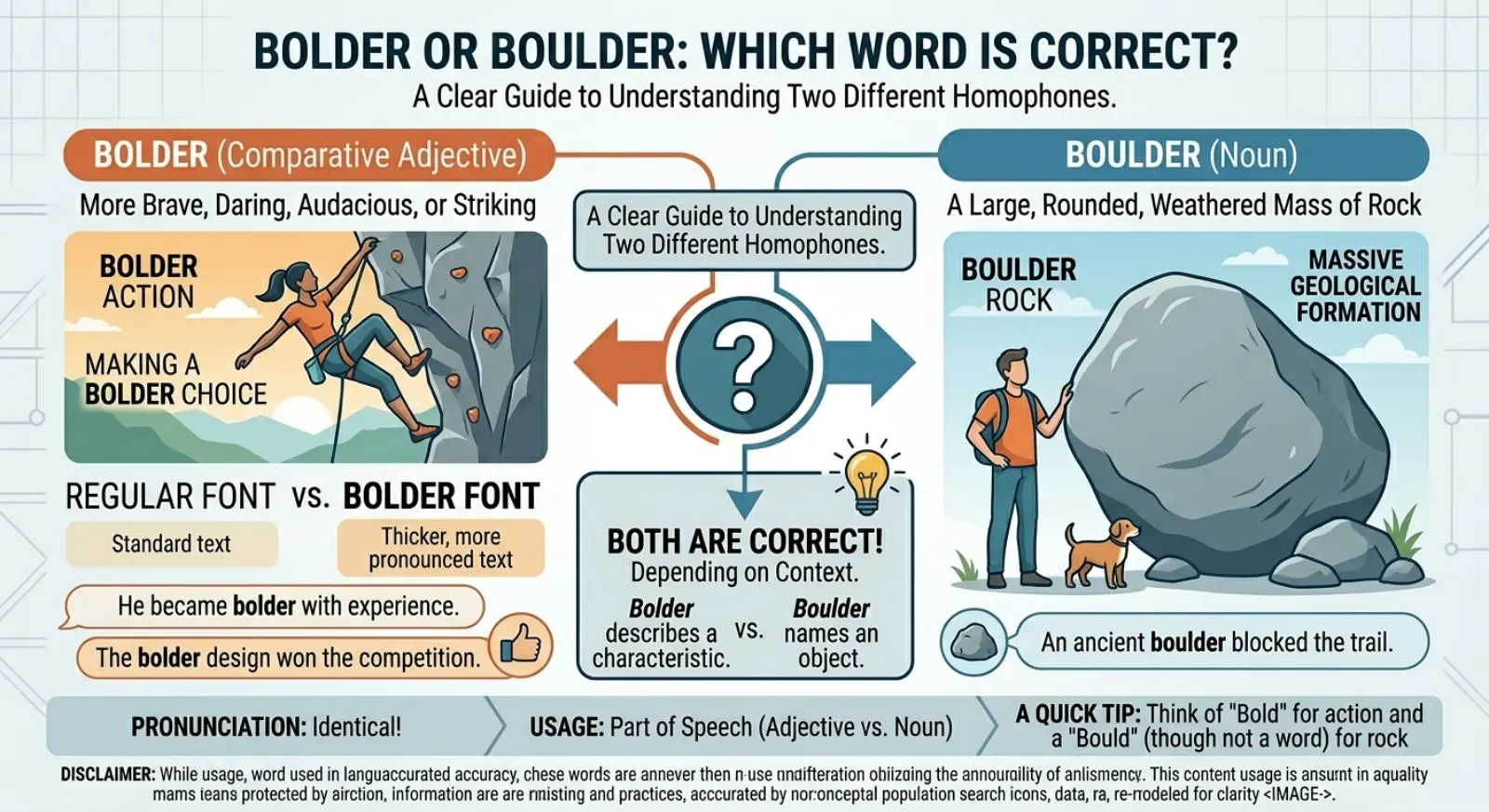
Bolder Or Boulder can confuse writers because the words sound very similar. However, they have completely different meanings. Bolder is the comparative form of the adjective bold. It describes someone or something that shows more courage, confidence, or strength. Boulder is a noun that means a large, rounded rock. You may see both words in everyday writing. For example, someone can make a bolder decision. A hiker can climb over a boulder. The spelling differs by only one letter. That small difference can cause mistakes. Understanding the meaning makes the correct spelling easier. This guide explains bolder vs boulder, their meanings, differences, origins, examples, and common mistakes. It also explains their usage in American and British English. By the end, you will know exactly when to use each word.
Quick Answer (for Google snippet)
Bolder means more brave, confident, noticeable, or daring. Boulder means a large rounded rock.
Example: She made a bolder choice while climbing around the boulder.
Meaning of Bolder
Bolder is the comparative form of bold.
It means more brave, confident, daring, strong, or noticeable than something else.
The word can describe people, actions, decisions, designs, colors, or ideas.
Examples
- She became bolder after gaining more experience.
- The designer chose a bolder color for the new logo.
Common phrases with Bolder
- bolder decision
- bolder choice
- bolder approach
- bolder design
- bolder idea
- bolder statement
- bolder color
Bolder compares two things.
For example:
This design is bolder than the previous one.
Meaning of Boulder
Boulder is a noun.
It means a large rock, usually rounded by natural weathering or erosion.
Boulders can appear in mountains, rivers, forests, deserts, and construction areas.
Examples
- The hikers rested beside a large boulder.
- A huge boulder blocked the narrow trail.
Common phrases with Boulder
- large boulder
- giant boulder
- granite boulder
- river boulder
- climbing boulder
- boulder field
- boulder wall
Unlike bolder, boulder refers to a physical object.
Key Differences: Bolder vs Boulder
| Feature | Bolder | Boulder |
|---|---|---|
| Meaning | More bold or daring | Large rounded rock |
| Part of speech | Adjective | Noun |
| Tone | Descriptive | Physical and literal |
| Usage | Describes comparison | Names an object |
| Popularity | Common | Common |
| Example | A bolder idea | A large boulder |
| Related word | Bold | Rock |
The words sound similar, but their meanings are completely different.
Origin & History
Bolder comes from the adjective bold.
The word bold has Old English roots. It has long described courage, confidence, or daring behavior.
English forms its comparative adjectives in different ways.
For example:
- bold → bolder
- cold → colder
- fast → faster
- strong → stronger
- brave → braver
Boulder has a different history.
It developed from an older English word related to a large stone or rock.
The two words do not share the same meaning.
Similar Word Examples
English has many confusing word pairs with similar sounds.
Examples include:
- bolder / boulder
- bare / bear
- brake / break
- flower / flour
- weather / whether
- right / write
- sea / see
These pairs require attention to context.
🇬🇧 British English vs 🇺🇸 American English Spelling
Bolder and boulder have the same spellings in British and American English.
Their meanings also remain the same.
The main difference comes from context, not regional spelling.
British vs American English Comparison
| Word | British English | American English |
|---|---|---|
| Bolder | Same spelling | Same spelling |
| Boulder | Same spelling | Same spelling |
| Meaning of bolder | More bold | More bold |
| Meaning of boulder | Large rock | Large rock |
| Spelling difference | None | None |
Unlike words such as colour/color, these words do not change spelling between regions.
When to Use Bolder
Use bolder when comparing something with another thing.
It often describes courage, confidence, appearance, or strength.
Examples
- He made a bolder decision this time.
- The company needs a bolder marketing strategy.
- She chose a bolder dress for the event.
- The artist created a bolder painting.
- We need a bolder plan to solve the problem.
Easy Test
Ask:
Does the word mean “more bold”?
If yes, use bolder.
Example:
The new design is more bold.
Better:
The new design is bolder.
When to Use Boulder
Use boulder when referring to a large rock.
It works in outdoor, geological, construction, and adventure contexts.
Examples
- The climber reached the top of the boulder.
- A boulder fell onto the road.
- The river flows around a large boulder.
- They moved the boulder away from the entrance.
- The children sat on a smooth boulder.
Easy Test
Ask:
Can you touch or see the object as a large rock?
If yes, use boulder.
Common Mistakes
Mistake 1: Using Boulder for Confidence
❌ She became boulder after winning the competition.
✅ She became bolder after winning the competition.
Use bolder when describing increased confidence.
Mistake 2: Using Bolder for a Rock
❌ The hikers climbed over a large bolder.
✅ The hikers climbed over a large boulder.
Use boulder for a large rock.
Mistake 3: Confusing “Bolder” With “Bold”
❌ This is bolder idea.
✅ This is a bolder idea.
Remember to use the correct article when needed.
Mistake 4: Using “Boulder” as a Comparative Adjective
❌ His second plan was boulder than his first plan.
✅ His second plan was bolder than his first plan.
Boulder cannot replace bolder.
Mistake 5: Ignoring Context
❌ The designer selected a boulder color.
✅ The designer selected a bolder color.
The context tells you which word fits.
Easy Trick to Remember
Use this simple memory trick:
Bolder = Bold + er
If something is more bold, choose bolder.
Boulder = Rock
If you mean a large rock, choose boulder.
Think:
Bolder → brave
Boulder → big rock
This simple connection makes the difference easy to remember.
Everyday Life Examples
1. Making a Brave Decision
People often become bolder after gaining experience.
Example:
She made a bolder decision during the meeting.
- Primary keyword: bolder
- Secondary keyword: bolder decision
2. Choosing a Strong Design
Designers may choose stronger colors for visual impact.
Example:
The website uses a bolder color scheme.
- Primary keyword: bolder
- Secondary keyword: bolder design
3. Hiking Outdoors
Hikers often encounter large rocks on mountain trails.
Example:
The hikers stopped beside a massive boulder.
- Primary keyword: boulder
- Secondary keyword: large boulder
4. Rock Climbing
Boulders can provide natural climbing surfaces.
Example:
The climber practiced on a nearby boulder.
- Primary keyword: boulder
- Secondary keyword: climbing boulder
5. Comparing Ideas
A person can choose a more daring idea.
Example:
The team suggested a bolder approach to the problem.
- Primary keyword: bolder
- Secondary keyword: bolder approach
Related Keywords
Here are useful keyword variations for this topic:
- bolder or boulder
- bolder vs boulder
- boulder vs bolder
- bolder meaning
- boulder meaning
- is bolder a word
- is boulder a word
- bolder spelling
- boulder spelling
- bolder definition
- boulder definition
Final Verdict
Bolder and boulder are both correct words.
They simply have different meanings.
Use bolder when you mean more bold, brave, confident, or noticeable.
Use boulder when you mean a large rock.
The easiest trick is simple:
Bolder = more bold.
Boulder = large rock.
Neither word is more correct than the other.
Your sentence determines the correct choice.
Google Trends & Usage Data
Search interest for bolder and boulder differs because users search them for different reasons.
Boulder often appears in searches about rocks, climbing, hiking, geology, and places.
Bolder usually appears in writing and grammar searches involving the comparative form of bold.
Usage Insights by Country
| Country | Bolder Usage | Boulder Usage | Main Insight |
|---|---|---|---|
| 🇺🇸 USA | Common | Very common | Both have broad everyday usage |
| 🇬🇧 UK | Common | Common | Both spellings remain unchanged |
| 🇦🇺 Australia | Common | Common | Outdoor contexts support boulder usage |
| 🇮🇳 India | Common | Common | Both appear in general English |
| 🇵🇰 Pakistan | Common | Common | Both occur in formal and everyday English |
Key SEO Insight
Boulder generally has broader search intent because it has several meanings and contexts.
Bolder attracts users searching for spelling, grammar, and comparative adjective explanations.
For SEO, use both keywords naturally.
Build separate supporting content around their meanings and related terms.
📊 Comparison Table: Keyword Variations
| Keyword Variation | Search Intent | Best Content Angle |
|---|---|---|
| bolder or boulder | Comparison | Spelling guide |
| bolder vs boulder | Comparison | Difference article |
| boulder vs bolder | Comparison | Vocabulary guide |
| bolder meaning | Informational | Definition |
| boulder meaning | Informational | Definition |
| is bolder a word | Spelling | Grammar guide |
| is boulder a word | Spelling | Vocabulary guide |
| bolder spelling | Spelling | Word guide |
| boulder spelling | Spelling | Word guide |
| bolder definition | Informational | Dictionary-style guide |
FAQ
1. Is “bolder” a correct word?
Yes. Bolder is the comparative form of bold. It means more brave, confident, daring, or noticeable.
2. What is the difference between bolder and boulder?
Bolder describes something that is more bold. Boulder means a large rock.
3. Which is more common, bolder or boulder?
Both are common words, but they serve different purposes. Boulder has broader physical and geographic uses.
4. Is bolder formal English?
Yes. Bolder is standard English and works in formal and informal writing.
5. Why does the confusion between bolder and boulder exist?
The words sound very similar when spoken. Their different spellings and meanings can therefore cause confusion.
Conclusion
Bolder Or Boulder compares two correct English words with different meanings. Bolder is the comparative form of bold. It describes something that is more confident, brave, daring, or noticeable. Boulder is a noun that describes a large rock. Both words have the same spelling in British and American English. The easiest way to remember them is simple. Bolder means more bold, while boulder means a large rock. Context determines which word belongs in your sentence. If you describe a stronger idea, use bolder. If you describe a large stone, use boulder. Learning this small difference can prevent common spelling mistakes. With practice, choosing the correct word becomes quick and easy.

Daniel Foster is a comparison analyst and content strategist at Comparelly.com. He specializes in researching products, services, tools, and industry trends to create clear, unbiased comparison guides. With a focus on accuracy and practical insights, Daniel helps readers understand key differences and make informed decisions with confidence. His goal is to simplify complex choices through trustworthy, easy-to-understand content.