Whisky or whiskey confuses many drinkers and writers alike. Both words describe the same type of strong, aged spirit. But the spelling changes depending on where the drink comes from. This is not a simple grammar mistake.
It’s actually a tradition tied to specific countries. Scotland, Canada, and Japan use one spelling. Ireland and the United States use another. This small difference matters a lot to distillers and drink experts. In this guide, you will learn exactly which spelling to use and when. You will see clear examples, common mistakes, and an easy trick to remember the rule forever.
Quick Answer
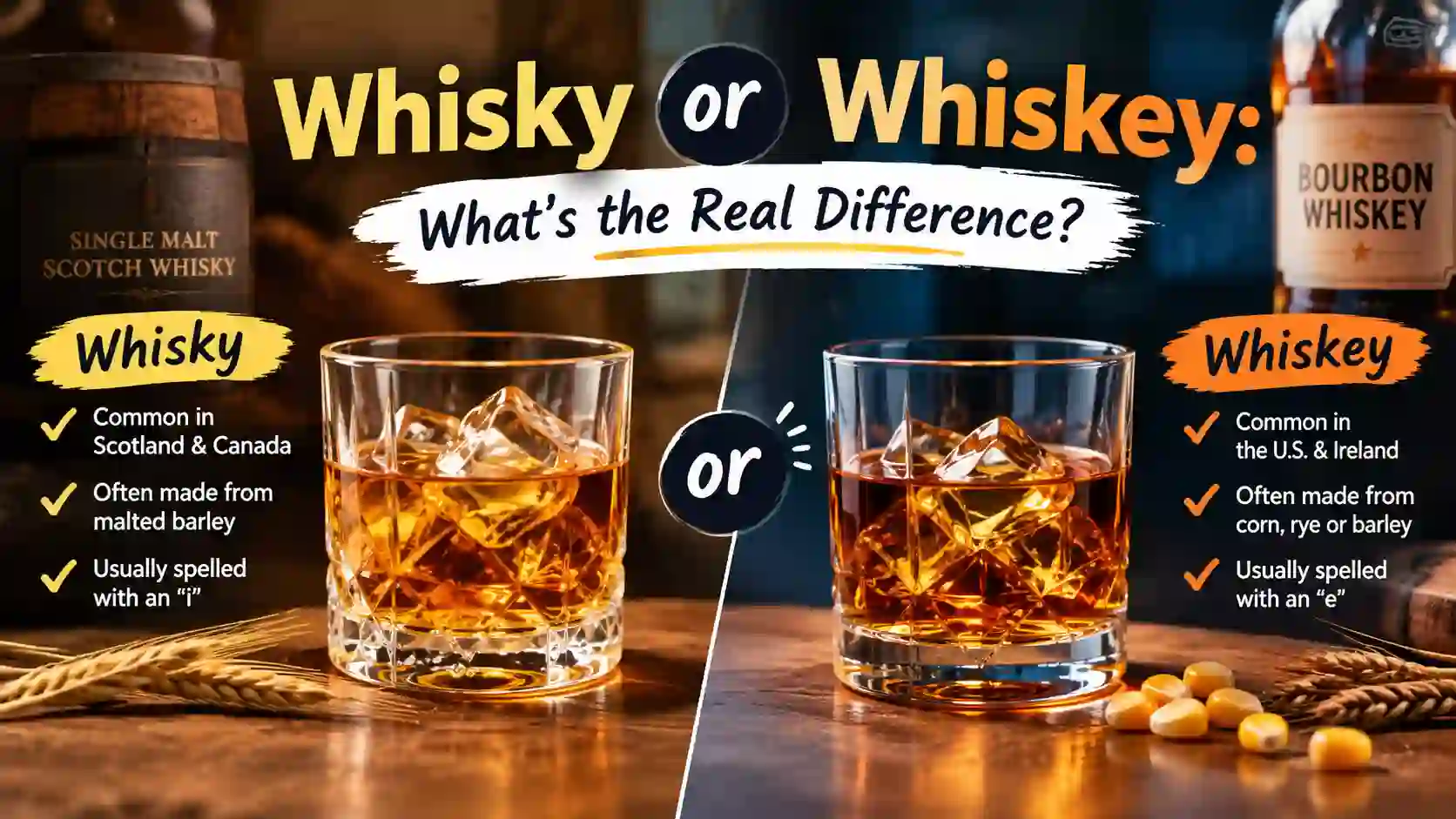
Whisky is used in Scotland, Canada, and Japan. Whiskey is used in Ireland and the United States.
Example: “Scotch whisky is famous around the world.” ✅ Example: “Irish whiskey has a smooth, light taste.” ✅
Meaning Section
Meaning of Whisky
Whisky refers to a distilled alcoholic drink made from grain, using the Scottish spelling style.
Examples:
- He ordered a glass of Scotch whisky.
- Japanese whisky has grown popular worldwide.
Meaning of Whiskey
Whiskey refers to the same type of drink, using the Irish and American spelling style.
Examples:
- Bourbon is a well-known American whiskey.
- She enjoys sipping Irish whiskey on weekends.
Key Differences Table
| Feature | Whisky | Whiskey |
|---|---|---|
| Meaning | Distilled grain spirit (Scottish style) | Distilled grain spirit (Irish/American style) |
| Tone | Traditional, refined | Warm, classic |
| Usage | Scotland, Canada, Japan | Ireland, United States |
| Popularity | Common in global whisky markets | Common in American and Irish markets |
Origin & History
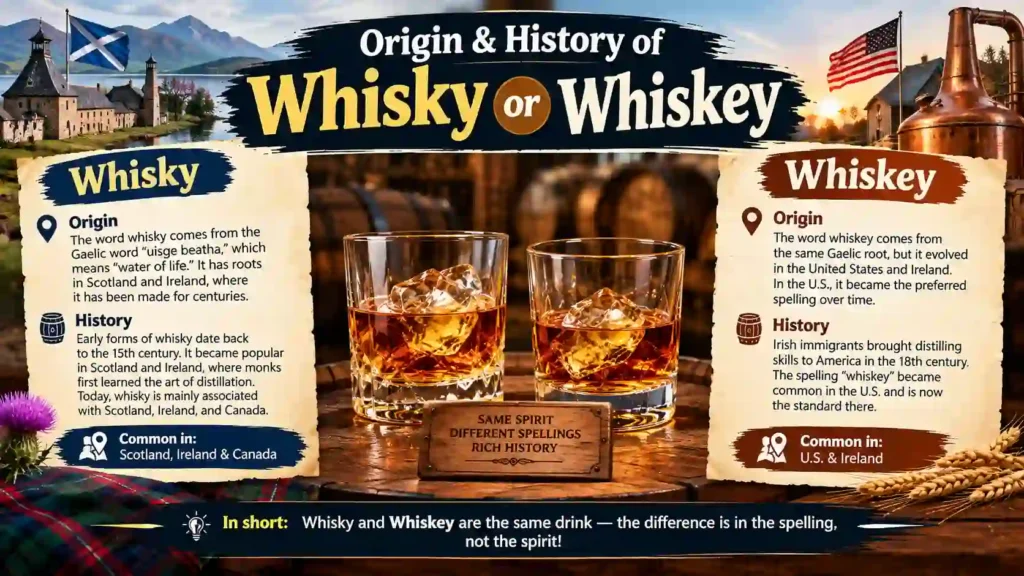
Both words come from the Gaelic phrase “uisce beatha,” meaning “water of life.” Scottish distillers dropped the “e” over time, creating “whisky.” Irish and American distillers kept the “e,” forming “whiskey.”
Similar spelling debates exist for words like “grey/gray” and “colour/color,” where regional habits shape spelling choices.
British English vs American English Spelling
This spelling difference is not strictly British versus American English. It follows country of origin instead. Scotland, part of the UK, still uses “whisky,” while the United States uses “whiskey.”
Comparison Table: British vs American English
| Region | Spelling Used | Example Product |
|---|---|---|
| Scotland (UK) | Whisky | Scotch whisky |
| United States | Whiskey | Bourbon whiskey |
| Ireland | Whiskey | Irish whiskey |
| Canada | Whisky | Canadian whisky |
| Japan | Whisky | Japanese whisky |
When to Use Each Word
When to Use “Whisky”
Use “whisky” when writing about Scotch, Canadian, or Japanese products.
Examples:
- This whisky comes from a Highland distillery.
- Canadian whisky is known for its smoothness.
When to Use “Whiskey”
Use “whiskey” when writing about American or Irish products.
Examples:
- Kentucky produces most American whiskey brands.
- Irish whiskey often has a lighter flavor profile.
Common Mistakes
- Incorrect: Scotch whiskey is aged in oak barrels. Correct: Scotch whisky is aged in oak barrels.
- Incorrect: Bourbon is a type of whisky. Correct: Bourbon is a type of whiskey.
- Incorrect: Japanese whiskey has won many awards. Correct: Japanese whisky has won many awards.
- Incorrect: Irish whisky is famous for its smooth taste. Correct: Irish whiskey is famous for its smooth taste.
Easy Trick to Remember
Think: “Countries with an ‘E’ in their name use ‘whiskEy.'”
Ireland and the United States both fit this pattern. Scotland, Canada, and Japan do not, so they use “whisky.”
Everyday Life Examples
1. Ordering Drinks at a Bar
He asked the bartender for a glass of Scotch whisky.
2. Gift Shopping
She bought a bottle of Irish whiskey as a gift.
3. Cooking and Recipes
The recipe called for a splash of bourbon whiskey.
4. Traveling and Tourism
Tourists often visit whisky distilleries in the Scottish Highlands.
5. Whisky or Whiskey in Writing
Writers often search “whisky or whiskey” before publishing drink reviews.
Related Keywords
- Whisky vs whiskey spelling
- Scotch whisky meaning
- American whiskey brands
- Whiskey or whisky difference
- Irish whiskey vs Scotch whisky
- Japanese whisky spelling
- Correct spelling of whisky
Final Verdict
Use “whisky” for products from Scotland, Canada, or Japan. Use “whiskey” for products from Ireland or the United States. Neither spelling is wrong. The correct choice depends on the product’s country of origin.
Google Trends & Usage Data (USA, UK, AUS, IND, PAK)
Search data shows “whiskey” leads clearly in the USA, matching local spelling habits. The UK shows strong interest in “whisky,” tied to Scotch whisky culture. Australia shows mixed searches, often influenced by both British and American brands. India and Pakistan show growing interest in “whisky,” linked to imported Scotch and local products.
Comparison Table: Keyword Variations
| Keyword Variation | Common Region | Search Intent |
|---|---|---|
| Whisky or whiskey | Global | Spelling confusion |
| Scotch whisky | UK, India | Product search |
| American whiskey | USA | Product search |
| Irish whiskey | Ireland, USA | Product search |
| Japanese whisky | Global | Product curiosity |
FAQ’s Section
1. Is it “whisky” or “whiskey”? Both are correct, depending on the product’s country of origin.
2. What is the difference between whisky and whiskey? Only the spelling differs, based on where the drink is produced.
3. Which spelling is more common: whisky or whiskey? “Whiskey” is more common in the USA, while “whisky” leads globally overall.
4. Can I use either spelling in formal writing? Yes, but match the spelling to the product’s country of origin.
5. Why does this confusion exist? Different countries adopted different spellings over centuries of whisky production.
Conclusion
Whisky or whiskey does not have to confuse you anymore. “Whisky” fits Scotland, Canada, and Japan. “Whiskey” fits Ireland and the United States. Remember the simple trick: countries with an “e” use “whiskey.”
Both spellings describe the same beloved spirit enjoyed worldwide. Choosing the right spelling shows respect for tradition and accuracy. Keep this guide handy for your next article, menu, or product review. Clear spelling builds trust with readers and whisky lovers alike.

Daniel Foster is a comparison analyst and content strategist at Comparelly.com. He specializes in researching products, services, tools, and industry trends to create clear, unbiased comparison guides. With a focus on accuracy and practical insights, Daniel helps readers understand key differences and make informed decisions with confidence. His goal is to simplify complex choices through trustworthy, easy-to-understand content.