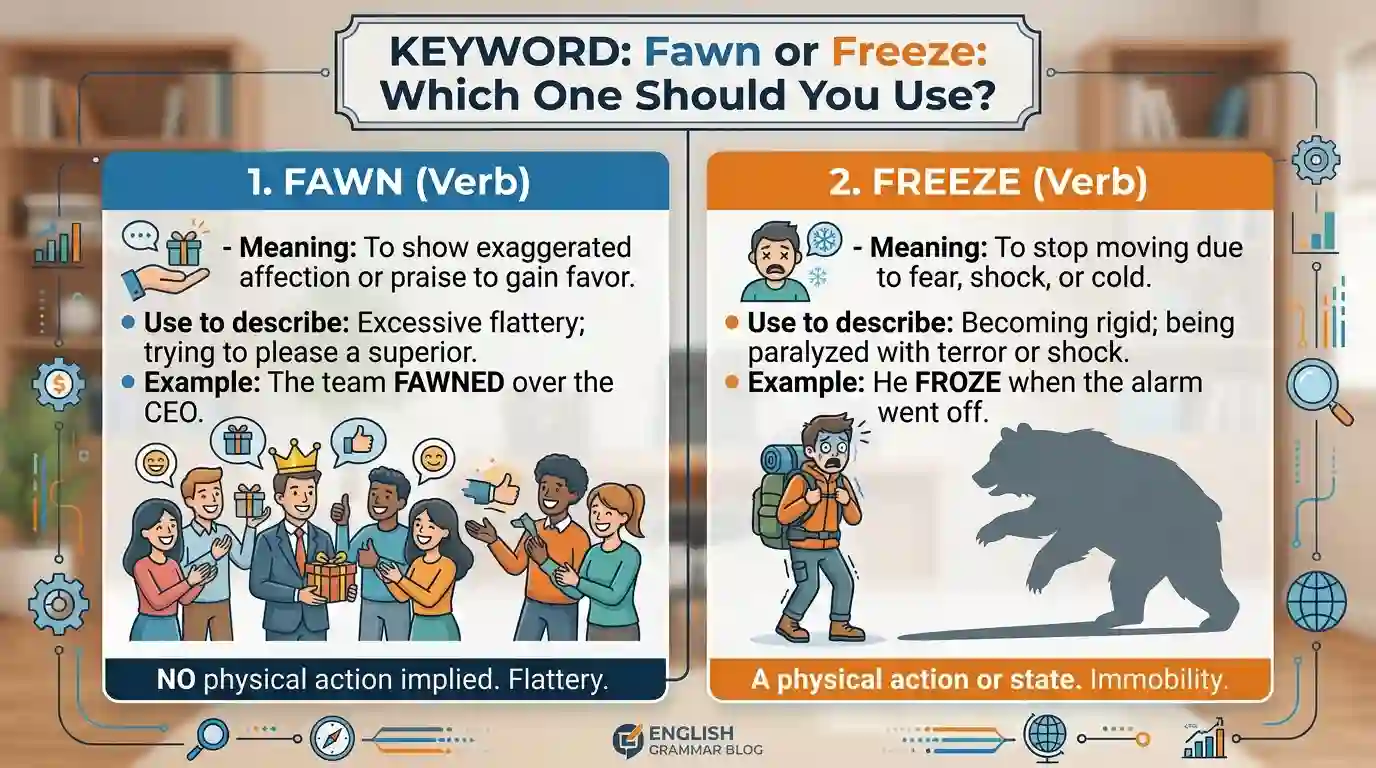
Fawn or Freeze can confuse readers because both words describe reactions to situations. However, they have different meanings and uses. Fawn can mean showing excessive friendliness or praise toward someone. It can also describe a young deer. In psychology, fawn can describe a response based on pleasing others.
Freeze means to stop moving or become unable to act. It can describe physical cold, a sudden pause, or a stress response. Understanding the difference helps you choose the right word. This guide explains fawn or freeze with simple meanings, examples, usage rules, and common mistakes. You will also learn how each word works in everyday English. By the end, you can use fawn and freeze confidently in writing and conversation.
Quick Answer
Fawn means to flatter, please, or act overly submissive toward someone. Freeze means to stop moving, become still, or become unable to act.
Example: She may fawn over her manager, while fear may make her freeze.
Meaning of Fawn
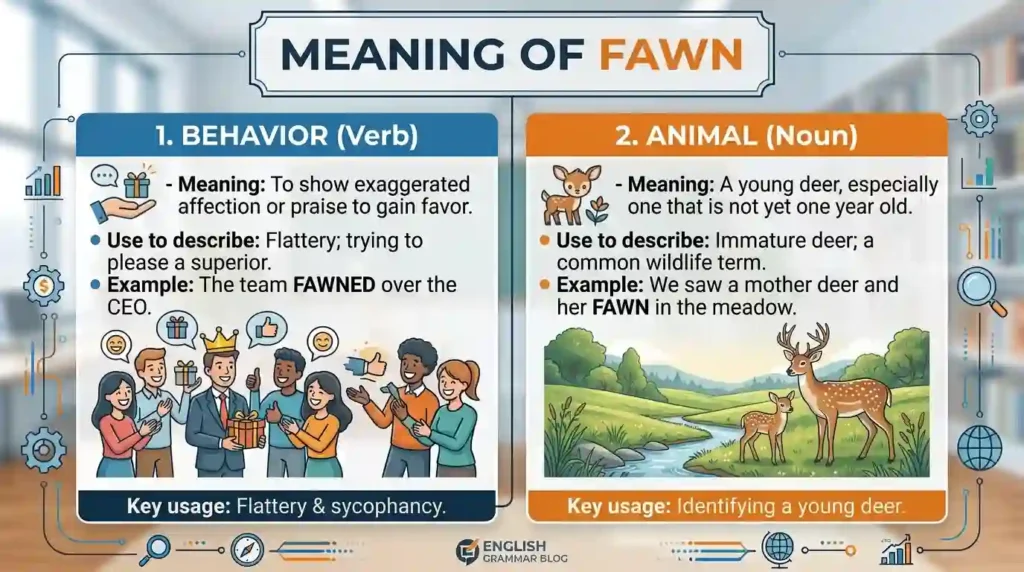
Fawn has several meanings. As a noun, it means a young deer. As a verb, it means to flatter someone excessively.
In psychology, fawn can describe trying to please others to avoid conflict.
Examples of Fawn
- The young fawn followed its mother through the forest.
- He tends to fawn over powerful people.
Meaning of Freeze
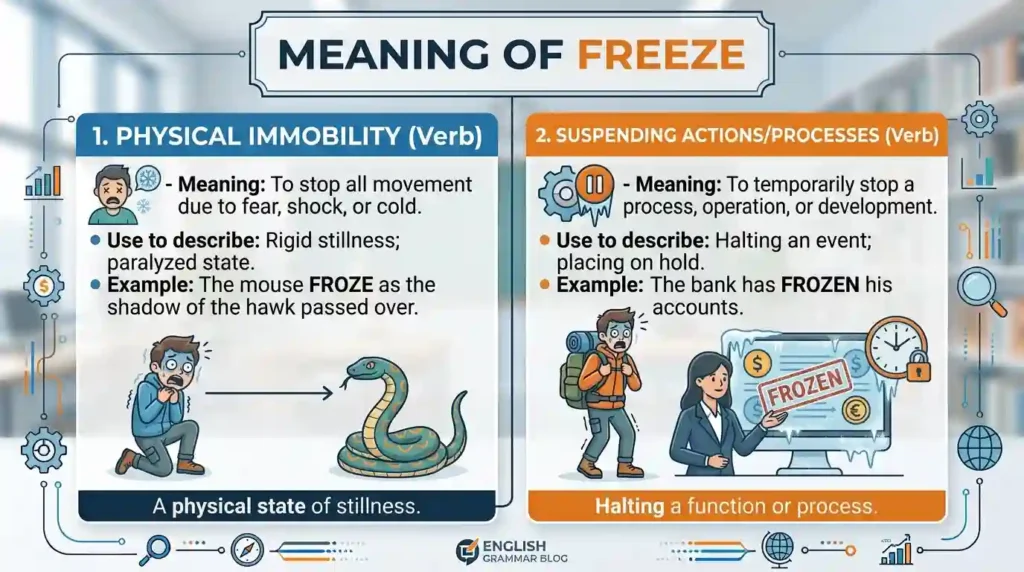
Freeze means to become very cold or turn into ice. It also means to stop moving suddenly.
People can also freeze when fear, shock, or pressure makes them unable to respond.
Examples of Freeze
- Water can freeze when temperatures drop below 0°C.
- She began to freeze when the teacher called on her.
Key Differences Between Fawn and Freeze
| Feature | Fawn | Freeze |
|---|---|---|
| Meaning | Flatter or please excessively | Stop moving or responding |
| Tone | Often negative or submissive | Neutral, fearful, or physical |
| Usage | Social behavior, animals, psychology | Cold, movement, fear, reactions |
| Popularity | Common | Very common |
Origin & History of Fawn and Freeze
Fawn comes from an old word connected with a young deer. The verb fawn later developed the sense of acting submissively.
Freeze comes from Old English frēosan. It has long described becoming solid because of cold.
Similar words include:
- Fawn → flatter, praise, please
- Freeze → chill, solidify, stop
- Fawn → submit, flatter, court
- Freeze → pause, stiffen, halt
🇬🇧 British English vs American English Spelling
Both fawn and freeze are standard English words. Their spelling stays the same in British and American English. However, related forms can sometimes differ in usage or pronunciation.
| Word | British English | American English |
|---|---|---|
| Fawn | Fawn | Fawn |
| Freeze | Freeze | Freeze |
| Past tense | Froze | Froze |
| Past participle | Frozen | Frozen |
When to Use Fawn
Use fawn when you mean excessive praise or submissive behavior.
You can also use fawn as a noun for a young deer.
Examples
- She continued to fawn over the celebrity.
- The fawn stayed close to its mother.
- He does not like people who fawn over authority.
- We saw a small fawn near the trees.
When to Use Freeze
Use freeze when something becomes solid because of cold.
Use it when someone suddenly stops moving or responding.
Examples
- Do not let the pipes freeze.
- The lake may freeze during winter.
- I tend to freeze during stressful interviews.
- The computer screen seemed to freeze.
Common Mistakes
Mistake 1
❌ She froze over her boss.
✅ She fawned over her boss.
Why: Flattering someone excessively is fawn, not freeze.
Mistake 2
❌ The water fawned overnight.
✅ The water froze overnight.
Why: Water becomes ice when it freezes.
Mistake 3
❌ The deer was a small freeze.
✅ The deer was a small fawn.
Why: A young deer is called a fawn.
Mistake 4
❌ He fawned when the interviewer asked a difficult question.
✅ He froze when the interviewer asked a difficult question.
Why: Becoming unable to respond is freeze.
Easy Trick to Remember
Think of FAWN = Flatter And Win Notice.
A person may fawn when trying to gain approval.
Think of FREEZE = Fear or Extreme Cold.
You can freeze because of cold or fear.
Quick memory tip:
- Fawn = flatter or young deer
- Freeze = stop or become icy
Everyday Life Examples
1. Workplace Behavior
Some employees may fawn over senior managers to gain approval.
A stressful presentation may cause another employee to freeze.
Primary keyword: Fawn or Freeze
Secondary keywords: fawn meaning, freeze meaning
2. Social Situations
People sometimes fawn when they strongly want someone’s approval.
Others may freeze when they face an uncomfortable question.
Primary keyword: Fawn or Freeze
Secondary keywords: fawn vs freeze, difference between fawn and freeze
3. Cold Weather
A pond can freeze during extremely cold weather.
A fawn may hide in a sheltered area during winter.
Primary keyword: Fawn or Freeze
Secondary keywords: freeze meaning, fawn definition
4. Public Speaking
Some people freeze when they must speak before a large audience.
Others may fawn over influential people during social events.
Primary keyword: Fawn or Freeze
Secondary keywords: freeze response, fawn behavior
5. Nature and Wildlife
A fawn is a young deer that stays near its mother.
Cold temperatures can cause nearby water to freeze.
Primary keyword: Fawn or Freeze
Secondary keywords: young deer, freeze definition
Related Keywords
- fawn or freeze meaning
- fawn vs freeze
- difference between fawn and freeze
- fawn meaning
- freeze meaning
- fawn definition
- freeze definition
Google Trends & Usage Data
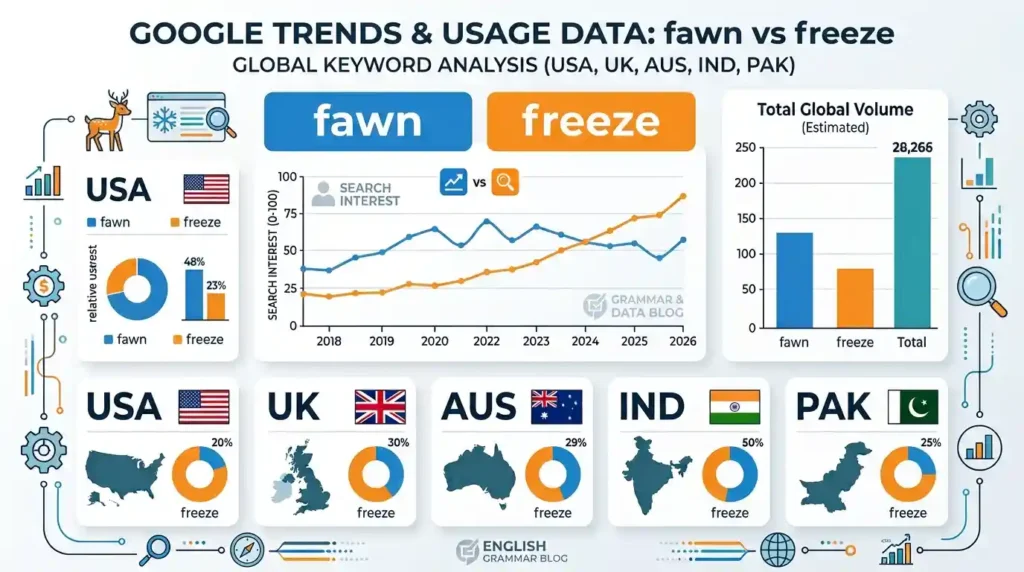
Search interest generally favors freeze because it has many everyday meanings and uses.
Fawn has narrower usage outside wildlife and social behavior contexts.
Usage varies by topic, with freeze appearing often in weather, technology, and everyday speech.
For content targeting broad searches, freeze usually offers wider topical coverage.
Keyword Variations Comparison
| Keyword Variation | Search Intent | Usage Scope |
|---|---|---|
| Fawn or Freeze | Comparison | Medium |
| Fawn vs Freeze | Comparison | Medium |
| Fawn meaning | Definition | Narrow |
| Freeze meaning | Definition | Broad |
| Difference between Fawn and Freeze | Educational | Medium |
| Fawn definition | Definition | Narrow |
| Freeze definition | Definition | Broad |
Final Verdict
Fawn and freeze are completely different words.
Use fawn for a young deer or excessive flattering behavior. Use freeze for becoming solid, stopping suddenly, or becoming unable to respond.
If you mean pleasing someone excessively, choose fawn.
If you mean stopping because of fear or cold, choose freeze.
FAQ’s
1. Is it correct to use “fawn” for stopping suddenly?
No. Use freeze when someone suddenly stops moving or responding.
2. What is the difference between fawn and freeze?
Fawn means a young deer or excessive flattering behavior. Freeze means stopping or becoming solid from cold.
3. Which is more common, fawn or freeze?
Freeze is more common in everyday English because it has many meanings.
4. Is fawn formal or informal?
Fawn is acceptable in formal writing. Its social meaning can sound critical or negative.
5. Why does confusion between fawn and freeze exist?
The words can describe reactions to stressful situations. Their meanings remain different, however.
Conclusion
Fawn or Freeze is an important word comparison for clear English writing. Fawn can describe a young deer or excessive flattering behavior. Freeze can describe becoming solid, stopping movement, or becoming unable to respond. These words should not replace each other. Remember the simple trick: fawn means flatter or young deer, while freeze means stop or become icy.
Context makes the correct choice easier. Use fawn when discussing submissive praise or wildlife. Use freeze when discussing cold, sudden stopping, or fear-based reactions. Learning this difference can improve your vocabulary and writing accuracy. Once you understand their meanings, choosing between fawn and freeze becomes simple.

Daniel Foster is a comparison analyst and content strategist at Comparelly.com. He specializes in researching products, services, tools, and industry trends to create clear, unbiased comparison guides. With a focus on accuracy and practical insights, Daniel helps readers understand key differences and make informed decisions with confidence. His goal is to simplify complex choices through trustworthy, easy-to-understand content.