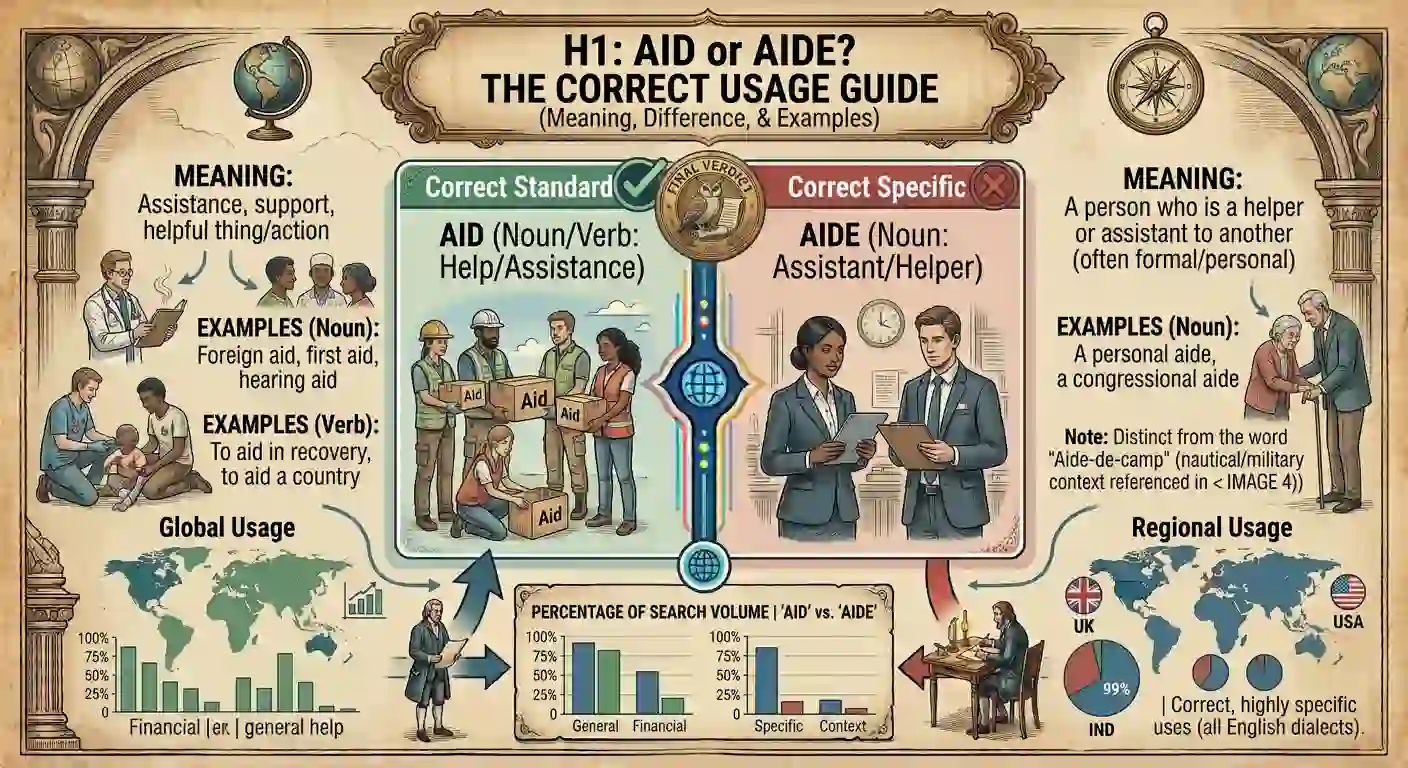
Aid Or Aide are two commonly confused English words. They sound the same but have different meanings and uses. Aid means help, support, assistance, or the act of helping. Aide means a person who helps another person. Both words are correct, but you cannot use them interchangeably. This small spelling difference can change the meaning of a sentence.
For example, “financial aid” means financial help. However, “the senator’s aide” means the senator’s assistant. Understanding this difference helps you write clearly and correctly. The words are especially easy to confuse because they are homophones. They share the same pronunciation in standard English. Their meanings, however, depend on context and grammar. This guide explains Aid Or Aide with simple definitions, examples, common mistakes, history, usage tips, and an easy memory trick.
Quick Answer (for Google snippet)
Aid means help, support, or assistance. Aide means a person who provides help or works as an assistant.
Example: The charity provided aid after the flood. The senator’s aide arranged the meeting.
Meaning of Aid
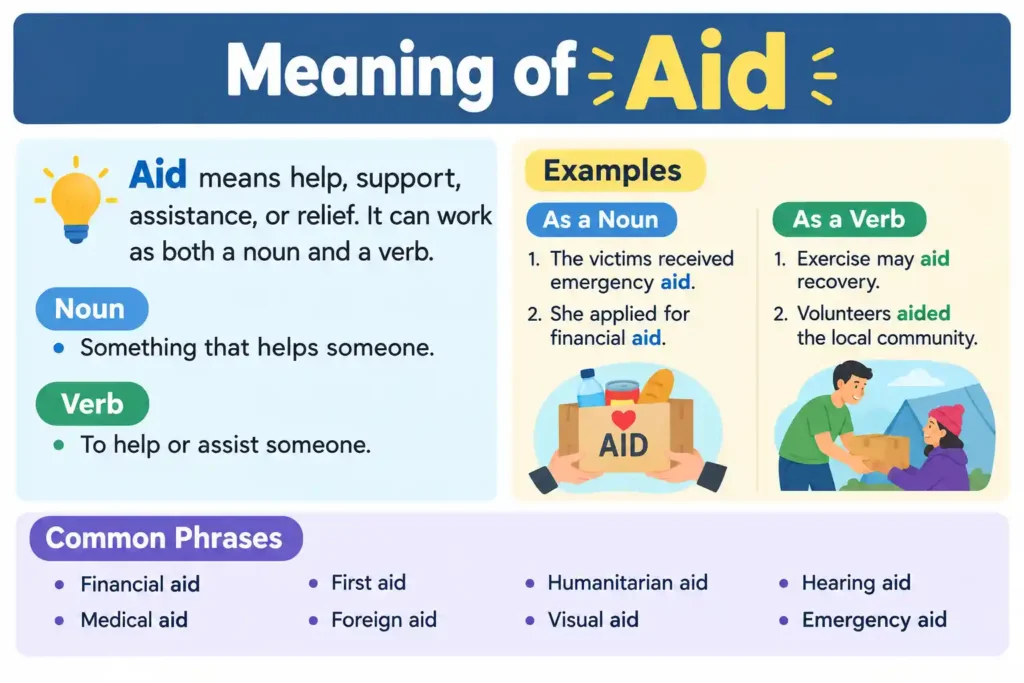
Aid means help, support, assistance, or relief. It can work as both a noun and a verb.
As a noun, aid means something that helps someone.
Examples:
- The victims received emergency aid.
- She applied for financial aid.
As a verb, aid means to help or assist.
Examples:
- Exercise may aid recovery.
- Volunteers aided the local community.
Common phrases include:
- Financial aid
- Medical aid
- First aid
- Foreign aid
- Humanitarian aid
- Visual aid
- Hearing aid
- Emergency aid
The word aid can describe help, resources, support, or the action of helping.
Meaning of Aide
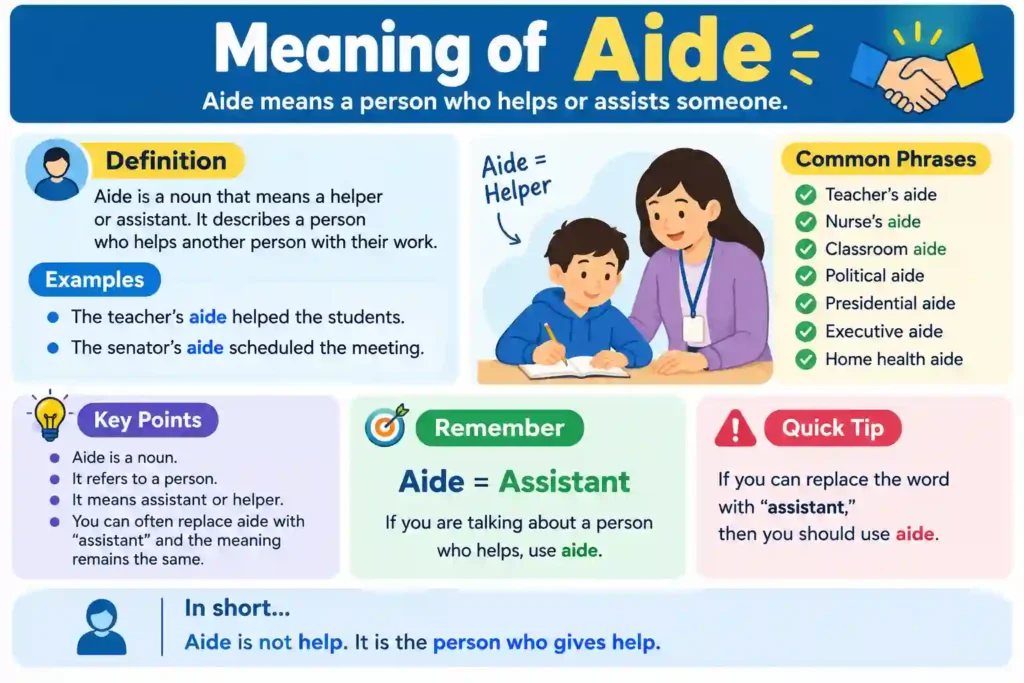
Aide is a noun that means a helper or assistant. It usually describes someone who helps another person with their work.
Examples:
- The teacher’s aide helped the students.
- The senator’s aide scheduled the meeting.
You can often replace aide with “assistant.”
For example:
- The president’s aide called the reporter.
- The president’s assistant called the reporter.
The meaning remains almost the same.
Common phrases include:
- Teacher’s aide
- Nurse’s aide
- Classroom aide
- Political aide
- Presidential aide
- Executive aide
- Home health aide
Unlike aid, the word aide refers to a person.
Key Differences Between Aid and Aide
| Feature | Aid | Aide |
|---|---|---|
| Meaning | Help or assistance | A person who helps |
| Part of speech | Noun and verb | Noun |
| Tone | Neutral to formal | Neutral to formal |
| Usage | Help, support, relief, assistance | Assistant or helper |
| Refers to a person? | Usually no | Yes |
| Example | We received medical aid. | The nurse’s aide helped us. |
| Popularity | Very common | Common in specific roles |
The simplest distinction is clear: aid is help, while an aide is a helper.
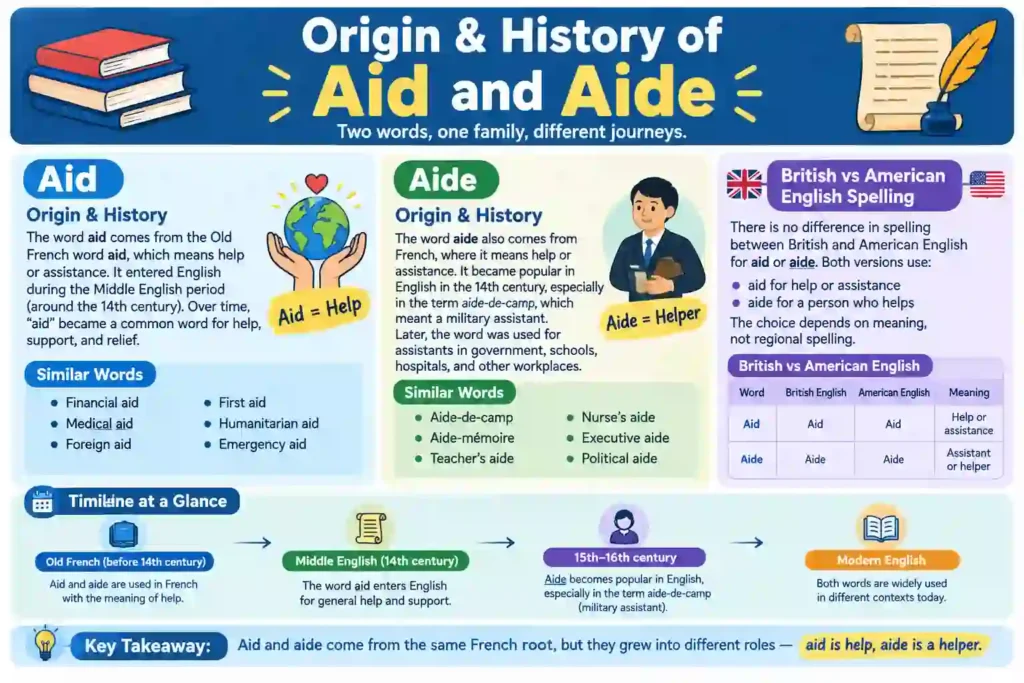
Origin & History of Aid and Aide
The history of aid and aide is connected to French.
The word aid developed from French forms related to help and assistance. English adopted the word during the Middle English period.
The spelling aide has a more specific history. It comes from French aide, meaning help or assistance. The spelling became especially associated with aide-de-camp, meaning a military assistant.
English later used aide for assistants in government, politics, schools, hospitals, and other workplaces.
Similar related expressions include:
- Aide-de-camp
- Aide-mémoire
- Financial aid
- Foreign aid
- Medical aid
- First aid
- Visual aid
Today, aid generally refers to help or assistance. Aide generally refers to a person who provides assistance.
🇬🇧 British English vs American English Spelling
There is no major spelling difference between British and American English for aid or aide.
Both varieties use aid for help and aide for an assistant.
The correct choice depends on meaning, not regional spelling.
British vs American English Comparison
| Word | British English | American English | Meaning |
|---|---|---|---|
| Aid | Aid | Aid | Help or assistance |
| Aide | Aide | Aide | Assistant or helper |
| Financial aid | Financial aid | Financial aid | Financial assistance |
| Teacher’s aide | Teacher’s aide | Teacher’s aide | Teaching assistant |
| Foreign aid | Foreign aid | Foreign aid | Assistance between countries |
When to Use Aid
Use aid when you mean help, assistance, support, or relief.
1. Use Aid as a Noun
Use aid when something provides help.
Examples:
- The country requested emergency aid.
- The student received financial aid.
- The hospital needs medical aid.
2. Use Aid as a Verb
Use aid when someone helps another person or group.
Examples:
- Volunteers aided the flood victims.
- This medicine may aid recovery.
- Good instructions can aid learning.
3. Use Aid for Helpful Tools
Use aid for something that helps people perform a task.
Examples:
- The teacher used a visual aid.
- He wears a hearing aid.
- The guide provides a useful learning aid.
4. Use Aid for Financial Support
Use aid for money or resources given to someone.
Examples:
- She received financial aid.
- The organization provides educational aid.
- The government offered disaster aid.
When to Use Aide
Use aide when you mean a person who assists someone.
1. Use Aide for a Personal Assistant
Example:
The executive’s aide arranged the appointments.
2. Use Aide for a Political Assistant
Example:
The senator’s aide answered questions from reporters.
3. Use Aide for a School Assistant
Example:
The classroom aide helped the teacher organize activities.
4. Use Aide for a Healthcare Assistant
Example:
The nurse’s aide helped prepare the patient’s room.
5. Use Aide for an Official Assistant
Example:
The governor’s aide prepared the documents.
A simple test works well here. If you can replace aide with assistant, the spelling is usually aide.
Common Mistakes With Aid and Aide
Mistake 1: Using Aide for Financial Help
❌ Incorrect: She applied for financial aide.
✅ Correct: She applied for financial aid.
Financial aid means financial assistance. It does not describe a person.
Mistake 2: Using Aid for a Person
❌ Incorrect: The senator’s aid called the reporter.
✅ Correct: The senator’s aide called the reporter.
The sentence refers to the senator’s assistant.
Mistake 3: Writing Visual Aide
❌ Incorrect: The teacher used a visual aide.
✅ Correct: The teacher used a visual aid.
A visual aid is a tool that helps people understand information.
Mistake 4: Writing Teacher’s Aid for a Person
❌ Incorrect: The teacher’s aid helped the children.
✅ Correct: The teacher’s aide helped the children.
The person working as an assistant is an aide.
Mistake 5: Using Aide as a Verb
❌ Incorrect: The volunteers will aide the victims.
✅ Correct: The volunteers will aid the victims.
Aid can function as a verb. Aide is normally a noun.
Easy Trick to Remember Aid or Aide
Use this simple memory trick:
Aid = Assistance
Aide = Assistant
Think of the extra e in aide as pointing to a person who works as an employee.
Ask yourself:
“Am I talking about help or a helper?”
If you mean help, choose aid.
If you mean a helper, choose aide.
Quick Memory Examples
- Financial aid = financial help
- Medical aid = medical help
- Visual aid = helpful tool
- Teacher’s aide = teacher’s assistant
- Senator’s aide = senator’s assistant
This rule covers most everyday situations.
Everyday Life Examples of Aid or Aide
1. School Example
The teacher used a visual aid during the lesson.
Here, aid means a helpful learning tool.
Primary keyword: Aid
Secondary keyword: Aide
2. Workplace Example
The manager’s aide organized the meeting schedule.
Here, aide means an assistant.
Primary keyword: Aide
Secondary keyword: Aid
3. Medical Example
The patient received first aid after the accident.
Here, aid means emergency medical help.
Primary keyword: Aid
Secondary keyword: Aide
4. Government Example
The minister’s aide prepared the official documents.
Here, aide means an assistant.
Primary keyword: Aide
Secondary keyword: Aid
5. Charity Example
The organization provided food aid after the earthquake.
Here, aid means supplies or assistance.
Primary keyword: Aid
Secondary keyword: Aide
Related Keywords
Use these related keywords naturally throughout your article:
- Aid or Aide difference
- Aid vs Aide
- Aide or Aid
- Meaning of aid
- Meaning of aide
- Aid and aide examples
- How to use aid and aide
Final Verdict: Aid or Aide?
Both aid and aide are correct words. They simply have different meanings.
Use aid when you mean help, support, assistance, relief, or the act of helping.
Use aide when you mean a person who works as an assistant or helper.
Remember this simple rule:
Aid = help.
Aide = helper.
For example, financial aid means financial help. The teacher’s aide means the teacher’s assistant.
The extra e changes the meaning, so context matters.
Google Trends & Usage Data
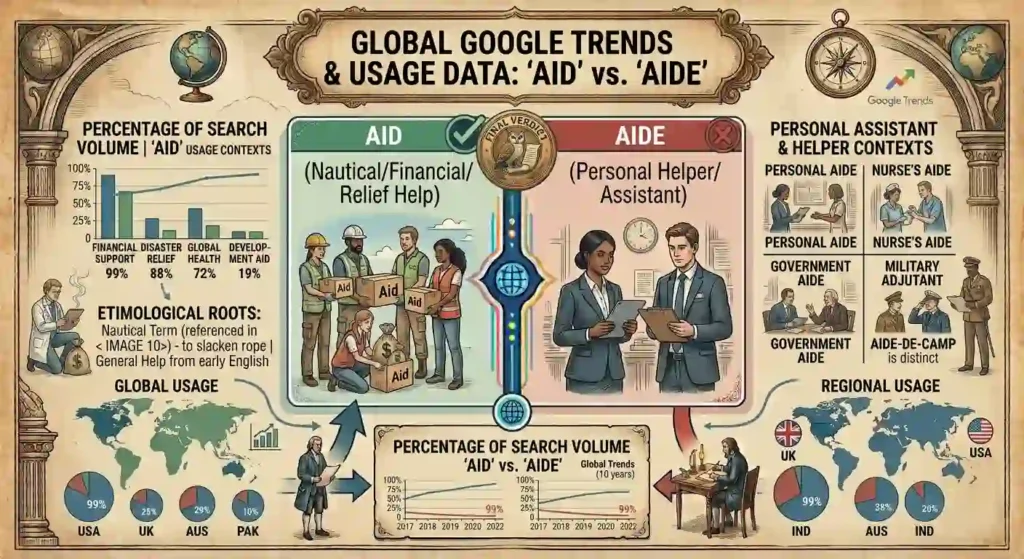
Google Trends comparisons should use the same country, date range, search type, and category. Exact trend values can also change over time. Aid has a much broader meaning, including financial, medical, foreign, emergency, and humanitarian assistance. Aide has a narrower meaning focused mainly on assistants. Therefore, direct search-interest comparisons can be misleading.
| Country | Aid | Aide | Main Insight |
|---|---|---|---|
| 🇺🇸 USA | Broad usage | Niche usage | Aid has wider meanings |
| 🇬🇧 UK | Broad usage | Role-specific | Both are established |
| 🇦🇺 Australia | Broad usage | Role-specific | Meaning determines choice |
| 🇮🇳 India | Broad usage | More limited | Aid appears across many contexts |
| 🇵🇰 Pakistan | Broad usage | More limited | Aid is common in support-related contexts |
Comparison Table: Keyword Variations
| Keyword | Meaning | Correct Use |
|---|---|---|
| Aid | Help or assistance | Financial aid |
| Aide | Person who helps | Teacher’s aide |
| Aid vs Aide | Comparison | Grammar searches |
| Aide vs Aid | Comparison | Spelling searches |
| Financial aid | Financial assistance | College support |
| Teacher’s aide | Teaching assistant | School setting |
| Medical aid | Medical help | Healthcare setting |
Usage insight: Aid has broader everyday and institutional uses. Aide appears more often in specific job and assistant roles.
FAQ’s: Aid Or Aide
1. Is “aid” correct?
Yes. Aid is correct when you mean help, assistance, support, or the act of helping.
Example: The charity provided aid to the victims.
2. What is the difference between aid and aide?
Aid means help or assistance. Aide means a person who provides assistance.
Example: We received medical aid. The nurse’s aide helped us.
3. Which is more common, aid or aide?
Aid is generally more widely used because it has several meanings and grammatical uses. Aide has a narrower meaning.
4. Is aide formal?
Aide can sound formal, especially in government, politics, business, and official settings.
For example, “presidential aide” is a common formal expression.
5. Why do aid and aide cause confusion?
They cause confusion because they sound the same and look almost identical.
Their meanings are also closely related. Aid means help, while aide means a person who helps.
Conclusion
Aid Or Aide are both correct English words, but they serve different purposes. Aid means help, assistance, support, relief, or the act of helping. It can work as both a noun and a verb. Aide is a noun that means an assistant or helper. The easiest way to remember the difference is simple: aid is help, while an aide is a helper.
Use financial aid, medical aid, and first aid when describing assistance. Use teacher’s aide, senator’s aide, and nurse’s aide when describing people. These words sound the same, which creates confusion. However, their meanings make the correct choice easy. Always consider whether your sentence describes help or a person who helps.

Daniel Foster is a comparison analyst and content strategist at Comparelly.com. He specializes in researching products, services, tools, and industry trends to create clear, unbiased comparison guides. With a focus on accuracy and practical insights, Daniel helps readers understand key differences and make informed decisions with confidence. His goal is to simplify complex choices through trustworthy, easy-to-understand content.