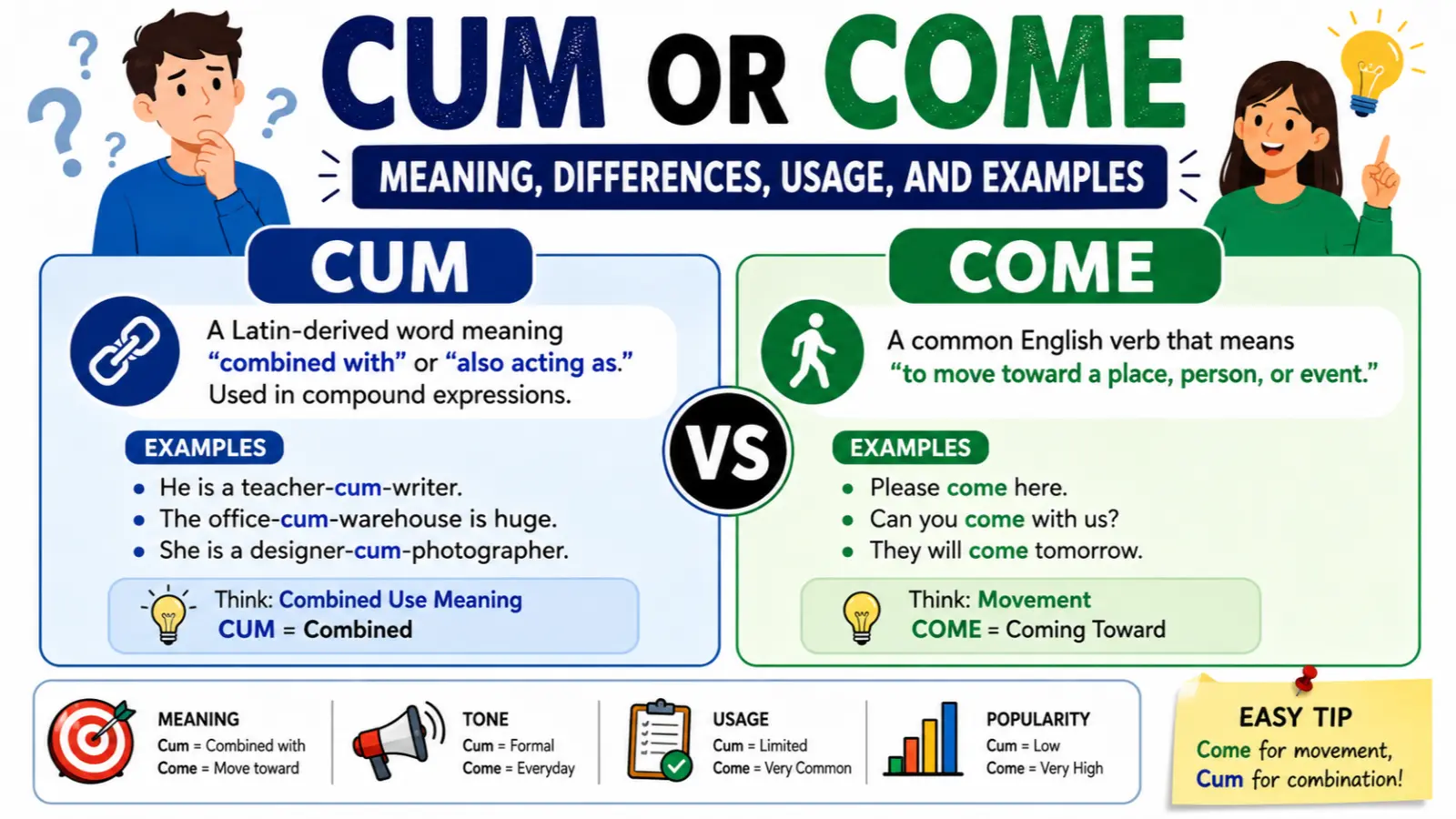
Cum Or Come is a common word comparison that confuses many English learners and writers. These two words look similar, but they have very different meanings and uses.
The confusion often happens because cum is sometimes used as an alternative spelling of come in specific contexts. However, the meanings are not always the same. In everyday English, come is the standard and widely accepted word.
Cum appears in special situations, including formal compound terms and certain slang usage. Understanding the difference helps you avoid mistakes and communicate clearly in both casual and professional writing.
Quick Answer
Come is the standard English word that means to move toward someone or something. Cum is a less common word used in specific formal expressions and as a slang spelling in some contexts.
Example:
- Correct: Please come here.
- Correct: She works as a teacher-cum-writer.
Meaning of Cum
Cum has two main meanings:
- A Latin-derived word meaning “combined with” or “also acting as.”
- A slang spelling sometimes used in informal contexts.
Examples
- He is a singer-cum-actor.
- The kitchen-cum-dining room looks spacious.
More Examples
- She is a designer-cum-photographer.
- They bought a shop-cum-office building.
Meaning of Come
Come is a common English verb that means to move toward a place, person, or event.
Examples
- Please come to my house tomorrow.
- Can you come with us?
More Examples
- She will come after work.
- They come here every weekend.
Key Differences Between Cum and Come

| Feature | Cum | Come |
|---|---|---|
| Meaning | Combined with; also acting as | Move toward a place or person |
| Word Type | Preposition or modifier | Verb |
| Tone | Formal or specialized | Standard everyday English |
| Usage | Limited and specific | Very common |
| Popularity | Low | Very high |
Origin and History
Cum
The word cum comes from Latin and means “with” or “combined with.” English adopted it for compound descriptions.
Examples:
- Teacher-cum-writer
- Office-cum-warehouse
- Bedroom-cum-study
Come
The word come comes from Old English cuman. It has been used for centuries as a basic verb of movement.
Similar words:
- Go
- Arrive
- Approach
- Return
British English vs American English Spelling
There is no spelling difference between British and American English for come. Both countries use come as the standard form.
The word cum is also recognized in both varieties of English, but it appears mostly in formal compounds and specialized writing.

Comparison Table
| Usage | British English | American English |
|---|---|---|
| Come | Very common | Very common |
| Cum in compounds | Common in formal writing | Less common but accepted |
| Everyday use | Come | Come |
| Preferred standard word | Come | Com |
When to Use Each Word
Use “Cum” When
Use cum when describing something that combines two roles, functions, or purposes.
Examples:
- He is a lawyer-cum-politician.
- They built a garage-cum-workshop.
- She is an artist-cum-author.
Use “Come” When
Use come when talking about movement, arrival, invitations, or events.
Examples:
- Come and sit down.
- Please come early.
- They will come tomorrow.
Common Mistakes
Mistake 1
❌ Please cum here.
✅ Please come here.
Mistake 2
❌ I will cum tomorrow.
✅ I will come tomorrow.
Mistake 3
❌ He is a teacher come writer.
✅ He is a teacher-cum-writer.
Mistake 4
❌ Come office building.
✅ Office-cum-building.
Easy Trick to Remember
- Come = Movement. Think of someone coming toward you.
- Cum = Combined. Think of two roles combined into one.
Memory Tip:
CUM = Combined Use Meaning
Write 5 Examples
1 Example 1: School
- Our teacher-cum-coach organized the event.
- Please come to the school meeting.
2 Example 2: Workplace
- She works in an office-cum-showroom.
- Come to the office before noon.
3 Example 3: Home
- They built a kitchen-cum-dining room.
- Come inside and have a seat.
4 Example 4: Events
- He is a host-cum-performer.
- Come to the concert tonight.
5 Example 5: Business
- They opened a shop-cum-cafe.
- Customers come here daily.
Related Keywords
- cum meaning
- come meaning
- cum vs come
- difference between cum and come
- teacher cum writer meaning
- come definition
- English word comparison
Google Trends & Usage Data
USA
Come dominates search volume and everyday usage. Cum receives searches mainly for meaning clarification and slang-related queries.
UK
The UK shows regular use of cum in compound expressions such as teacher-cum-author. Come remains far more common.
Australia
Australian English follows a pattern similar to the UK. Come is dominant, while cum appears in formal descriptions.
India
Searches for cum vs come are common because many learners want to understand the difference. Come is heavily used.
Pakistan
English learners frequently search this comparison. Come is the preferred standard word in education and professional writing.
Usage Insight
Across all five countries, come is significantly more popular than cum. Most searches involving cum are related to meaning, grammar, or word confusion.
Comparison Table: Keyword Variations
| Keyword Variation | Search Intent |
|---|---|
| cum or come | Comparison |
| cum vs come | Difference |
| meaning of cum | Definition |
| meaning of come | Definition |
| teacher cum writer meaning | Usage |
| come definition | Grammar |
| difference between cum and come | Educational |
Frequently Asked Questions
Is “cum” correct?
Yes. It is correct when used to mean “combined with” or “also acting as.”
What is the difference between cum and come?
Come is a verb showing movement. Cum usually means combined roles or functions.
Which is more common?
Come is much more common in everyday English.
Which word is suitable for formal writing?
Come is suitable in most writing. Cum is acceptable in formal compound expressions.
Why does the confusion exist?
The words look similar, and some people encounter cum without knowing its specialized meaning.
Final Verdict
If you are talking about movement, arrival, or invitations, always use come.
Use cum only when describing something that combines two roles, functions, or purposes, such as teacher-cum-writer or office-cum-warehouse.
For most everyday situations, come is the correct and preferred word
Conclusion
Cum Or Come is an important English word comparison because the two terms serve different purposes. Come is a common verb used to describe movement, arrival, or joining someone somewhere. It is the standard choice in everyday conversation, business communication, and academic writing.
Cum, on the other hand, is a specialized word that means “combined with” or “also acting as.” It is mainly used in compound expressions such as teacher-cum-author or shop-cum-cafe. While both words are correct in the right context, they should not be used interchangeably. Understanding their meanings, history, and proper usage will help you write more accurately and confidently.

Daniel Foster is a comparison analyst and content strategist at Comparelly.com. He specializes in researching products, services, tools, and industry trends to create clear, unbiased comparison guides. With a focus on accuracy and practical insights, Daniel helps readers understand key differences and make informed decisions with confidence. His goal is to simplify complex choices through trustworthy, easy-to-understand content.