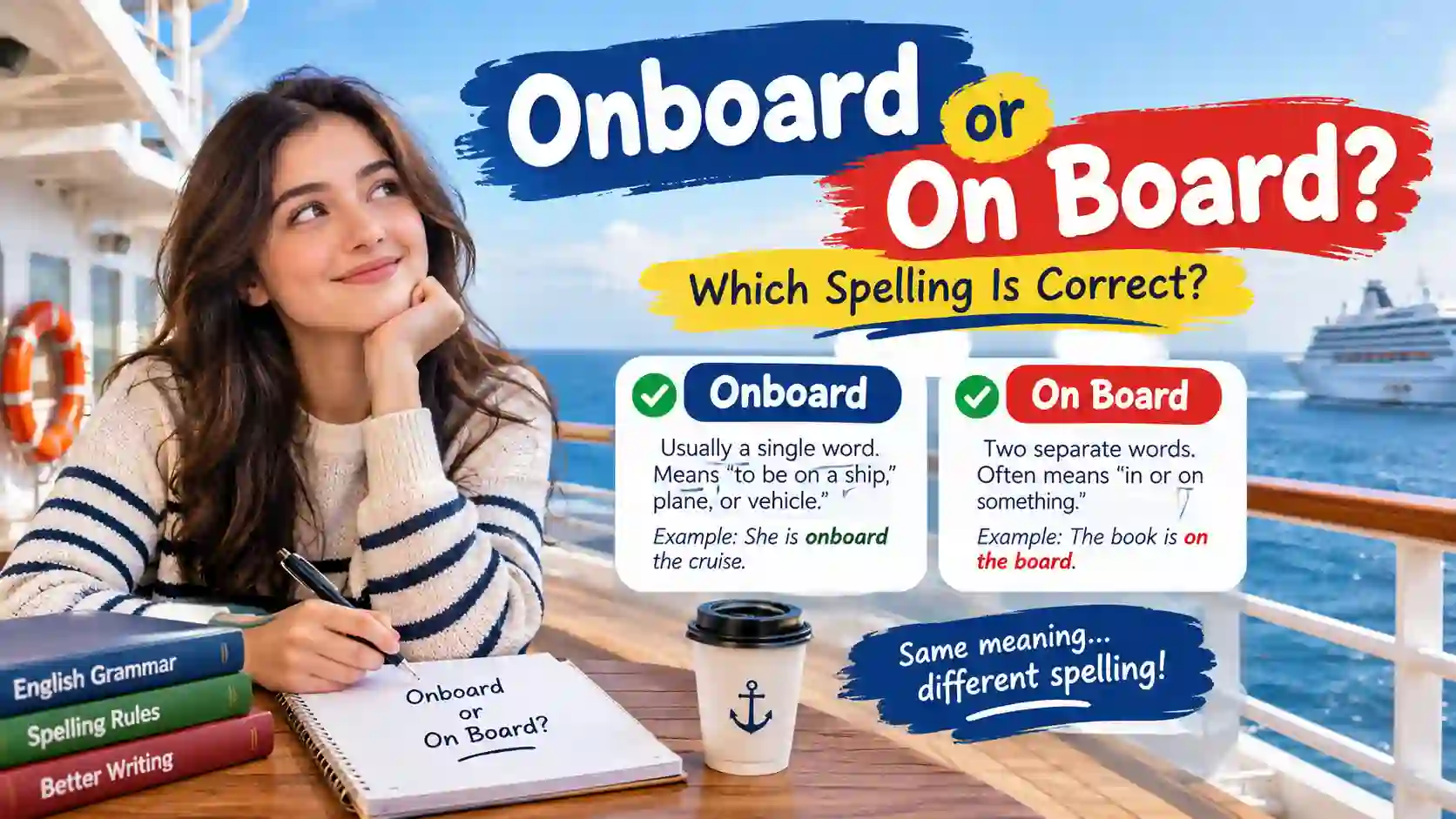
Onboard or on board is a spelling question that confuses millions of writers every day. Both forms sound the same when you say them out loud. Both appear in emails, job posts, and travel documents. But they are not always interchangeable.
One is a single word. The other is two words. The rule depends on how you use them in a sentence. This guide explains the difference in plain English. You will learn when to write “onboard” and when to write “on board.” You will also see real examples, common mistakes, and a memory trick that sticks.
⭐ Quick Answer
Use “onboard” as one word when it means to join a team, train a new hire, or integrate something. Use “on board” as two words when it means physically on a ship, plane, or vehicle.
Example: “We will onboard the new manager next week.” vs. “All passengers are now on board the plane.”
📖 Meaning Section
What Does “Onboard” Mean?
“Onboard” is one word. It works as a verb or an adjective. As a verb, it means to bring a new person into a team or system. As an adjective, it describes something built into a device or plan.
Examples:
- “The company will onboard ten new staff members this month.”
- “The onboard computer controls the car’s navigation.”
What Does “On Board” Mean?
“On board” is two words. It means physically located on a ship, plane, train, or other vehicle. It can also mean agreeing with a plan or idea.
Examples:
- “The captain welcomed everyone on board the ship.”
- “The whole team is on board with the new strategy.”
📊 Key Differences Table
| Feature | Onboard | On Board |
|---|---|---|
| Meaning | To integrate a person or thing | Physically on a vehicle or in agreement |
| Tone | Professional, corporate | Neutral, literal |
| Usage | Verb or adjective | Prepositional phrase |
| Popularity | Rising in business writing | Stable across all writing |
📜 Origin & History
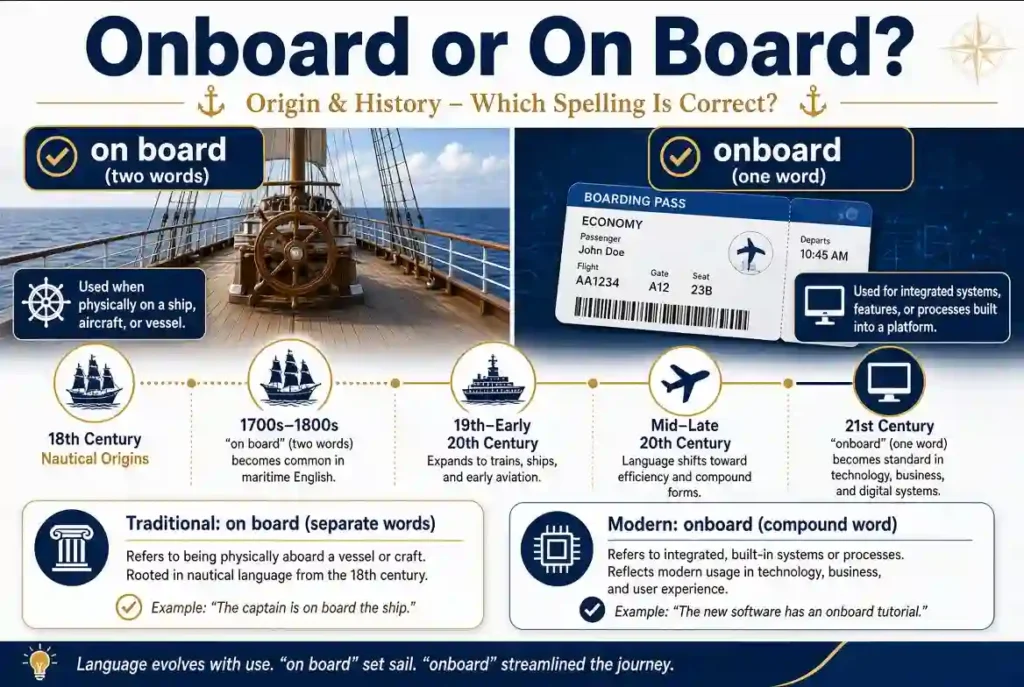
Both forms come from nautical language. Sailors said “on board” to mean being on a ship. The phrase dates back to the 1500s. Over time, businesses borrowed the word. They turned it into a verb meaning to bring someone into a company. This is how “onboard” became one word.
Similar word examples:
- Any more / anymore
- Every day / everyday
- Some time / sometime
🇬🇧 British English vs American English Spelling
British and American English treat “onboard” and “on board” the same way. Both use “onboard” as a verb. Both use “on board” for physical location. No spelling difference exists between the two regions.
| Context | British English | American English |
|---|---|---|
| Verb (to hire/train) | Onboard | Onboard |
| Physical location | On board | On board |
| Agreement | On board | On board |
| Adjective (built-in) | Onboard | Onboard |
📝 When to Use Each Word
When to Use “Onboard”
Use “onboard” as one word when you talk about hiring or training. Use it in business and HR contexts.
Examples:
- “We need to onboard the new developer by Friday.”
- “The onboard camera captured the whole event.”
When to Use “On Board”
Use “on board” as two words when you mean physically on a vehicle. Use it when you mean agreeing with something.
Examples:
- “Please keep your bags with you while on board.”
- “The manager is on board with the budget plan.”
❌ Common Mistakes
Using “on board” as a verb.
- ❌ Incorrect: “We will on board the new hire tomorrow.”
- ✅ Correct: “We will onboard the new hire tomorrow.”
Using “onboard” for physical location.
- ❌ Incorrect: “The passengers are onboard the plane.”
- ✅ Correct: “The passengers are on board the plane.”
Mixing up the agreement meaning.
- ❌ Incorrect: “She is onboard with the idea.”
- ✅ Correct: “She is on board with the idea.”
Using “onboard” as a noun.
- ❌ Incorrect: “The onboard was smooth.”
- ✅ Correct: “The onboarding process was smooth.”
💡 Easy Trick to Remember
“One word for work. Two words for travel.”
If you are hiring or training someone, use onboard (one word). If you are talking about a ship, plane, or agreement, use on board (two words).
🏠 Everyday Life Examples
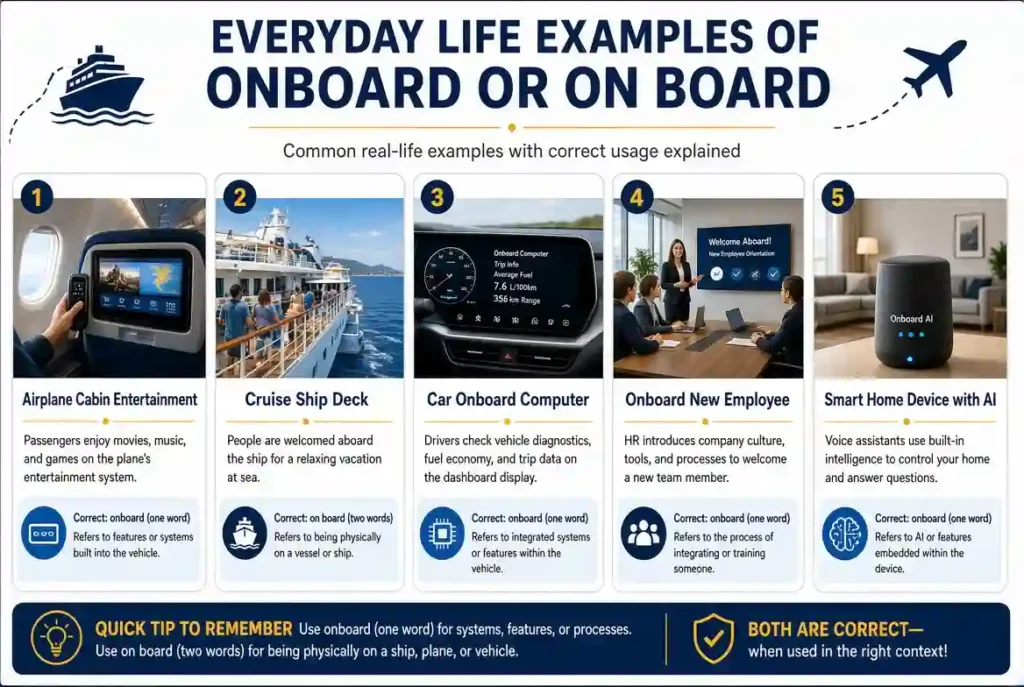
1. At Work
Primary keyword usage: “HR will onboard or on board the new staff next Monday.”
Secondary keyword usage: “The onboarding session starts at 9 AM.”
2. At the Airport
Primary keyword usage: “Please check if you are onboard or on board before the gate closes.”
Secondary keyword usage: “All passengers must be on board 30 minutes before takeoff.”
3. In a Meeting
Primary keyword usage: “The director asked if the team was onboard or on board with the plan.”
Secondary keyword usage: “Everyone is on board with the new timeline.”
4. On a Cruise
Primary keyword usage: “Guests often ask if they are onboard or on board the ship.”
Secondary keyword usage: “Dinner is served while you are on board.”
5. In an Email
Primary keyword usage: “Let me know if you are onboard or on board with this change.”
Secondary keyword usage: “We will onboard three interns next week.”
🔗 Related Keywords
- Onboard vs on board
- Onboarding meaning
- On board definition
- Onboard new employee
- On board the ship
- Onboarding process
- Onboard computer
📈 Google Trends & Usage Data (USA, UK, AUS, IND, PAK)
Searches for “onboard or on board” rise steadily in all five countries. The USA and UK show the highest volume overall. India and Pakistan show growing interest due to remote hiring trends. Australia follows closely behind the UK. Business and HR contexts drive most searches.
Insight: Search interest grows as remote work expands. More people write onboarding emails today than ever before. This makes the spelling rule more important than ever.
Comparison Table: Keyword Variations
| Keyword Variation | Search Intent | Best For |
|---|---|---|
| Onboard or on board | Comparison | Featured snippets, guides |
| Onboard vs on board | Comparison | Tables, quick answers |
| On board meaning | Definition | Informational content |
| Onboarding definition | Definition | HR content |
| Onboard new employee | How-to | Business guides |
| On board the plane | Usage | Travel content |
| Onboard computer meaning | Definition | Tech content |
❓ FAQ Section
Is it correct to say “onboard or on board”?
Yes. Both forms are correct. The right choice depends on your meaning.
What is the difference between onboard and on board?
“Onboard” is one word for hiring or training. “On board” is two words for physical location or agreement.
Which is more common?
“On board” is more common overall. “Onboard” is more common in business writing.
Can I use “onboard” in formal writing?
Yes. “Onboard” is standard in formal business and HR writing.
Why does confusion exist between onboard and on board?
Both sound identical when spoken. This makes it hard to know which form to write.
🎯 Final Verdict
Neither form is better. They serve different purposes. Use “onboard” (one word) as a verb for hiring, training, or integrating. Use “on board” (two words) for physical location on a vehicle or for agreement. The key test: if you can replace it with “hire” or “train,” use one word. If you can replace it with “aboard” or “agreeing,” use two words.
✅ Conclusion
The onboard or on board debate comes down to one simple rule. One word means to hire or train. Two words mean physically on a vehicle or in agreement. Use “onboard” in HR and business writing. Use “on board” in travel and casual contexts.
Remember the trick: “One word for work. Two words for travel.” This simple rule will keep your writing clean and correct. Bookmark this guide for the next time you write an onboarding email or a travel update.

Daniel Foster is a comparison analyst and content strategist at Comparelly.com. He specializes in researching products, services, tools, and industry trends to create clear, unbiased comparison guides. With a focus on accuracy and practical insights, Daniel helps readers understand key differences and make informed decisions with confidence. His goal is to simplify complex choices through trustworthy, easy-to-understand content.