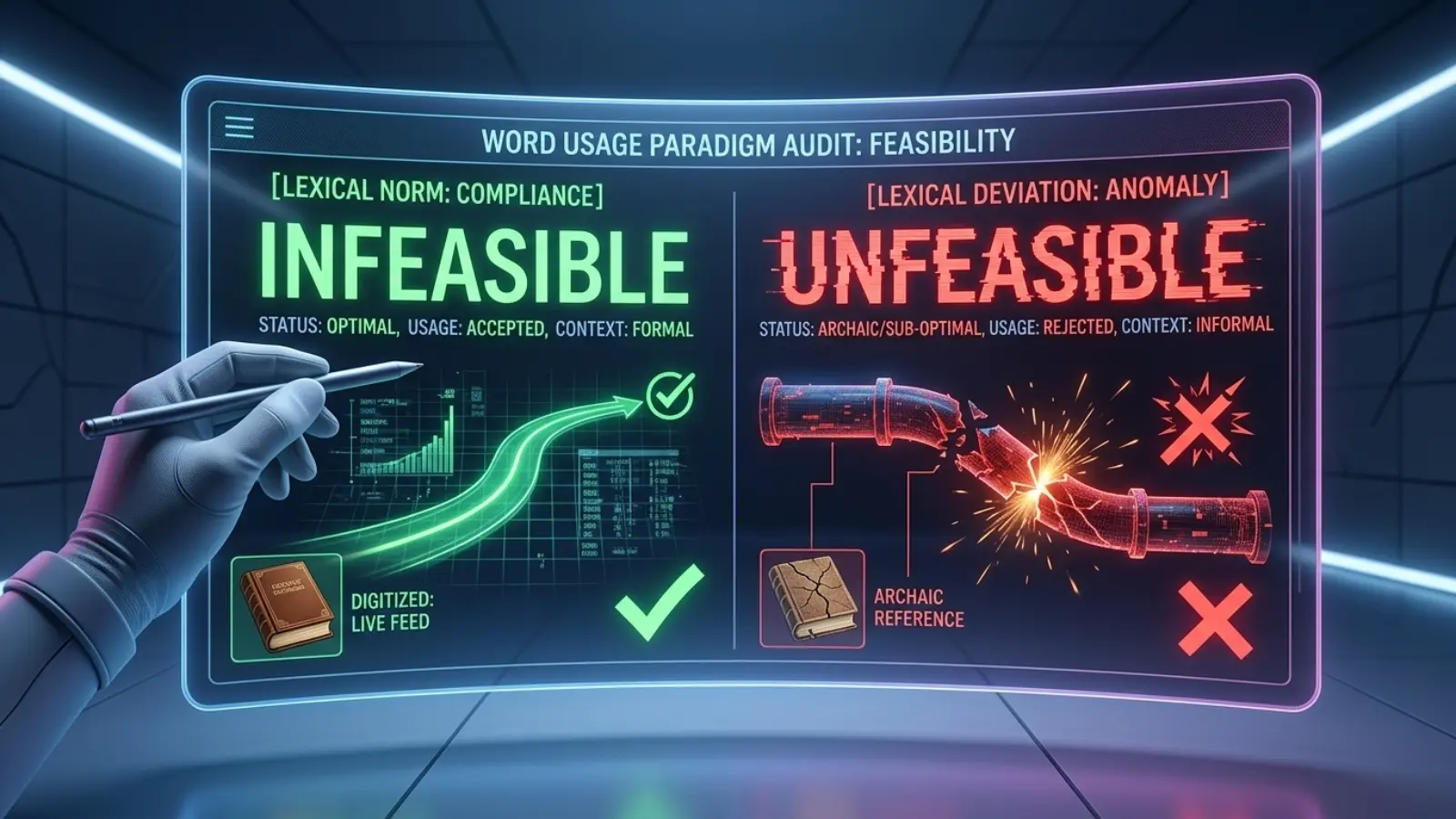
Unfeasible or infeasible is a common word-choice question in English. Both words mean that something cannot work or cannot be achieved. However, infeasible is the more common and widely accepted choice in modern English. It appears often in business, science, engineering, planning, and formal writing.
Unfeasible is also a real word. However, it is much less common than infeasible. Many writers prefer “infeasible” because it sounds more natural and established.
Both words describe an idea, plan, task, or proposal that is not practical or possible. The main difference is usage and frequency.
For most situations, choose infeasible. It works well in both American and British English. Understanding this difference can help you avoid awkward word choices. It can also make your writing sound clearer and more professional.
Quick Answer (for Google snippet)
Infeasible is the preferred and more common word. It means impossible or impractical to achieve. Unfeasible has the same basic meaning but is much less common.
Example:
“Building a bridge here would be infeasible because the ground is unstable.”
Meaning of Unfeasible
Unfeasible means something is not practical, possible, or achievable.
It uses the prefix un- to create the opposite of “feasible.” However, native English speakers usually prefer infeasible.
Examples of Unfeasible
- “The proposed schedule is unfeasible for the small team.”
- “The plan became unfeasible after the costs increased.”
These sentences are understandable. However, infeasible would sound more natural to most readers.
Meaning of Infeasible
Infeasible means impossible or impractical to accomplish under given conditions.
It often describes plans, projects, solutions, designs, or ideas that cannot realistically work.
Examples of Infeasible
- “The original construction plan was infeasible.”
- “Flying to every city in one day is infeasible.”
Infeasible is the stronger choice for formal and professional writing.
Key Differences: Unfeasible vs Infeasible
| Feature | Unfeasible | Infeasible |
|---|---|---|
| Meaning | Not feasible | Not feasible |
| Tone | Understandable but less natural | Natural and professional |
| Usage | Less common | More common |
| Popularity | Relatively uncommon | Widely used |
| Formal writing | Acceptable but unusual | Preferred |
| Business writing | Less preferred | Recommended |
| Academic writing | Less common | Common |
| Everyday writing | Rare | More natural |
Origin & History
The word feasible comes from French and ultimately relates to the Latin verb facere, meaning “to make” or “to do.”
English developed infeasible by adding the negative prefix in- to “feasible.” This form became established in formal English.
Unfeasible also follows a normal English pattern. English often uses un- to create opposites.
However, English does not always use prefixes in predictable ways. Some negative forms become more common than others.
Similar Word Examples
You can see similar patterns in these words:
- feasible → infeasible
- possible → impossible
- practical → impractical
- logical → illogical
- legal → illegal
- regular → irregular
- responsible → irresponsible
For “feasible,” infeasible is the standard choice in most professional contexts.
🇬🇧 British English vs 🇺🇸 American English Spelling
British and American English both recognize infeasible.
There is no major spelling difference between the two varieties.
Infeasible remains the safer choice in both British and American writing.
British vs American English Comparison
| Feature | British English | American English |
|---|---|---|
| Preferred word | Infeasible | Infeasible |
| Unfeasible | Possible but uncommon | Possible but uncommon |
| Meaning | Not practical or possible | Not practical or possible |
| Formal usage | Infeasible preferred | Infeasible preferred |
| Spelling difference | None | None |
When to Use Unfeasible
Use unfeasible when you specifically want to describe something as not feasible.
However, it is usually better to replace it with infeasible.
Examples
- “The deadline is unfeasible for our team.”
- “That proposal seems unfeasible at this stage.”
- “The original design became unfeasible.”
- “The travel plan is unfeasible without additional funding.”
These sentences are understandable. Yet infeasible would usually sound more polished.
Better Alternatives
Instead of:
“The project is unfeasible.”
Write:
“The project is infeasible.”
Instead of:
“The schedule seems unfeasible.”
Write:
“The schedule seems infeasible.”
When to Use Infeasible
Use infeasible when something cannot realistically be completed or achieved.
It works especially well in formal and professional writing.
Examples
- “The proposed solution is infeasible.”
- “The budget makes the project infeasible.”
- “The timeline is infeasible.”
- “Engineers considered the design infeasible.”
- “The company rejected the infeasible proposal.”
Common Areas of Use
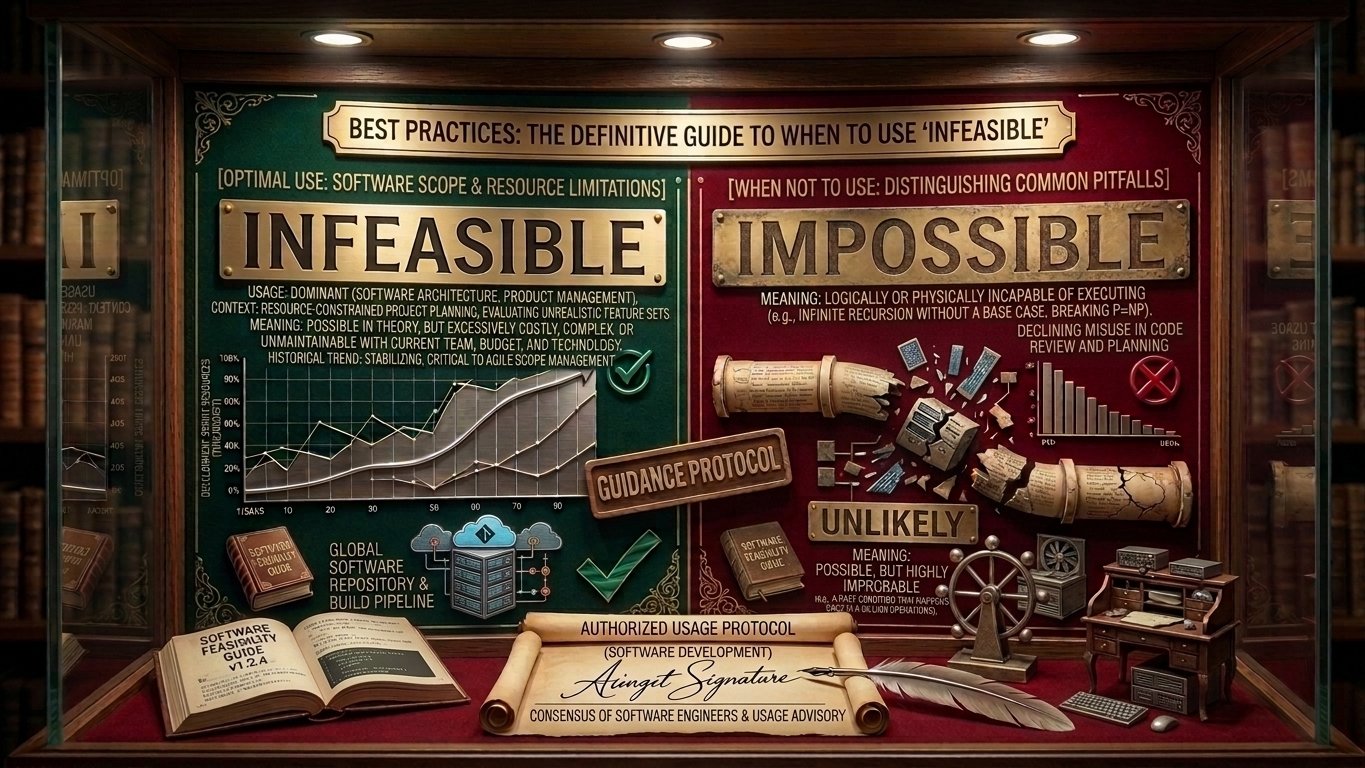
Infeasible commonly appears in:
- Business plans
- Engineering reports
- Academic papers
- Financial analysis
- Project management
- Scientific research
- Government planning
- Technology discussions
Common Mistakes
Mistake 1: Using “unfeasible” in formal writing
❌ “The proposed project is unfeasible.”
✅ “The proposed project is infeasible.”
Why?
“Infeasible” is more established in formal English.
Mistake 2: Treating both words as equally common
❌ “Unfeasible and infeasible are equally popular.”
✅ “Infeasible is much more common.”
Why?
“Infeasible” appears more frequently across professional writing.
Mistake 3: Using “infeasible” to mean simply difficult
❌ “The assignment is infeasible because it takes two hours.”
✅ “The assignment is difficult because it takes two hours.”
Why?
“Infeasible” suggests something cannot realistically be done.
Mistake 4: Confusing “infeasible” with “unnecessary”
❌ “The meeting is infeasible because we do not need it.”
✅ “The meeting is unnecessary because we do not need it.”
Why?
“Infeasible” means impractical or impossible, not unwanted.
Mistake 5: Using “unfeasible” when “impossible” is clearer
❌ “It is unfeasible to breathe underwater without equipment.”
✅ “It is impossible to breathe underwater without equipment.”
Why?
“Impossible” is clearer when something cannot happen at all.
Easy Trick to Remember
Remember this simple rule:
Feasible = possible or practical.
Infeasible = not possible or practical.
Think:
FEASIBLE → INFEASIBLE
When you are unsure, choose infeasible.
A quick memory sentence is:
“If a plan cannot work, it is infeasible.”
This trick works well for business, school, work, and everyday writing.
Everyday Life Examples
1. Travel Plans
Suppose someone wants to visit ten countries in one day.
Primary keyword: infeasible
Secondary keyword: unfeasible
“Visiting ten countries in one day is infeasible.”
You could also say:
“Visiting ten countries in one day is unfeasible.”
However, infeasible sounds more natural.
2. Work Deadlines
A manager gives a team one hour to complete a week-long project.
“The deadline is infeasible for the team.”
The word explains that the deadline cannot realistically be met.
3. Business Plans
A company plans to open 100 stores without enough money.
“The expansion plan is infeasible without additional funding.”
This usage suits business and financial writing.
4. Engineering Projects
An engineer discovers that a proposed structure cannot support its weight.
“The original design is infeasible.”
This is a common professional use of the word.
5. Personal Goals
Someone wants to learn five languages in one month.
“Learning five languages in one month is infeasible.”
The goal may be unrealistic under normal conditions.
Related Keywords
Here are useful keyword variations related to Unfeasible Or Infeasible:
- unfeasible vs infeasible
- infeasible meaning
- unfeasible meaning
- is unfeasible a word
- is infeasible a word
- infeasible definition
- unfeasible definition
Google Trends & Usage Insight
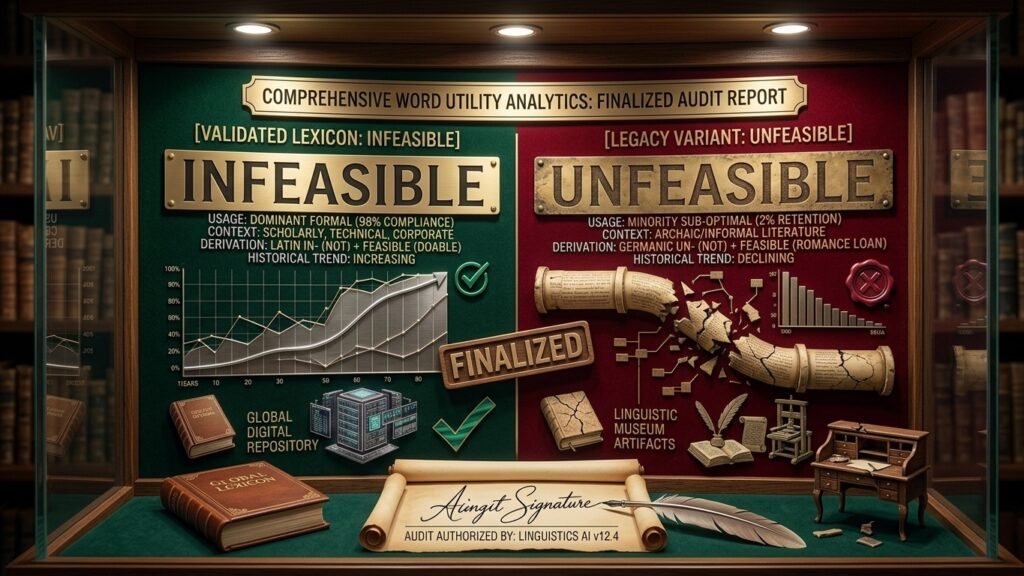
Exact Google Trends values can change by date, location, and search category. The broad usage pattern favors infeasible over unfeasible.
Across the USA, UK, Australia, India, and Pakistan, “infeasible” is the stronger standard form. “Unfeasible” appears far less often in professional English.
Search interest for both terms is relatively niche because people often search broader phrases such as “infeasible meaning” or “infeasible definition.”
Country Comparison
| Country | More Standard Term | Usage Insight |
|---|---|---|
| 🇺🇸 USA | Infeasible | Common in technical and business contexts |
| 🇬🇧 UK | Infeasible | Preferred in formal writing |
| 🇦🇺 Australia | Infeasible | Standard professional choice |
| 🇮🇳 India | Infeasible | Common in academic and technical English |
| 🇵🇰 Pakistan | Infeasible | Common in formal and educational English |
🔍 Keyword Variations Comparison
| Keyword Variation | Search Intent | Recommended Term |
|---|---|---|
| Unfeasible Or Infeasible | Spelling and comparison | Infeasible |
| Unfeasible vs Infeasible | Comparison | Infeasible |
| Infeasible Meaning | Definition | Infeasible |
| Unfeasible Meaning | Definition | Infeasible |
| Is Unfeasible a Word | Spelling | Infeasible preferred |
| Is Infeasible a Word | Definition | Infeasible |
| Infeasible Definition | Informational | Infeasible |
Conclusion
The choice between unfeasible or infeasible can confuse many English learners. Both words communicate the idea of something that cannot work or succeed. However, infeasible is the stronger choice in modern English.
Use infeasible for professional, academic, technical, and everyday writing. It sounds natural and appears more frequently than unfeasible.
Unfeasible is understandable, but it is less common. You may still encounter it in some texts.
The easiest rule is simple: feasible means practical, while infeasible means impractical or impossible.
When you need one reliable word, choose infeasible. It works well in both British and American English.

Daniel Foster is a comparison analyst and content strategist at Comparelly.com. He specializes in researching products, services, tools, and industry trends to create clear, unbiased comparison guides. With a focus on accuracy and practical insights, Daniel helps readers understand key differences and make informed decisions with confidence. His goal is to simplify complex choices through trustworthy, easy-to-understand content.