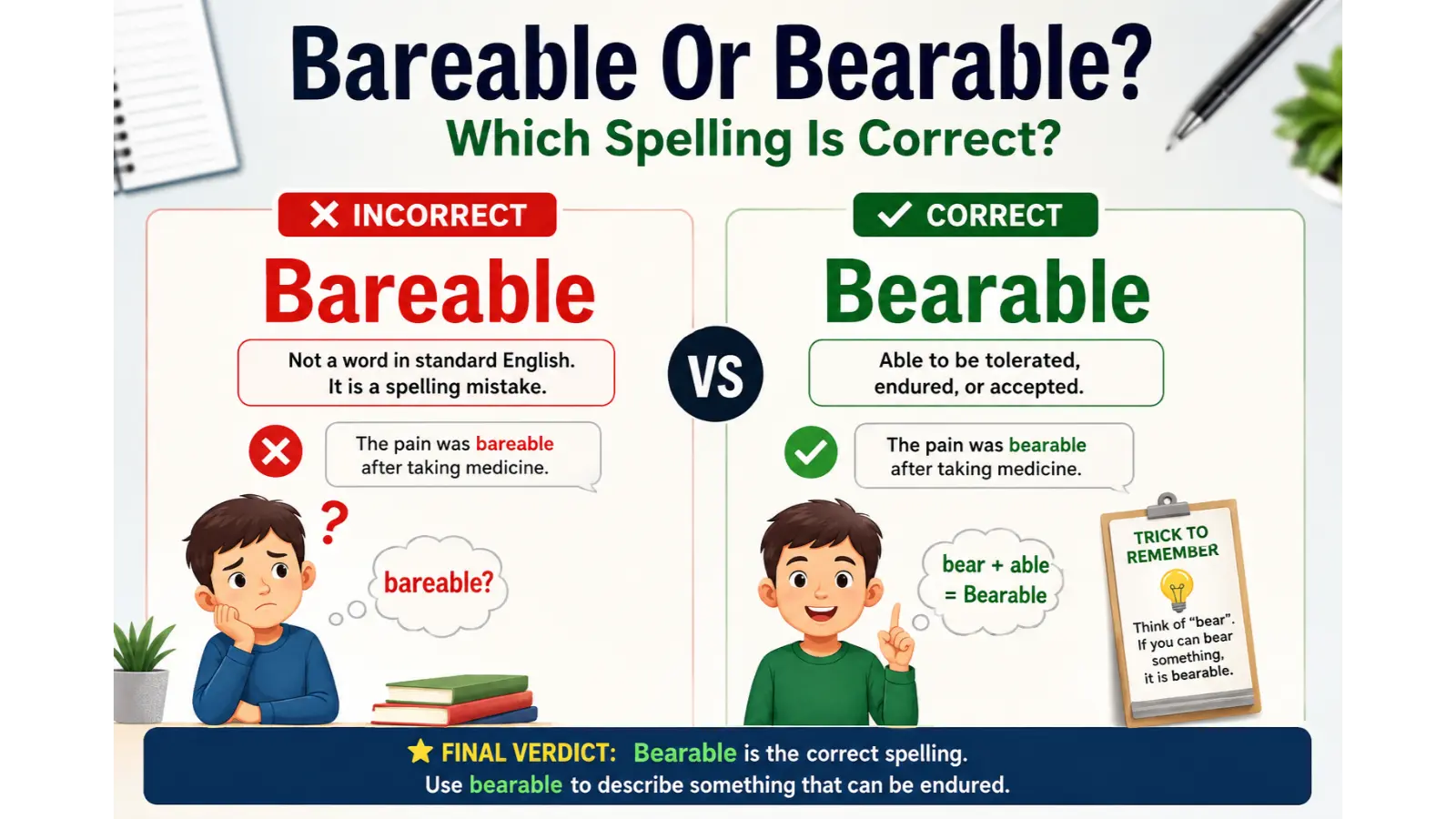
Bareable Or Bearable is a common spelling confusion that many English learners face. The two words look similar, but only one is correct in standard English. This mistake often happens because both words share a similar pronunciation.
Understanding the difference is important for clear writing. Using the wrong spelling can make your content look unprofessional. In this guide, you will learn the meaning, usage, history, and key differences between bareable and bearable. You will also discover simple memory tricks, examples, and common mistakes to help you use the correct word with confidence.
Quick Answer (for Google Snippet)
Bearable is the correct English word. It describes something you can tolerate, endure, or accept.
Standard dictionaries do not recognize Bareable, and most writers consider it a misspelling.
Example:
✅ The pain was bearable after taking medicine.
❌ The pain was bareable after taking medicine.
Meaning of Bareable
Bareable is not a standard English word.
Most people use it by mistake when they actually mean bearable.
Examples
❌ The weather was bareable today.
❌ Her headache became bareable after resting.
Both examples should use bearable instead.
Meaning of Bearable
Bearable means something that can be endured, tolerated, or managed.
It is commonly used for pain, situations, weather, stress, and discomfort.
Examples
✅ The heat became bearable after sunset.
✅ The workload was bearable with good planning.
Key Differences Between Bareable and Bearable

| Feature | Bareable | Bearable |
|---|---|---|
| Meaning | No accepted meaning | Able to be tolerated |
| Dictionary Status | Incorrect spelling | Correct spelling |
| Tone | Misspelling | Standard English |
| Usage | Rare and incorrect | Common worldwide |
| Popularity | Very low | Very high |
Origin and History
The word bearable comes from the verb bear, which means “to carry,” “to endure,” or “to tolerate.”
The suffix -able means “capable of.”
Therefore:
Bear + able = Bearable
Meaning: capable of being endured.
Similar Words
- Understandable
- Comfortable
- Manageable
- Acceptable
- Reasonable
British English vs American English Spelling
Unlike words such as colour/color or organise/organize, bearable has the same spelling in both British and American English.
There is no accepted regional spelling variation. Both countries use bearable.
Comparison Table
| Language Version | Correct Spelling |
|---|---|
| British English | Bearable |
| American English | Bearable |
| Australian English | Bearable |
| Canadian English | Bearable |
When to Use Bareable
You should generally not use bareable because it is considered a spelling mistake.
Example
❌ The journey was bareable.
Correct Form
✅ The journey was bearable.
When to Use Bearable
Use bearable when describing something that can be endured or tolerated.
Examples
✅ The cold weather was bearable with a warm jacket.
✅ The noise became bearable after a few minutes.
✅ The delay was bearable because we had snacks.
Common Mistakes

Mistake 1
❌ The pain was bareable.
✅ The pain was bearable.
Mistake 2
❌ The heat became bareable.
✅ The heat became bearable.
Mistake 3
❌ His behavior was barely bareable.
✅ His behavior was barely bearable.
Mistake 4
❌ The situation was not bareable.
✅ The situation was not bearable.
Easy Trick to Remember
Think about the word bear.
A bear is strong and can endure tough conditions.
Bearable = Able to Bear
If something is bearable, you can endure it.
Write 5 Examples
Example 1: Weather
The summer heat was bearable after the rain.
Example 2: Work
The project became bearable once the team helped.
Example 3: Health
The pain remained bearable throughout recovery.
Example 4: Travel
The long flight was bearable because of the comfortable seats.
Example 5: Daily Life
The waiting time was bearable with good company.
Related Keywords
- bearable meaning
- bearable definition
- bearable spelling
- bareable vs bearable
- correct spelling of bearable
- bearable pronunciation
- common spelling mistakes
Google Trends and Usage Data
Search interest consistently favors bearable across English-speaking countries. The spelling bareable appears mainly as a typo or spelling mistake.
Usage Insight
- USA: Bearable dominates searches.
- UK: Bearable is the accepted form.
- Australia: Bearable is widely used.
- India: Many searches compare bareable vs bearable.
- Pakistan: Users often search for spelling clarification.
Keyword Variations Comparison
| Keyword Variation | Usage Status |
|---|---|
| Bearable | Correct |
| Bareable | Incorrect |
| Bearable meaning | Popular |
| Bearable definition | Popular |
| Bareable meaning | Search typo |
| Bearable vs Bareable | Common comparison |
Final Verdict
Bearable is the correct spelling.
Bareable is a misspelling and should be avoided in formal and informal writing.
Use bearable whenever you want to describe something that can be tolerated, endured, or managed.
FAQs
Is bearable correct?
Yes. Bearable is the correct English spelling recognized by dictionaries.
What is the difference between bareable and bearable?
Bearable is correct and means tolerable. Bareable is a spelling mistake.
Which spelling is more common?
Bearable is overwhelmingly more common worldwide.
Is bearable suitable for formal writing?
Yes. It is widely accepted in academic, professional, and everyday writing.
Why does the confusion exist?
People often confuse the words because bearable sounds similar to bare, leading to spelling mistakes.
Conclusion
Bareable Or Bearable is a spelling comparison where only one form is correct. The correct word is bearable, which means something can be tolerated or endured. The spelling bareable is not accepted in standard English and usually appears as a typo. Fortunately, the difference is easy to remember. Think of the word bear, which means to endure. If you can bear something, it is bearable. This spelling remains the same in British English, American English, Australian English, and other major English varieties. Using bearable correctly will improve your writing and help you avoid a very common spelling mistake.

Daniel Foster is a comparison analyst and content strategist at Comparelly.com. He specializes in researching products, services, tools, and industry trends to create clear, unbiased comparison guides. With a focus on accuracy and practical insights, Daniel helps readers understand key differences and make informed decisions with confidence. His goal is to simplify complex choices through trustworthy, easy-to-understand content.