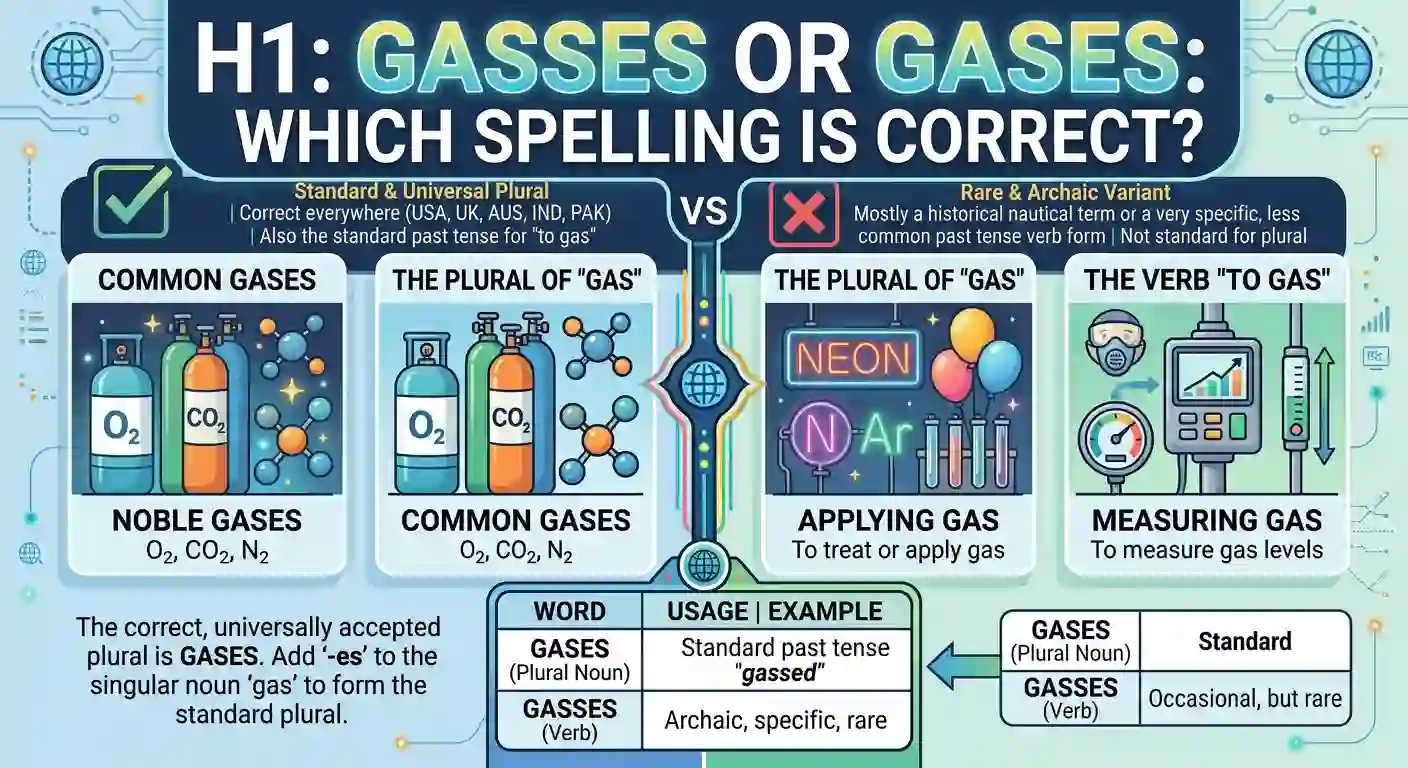
Confused about gasses or gases? You’re not alone. Both look right, but they play different roles. In science and most writing, gases is the standard plural noun.
Gasses usually works as a verb (third-person “to gas”). This guide gives you a clear rule, quick examples, and a memory trick so you never second-guess it again.
Quick Answer (for Google snippet) ⚡
Use gases as the plural noun for multiple types of gas (oxygen, carbon dioxide).
Use gasses as the verb form (he/she/it gasses the chamber).
Example: “The lab tests harmful gases.” vs. “The technician gasses the container.”
Meaning Section 📘
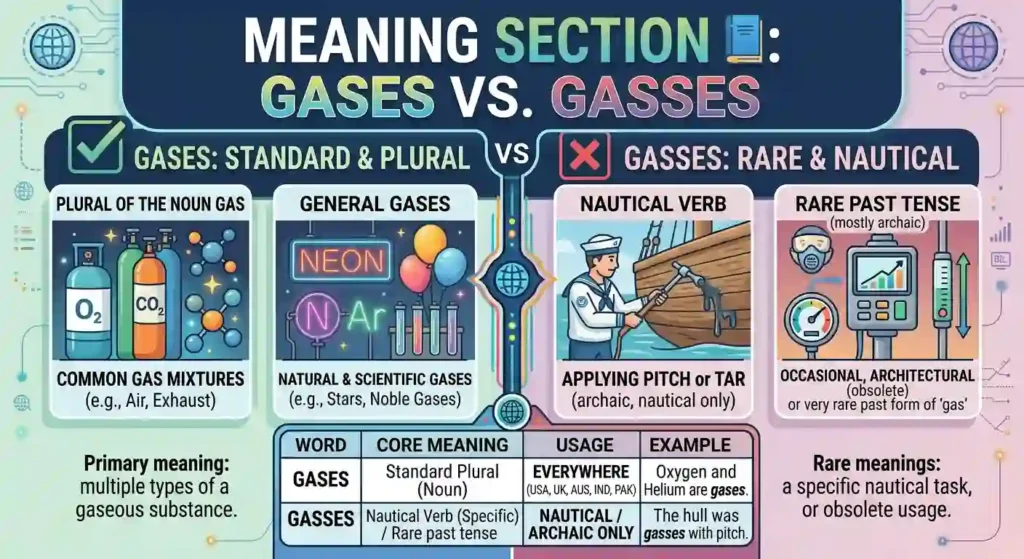
Gases
- Gases = plural noun of “gas,” meaning substances in a gaseous state.
- Used in science, environment, industry, and daily talk about air or fumes.
- Examples:
- “Greenhouse gases trap heat in the atmosphere.”
- “The tank stores compressed gases safely.”
Gasses
- Gasses = third-person singular verb of “to gas.”
- Means to treat, fill, or expose something to gas; or to refuel with gas.
- Examples:
- “The machine gasses the chamber before sealing.”
- “He gasses up the car before the road trip.”
Key Differences Table 🆚
| Aspect | Gases | Gasses |
|---|---|---|
| Meaning | Plural noun: more than one gas | Verb: he/she/it “to gas” something |
| Tone | Scientific, formal, general | Technical action, informal (refuel) |
| Usage | Chemistry, environment, industry | Labs, pest control, refueling, slang |
| Popularity | Very common (standard noun) | Less common (verb form) |
Origin & History 🧭
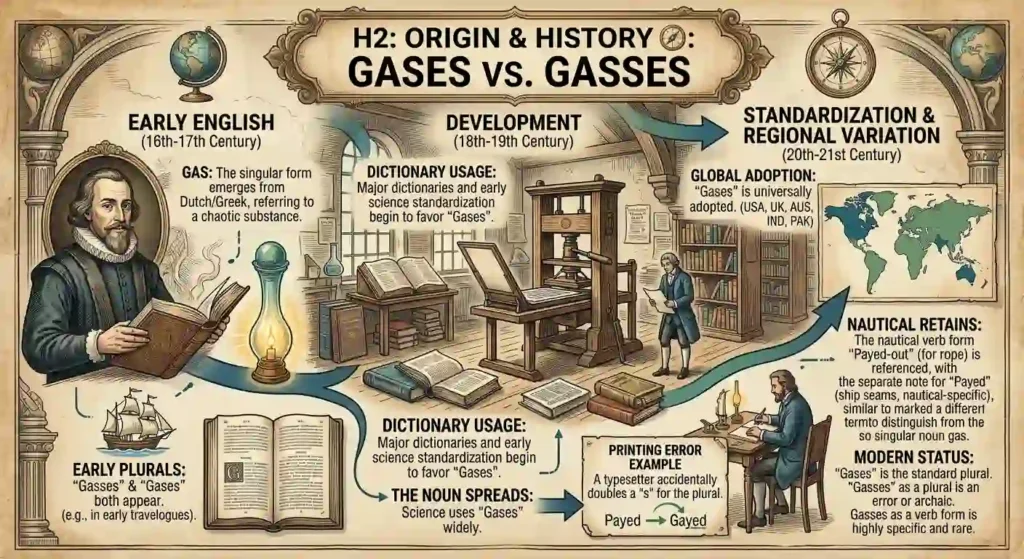
“Gas” entered English in the 17th century from Dutch gas (air, vapor).
The regular plural became gases, following patterns like “basis → bases.”
Gasses grew as the verb form (to gas) and as a less common plural variant.
Similar pairs: “focus → focuses” (verb) vs. “focuses” (noun plural); “bias → biases.”
British English vs American English Spelling 🇬🇧🇺🇸
Both British and American English prefer gases for the plural noun.
Both use gasses mainly as the verb (he/she/it gasses).
In informal US writing, “gasses” sometimes appears as a noun, but it’s less standard.
| Variant | Gases (noun) | Gasses (verb) |
|---|---|---|
| British English | Standard plural noun | Third-person verb |
| American English | Standard plural noun | Third-person verb (also informal noun variant) |
When to Use Each Word ✅
Use Gases (Plural Noun)
- Talking about types of gas, air quality, emissions, chemistry, physics.
- Examples:
- “The factory emits toxic gases.”
- “Noble gases include helium and neon.”
- “Greenhouse gases drive climate change.”
Use Gasses (Verb: He/She/It)
- Describing an action: treating, filling, or refueling with gas.
- Examples:
- “The technician gasses the room to kill pests.”
- “She gasses up the truck before dawn.”
- “The system gasses the line during maintenance.”
Common Mistakes ❌
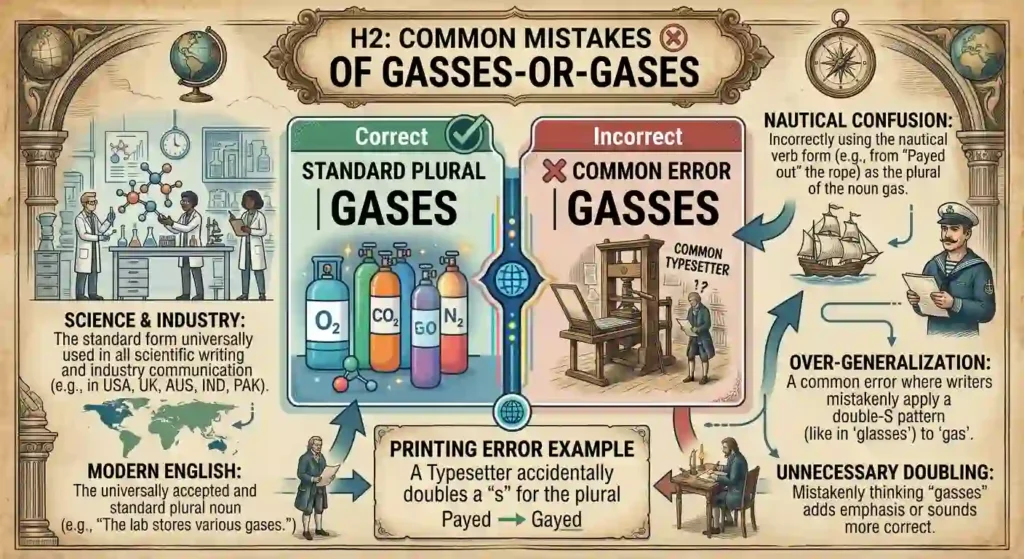
- Mistake: “The car releases harmful gasses.”
Correct: “The car releases harmful gases.” - Mistake: “Greenhouse gasses are rising.”
Correct: “Greenhouse gases are rising.” - Mistake: “He gases up the car.” (when meaning verb)
Correct: “He gasses up the car.” - Mistake: “The lab studies different gasses.”
Correct: “The lab studies different gases.”
Easy Trick to Remember 💡
Think: Science = Gases.
If you mean types of gas (noun), choose gases.
If someone “does” something with gas (verb), use gasses (he/she/it).
No action? It’s gases.
Everyday Life Examples 🌍
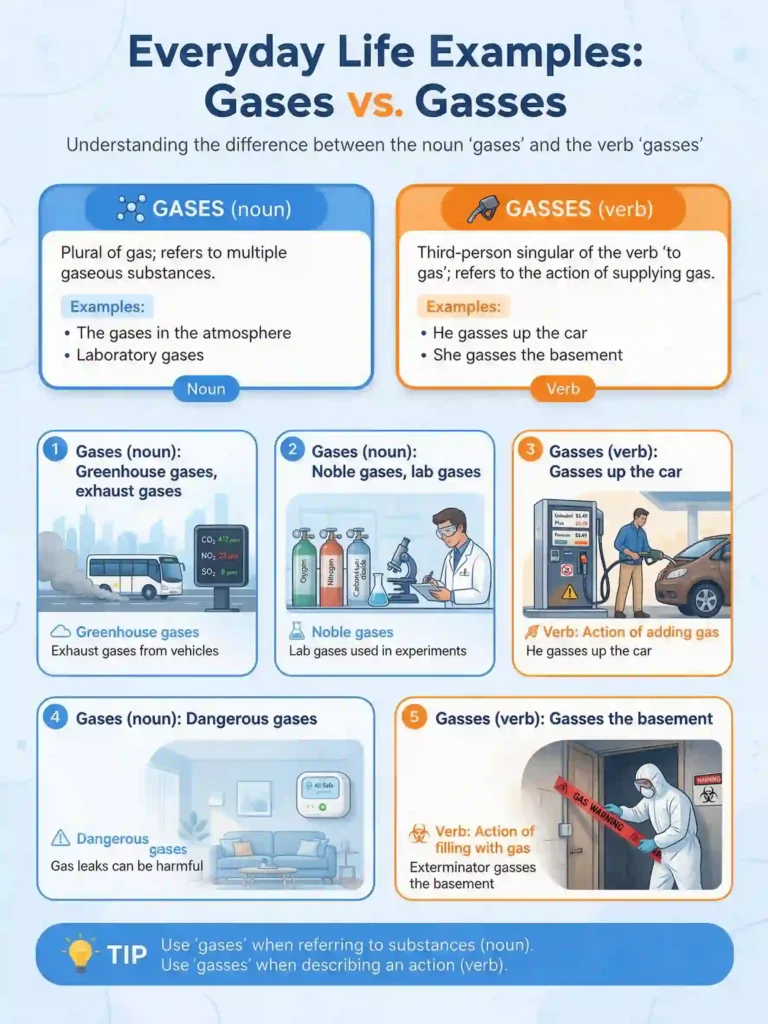
1) Air Quality and Pollution
- “City planners monitor harmful gases.”
- “The report tracks greenhouse gases each year.”
2) Chemistry and Labs
- “Students test noble gases in class.”
- “The technician gasses the chamber before the experiment.”
3) Vehicles and Fuel
- “Trucks emit exhaust gases on the highway.”
- “She gasses up the van before the delivery run.”
4) Home and Safety
- “Detectors warn about dangerous gases.”
- “The exterminator gasses the basement for bugs.”
5) Industry and Energy
- “Plants capture waste gases for reuse.”
- “The operator gasses the pipeline during startup.”
Related Keywords 🔎
- gases vs gasses
- is gasses a word
- plural of gas
- greenhouse gases or gasses
- noble gases spelling
- gasses up the car
- gases in chemistry
Google Trends & Usage Data 📈 (USA, UK, AUS, IND, PAK)
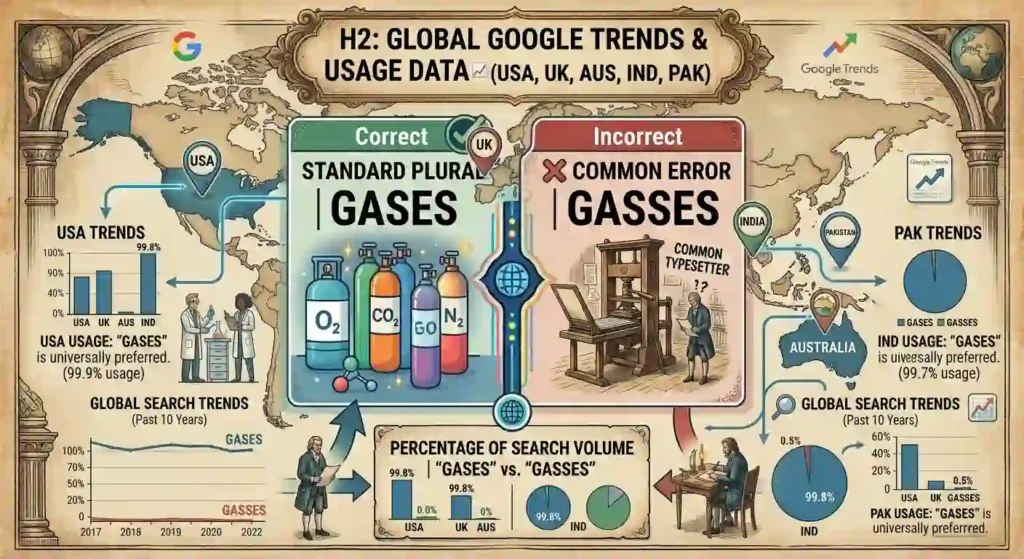
Search interest for gases is much higher than gasses across all five countries.
“Gasses” shows modest interest, often from learners or informal US usage.
In India and Pakistan, queries often come from students checking science spelling.
Insight: For SEO and formal writing, optimize for gases; note gasses only for verb contexts.
Comparison Table: Keyword Variations
| Keyword Variation | Common Use | Notes |
|---|---|---|
| gases vs gasses | Spelling/grammar check | High intent for correctness |
| is gasses correct | Spelling doubt | Usually expects “use gases for noun” |
| greenhouse gases | Climate/science | Standard term in reports |
| noble gases | Chemistry | Standard scientific term |
| gasses up the car | Informal verb phrase | Refuel action (US) |
Final Verdict 🏁
Use gases for the plural noun in science, environment, and general writing.
Use gasses only as the verb (he/she/it gasses) or in informal US noun variants.
For clear, credible content, gases is the safe, standard choice almost every time.
FAQ Section ❓
1) Is “gasses” correct?
Yes, but mainly as a verb (he/she/it gasses). For the plural noun, use gases.
2) What’s the difference between gases and gasses?
“Gases” = plural noun (types of gas). “Gasses” = verb form (to gas something).
3) Which is more common: gases or gasses?
“Gases” is far more common in all major English varieties.
4) When is “gasses” formal usage?
Rarely. In formal writing, prefer gases for the noun; use gasses only for precise verb needs.
5) Why does this confusion exist?
Because “gasses” can look like a plural noun, but standard English favors gases for the noun.
Conclusion ✅
Gases is the standard plural noun for multiple types of gas in science and daily use. Gasses works as the verb (he/she/it gasses) and as an informal noun variant.
For most writing, choose gases. Use gasses only when you truly mean an action with gas. This simple rule keeps your spelling clean and your content credible.

Daniel Foster is a comparison analyst and content strategist at Comparelly.com. He specializes in researching products, services, tools, and industry trends to create clear, unbiased comparison guides. With a focus on accuracy and practical insights, Daniel helps readers understand key differences and make informed decisions with confidence. His goal is to simplify complex choices through trustworthy, easy-to-understand content.