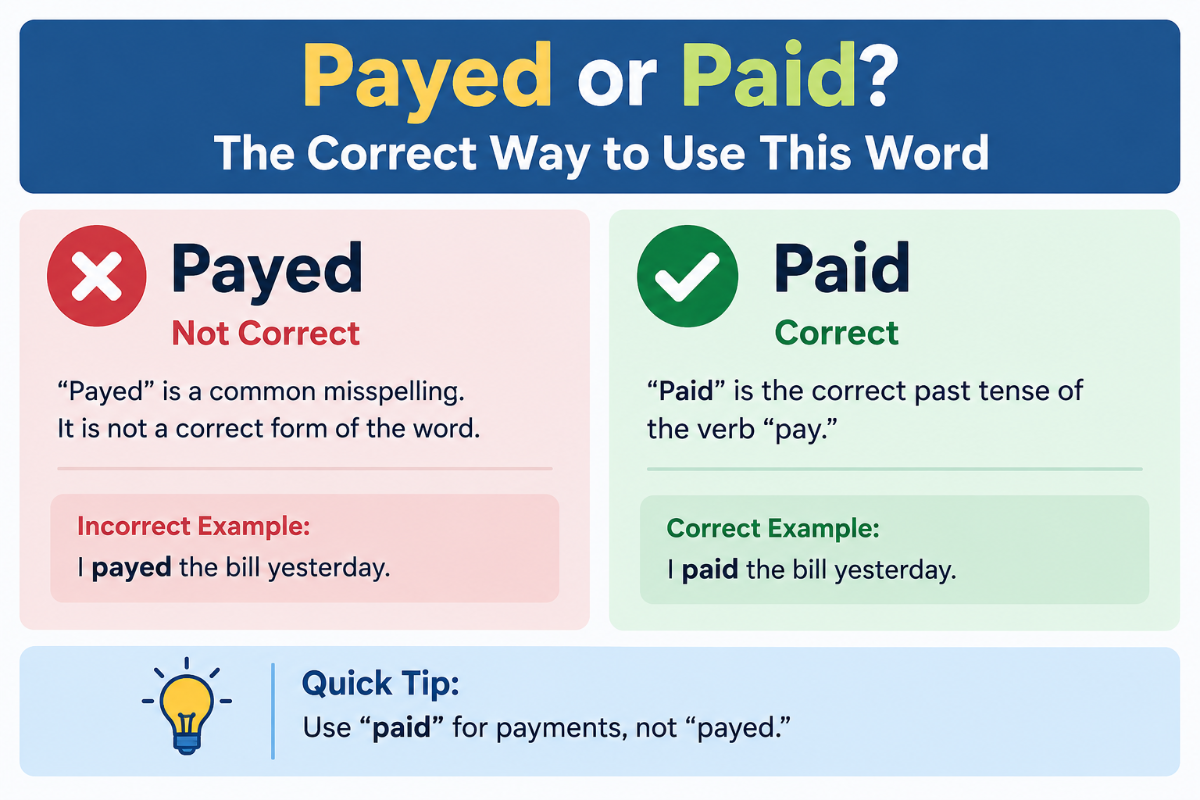
Payed or paid confuses many English learners and even native speakers. Both words look similar. Both sound the same when spoken. But only one is correct in most cases. This mix-up happens because English spelling rules are not always simple.
Some words change form in odd ways. “Pay” is one of them. In this guide, you will learn the real meaning of each word. You will see clear examples, common mistakes, and easy tricks to remember the difference. By the end, you will never confuse payed or paid again. Let’s clear up this confusion once and for all.
Quick Answer
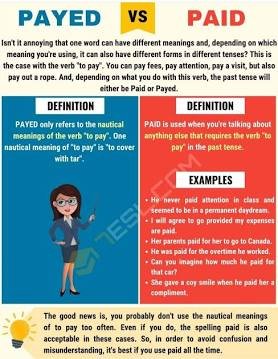
Paid is the correct past tense of “pay” in almost all situations. Use it for money, bills, and services. Payed is a rare nautical term. It means to let out a rope or chain on a ship.
Example: “She paid her rent on time.” ✅ Example: “The sailor payed out the anchor chain.” ✅ (nautical use only)
Meaning Section
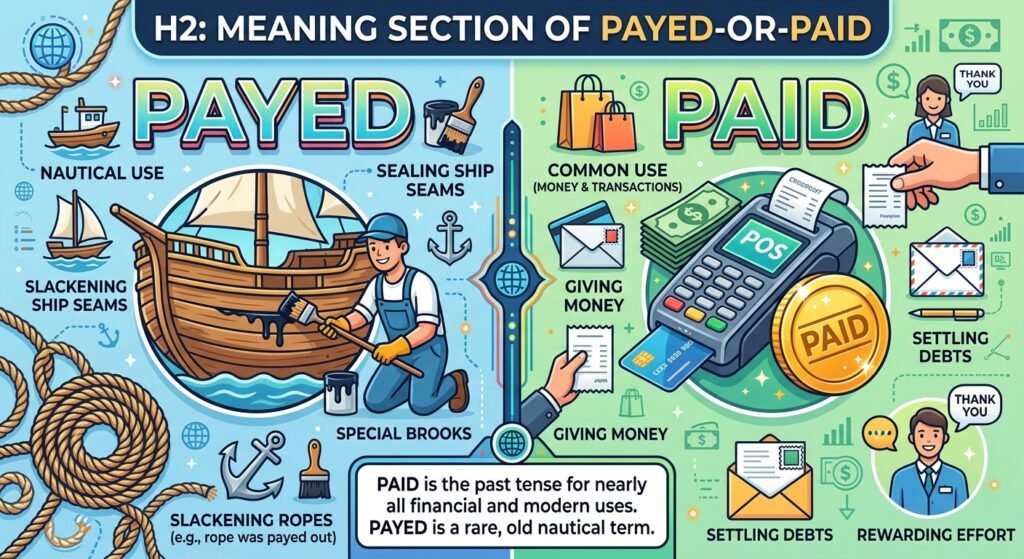
Meaning of Paid
Paid is the past tense and past participle of “pay.” It means you gave money for something.
Examples:
- He paid the taxi driver in cash.
- We paid our electricity bill yesterday.
Meaning of Payed
Payed is a special past tense form. Sailors use it when they let out a rope or chain slowly.
Examples:
- The crew payed out the rope as the boat moved away.
- They payed the anchor chain into the deep water.
Key Differences Table
| Feature | Paid | Payed |
|---|---|---|
| Meaning | Gave money for goods or services | Let out a rope or chain (nautical) |
| Tone | Neutral, everyday | Technical, rare |
| Usage | Common in all writing and speech | Used only in sailing contexts |
| Popularity | Extremely high | Very low |
Origin & History
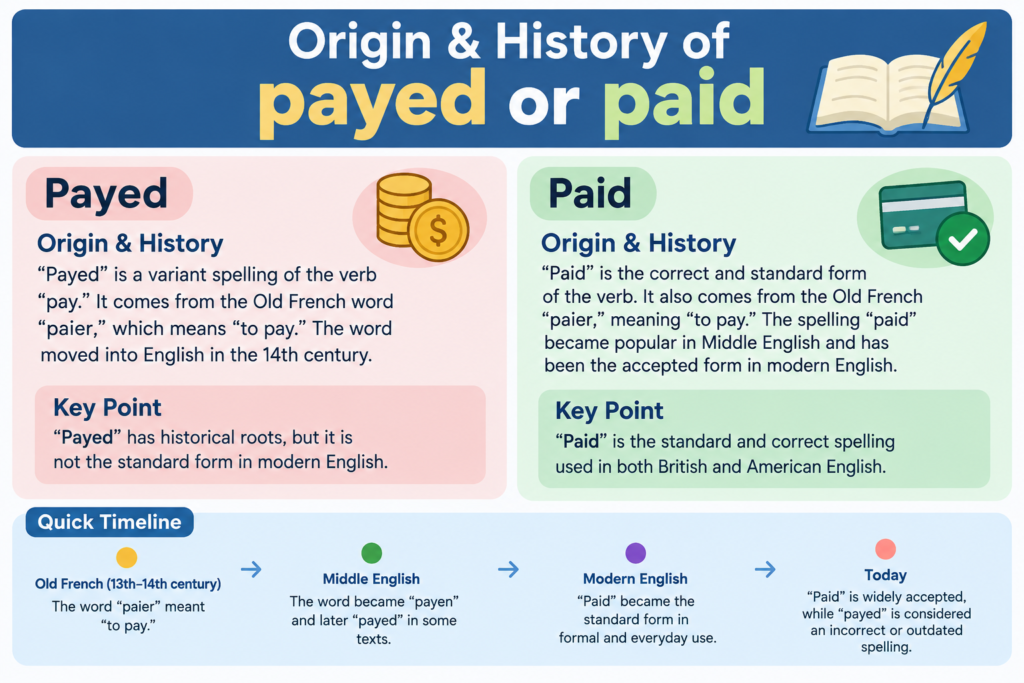
“Pay” comes from the Old French word “paier,” meaning to satisfy or please. Over time, “paid” became the standard past tense. “Payed” survived only in sailing language, where old spellings often stay in use.
Similar words with irregular forms include “laid” (from lay), “said” (from say), and “stayed” (from stay). These words show how English keeps some odd historical spellings alive.
British English vs American English Spelling
Both British and American English use “paid” as the standard past tense of pay. There is no spelling split here, unlike words such as “colour” and “color.” The word “payed” stays the same in both regions too, since it is a technical nautical term, not a regional spelling choice.
Comparison Table: British vs American English
| Word | British English | American English |
|---|---|---|
| Pay (past tense) | Paid | Paid |
| Nautical term | Payed | Payed |
| Colour/Color | Colour | Color |
| Favourite/Favorite | Favourite | Favorite |
When to Use Each Word
When to Use “Paid”
Use “paid” for any sentence about money, wages, bills, or debts.
Examples:
- I paid for dinner last night.
- She was paid a fair salary.
- They have already paid the invoice.
When to Use “Payed”
Use “payed” only when talking about ropes, chains, or cables on a ship.
Examples:
- The sailors payed out the mooring line slowly.
- He payed the cable over the side of the boat.
Common Mistakes
- Incorrect: I payed my rent last week. Correct: I paid my rent last week.
- Incorrect: She has payed for the tickets already. Correct: She has paid for the tickets already.
- Incorrect: He paid out the rope on the boat. Correct: He payed out the rope on the boat.
- Incorrect: We payed the babysitter extra. Correct: We paid the babysitter extra.
Easy Trick to Remember
Think: “Paid for things, Payed for ropes.”
If money is involved, use “paid.” If a rope or chain is involved, use “payed.” Ropes are rare, so “payed” is rare too.
Everyday Life Examples
1. Paying Bills at Home
She paid the water bill using her phone app.
2. Shopping at a Store
He paid for groceries with his debit card.
3. Freelance Work Payments
The client paid the freelancer through a payment app.
4. Sailing and Boating
The captain payed out the anchor line before docking.
5. Paid vs Payed in Writing
Writers often search “payed or paid” to check correct spelling before publishing.
Related Keywords
- Paid vs payed meaning
- Is payed a real word
- Past tense of pay
- Paid or payed grammar
- Payed nautical term
- Correct spelling of paid
- Paid vs payed examples
Final Verdict
Use “paid” in almost every situation. It is the correct past tense for money, wages, and payments. Use “payed” only for sailing and rope-related tasks. When in doubt, choose “paid.” It is right 99% of the time.
Google Trends & Usage Data (USA, UK, AUS, IND, PAK)
Search data shows “paid” dominates searches in all five countries by a huge margin. The USA and UK show steady, high search volume for “paid” in financial and work contexts. India and Pakistan show rising searches for “paid or payed,” often from English learners checking grammar. Australia shows similar patterns to the UK, with occasional searches about nautical terms from sailing communities. Overall, confusion searches spike in regions with large ESL populations.

Comparison Table: Keyword Variations
| Keyword Variation | Common Region | Search Intent |
|---|---|---|
| Paid or payed | India, Pakistan | Grammar confusion |
| Payed vs paid | USA, UK | Spelling check |
| Is payed a word | Australia, UK | Curiosity/definition |
| Past tense of pay | Global | Learning English |
| Payed nautical | UK, Australia | Sailing terminology |
FAQ Section
1. Is “payed” a correct word? Yes, but only in nautical contexts about ropes or chains. For money, use “paid.”
2. What is the difference between paid and payed? “Paid” means gave money. “Payed” means let out a rope on a ship.
3. Which word is more common: paid or payed? “Paid” is far more common and used in everyday writing and speech.
4. Can I use “payed” in formal writing? Only in technical or nautical writing. Avoid it in business or academic writing.
5. Why does this confusion exist? Both words sound the same and follow similar spelling patterns, causing mix-ups.
Conclusion
Payed or paid does not have to be confusing anymore. “Paid” is the correct choice for almost every sentence involving money or payment. “Payed” only applies to sailing terms like ropes and chains.
Remember the simple trick: money means paid, ropes mean payed. Keep this guide handy whenever you are unsure. With this knowledge, your writing will always be clear, correct, and professional.

Daniel Foster is a comparison analyst and content strategist at Comparelly.com. He specializes in researching products, services, tools, and industry trends to create clear, unbiased comparison guides. With a focus on accuracy and practical insights, Daniel helps readers understand key differences and make informed decisions with confidence. His goal is to simplify complex choices through trustworthy, easy-to-understand content.