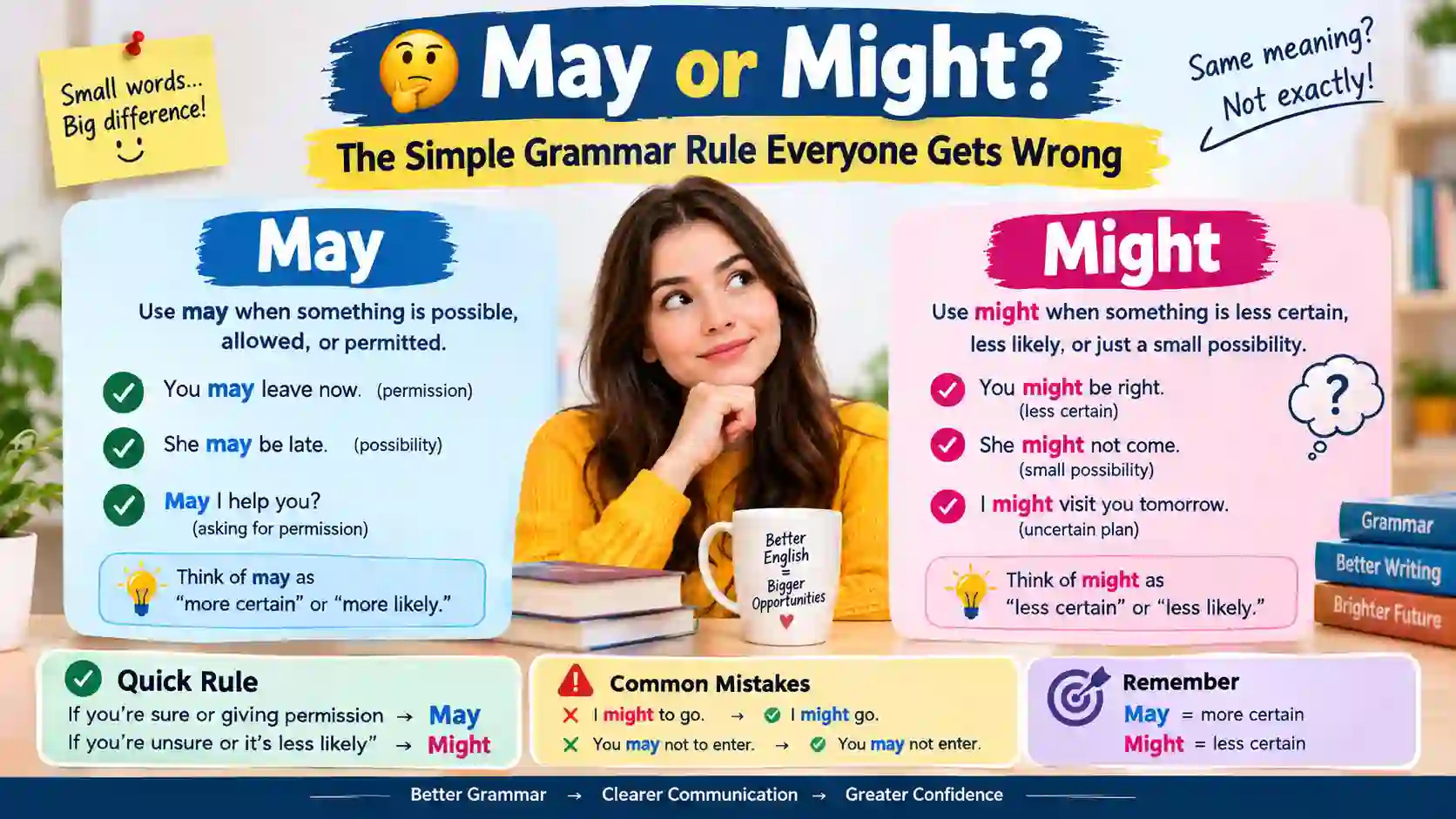
May or might is a grammar question that confuses even native English speakers. Both words talk about possibility. Both sound polite and formal. But they are not the same. The difference comes down to how likely something is. “May” suggests a stronger chance. “Might” suggests a weaker chance.
This guide breaks down the rule in plain English. You will learn when to use each word. You will also see real examples, common mistakes, and a memory trick that sticks. By the end, you will write with confidence.
⭐ Quick Answer
Use “may” when something is likely to happen. Use “might” when something is less likely or more uncertain. Both are correct, but “may” shows stronger possibility.
Example: “I may go to the party” means there is a good chance. “I might go to the party” means there is a small chance.
📖 Meaning Section
What Does “May” Mean?
“May” is a modal verb. It shows a strong possibility. It also asks for permission in a polite way. In formal writing, “may” often replaces “can” for permission.
Examples:
- “She may arrive before noon.”
- “May I borrow your pen?”
What Does “Might” Mean?
“Might” is a modal verb. It also works as the past tense of “may” in reported speech. It sounds softer and more uncertain than “may.”
Examples:
- “He might call you later tonight.”
- “She said she might visit next week.”
📊 Key Differences Table
| Feature | May | Might |
|---|---|---|
| Meaning | Strong possibility or permission | Weak possibility or uncertainty |
| Tone | Formal, confident | Softer, hesitant |
| Usage | Permission, polite requests, likely events | Uncertain events, past tense of “may” |
| Popularity | More common in formal writing | More common in casual speech |
📜 Origin & History

Both words come from Old English. “May” comes from “magan,” which means “to be able.” “Might” comes from “mihte,” the past form of “magan.” Over time, “might” became its own word for weaker possibility. This is why “might” often feels softer than “may.”
Similar word examples:
- Can / could
- Will / would
- Shall / should
🇬🇧 British English vs American English Spelling
Both “may” and “might” are spelled the same in British and American English. No spelling differences exist. However, British speakers use “may” for permission more often. American speakers often use “can” instead.
| Context | British English | American English |
|---|---|---|
| Permission | May I come in? | Can I come in? |
| Possibility | It may rain. | It might rain. |
| Past reported speech | She said she might go. | She said she might go. |
| Formal writing | May is preferred | Might is common |
📝 When to Use Each Word
When to Use “May”
Use “may” when something is likely. Use it in formal writing and business emails.
Examples:
- “The manager may approve the request today.”
- “May I ask a quick question?”
When to Use “Might”
Use “might” when something is uncertain. Use it in casual conversation.
Examples:
- “I might stop by later if I have time.”
- “He said he might join us.”
❌ Common Mistakes
Using “might” for polite permission.
- ❌ Incorrect: “Might I borrow your car?”
- ✅ Correct: “May I borrow your car?”
Using “may” for very weak possibility.
- ❌ Incorrect: “It may rain, but the sky is clear.”
- ✅ Correct: “It might rain, but the sky is clear.”
Mixing up past tense in reported speech.
- ❌ Incorrect: “She said she may come.”
- ✅ Correct: “She said she might come.”
Using “may” in casual speech for uncertainty.
- ❌ Incorrect: “I may go, I am not sure yet.”
- ✅ Correct: “I might go, I am not sure yet.”
💡 Easy Trick to Remember
“May = Maybe yes. Might = Maybe not.”
If you feel confident, use may. If you feel unsure, use might. Also remember: May asks permission. Might never does.
🏠 Everyday Life Examples
1. At Work
Primary keyword usage: “I may or might finish the report by Friday.”
Secondary keyword usage: “May I send the draft for review?”
2. At School
Primary keyword usage: “The teacher asked if we may or might need extra time.”
Secondary keyword usage: “It might snow, so school could close.”
3. At Home
Primary keyword usage: “We may or might go to the beach this weekend.”
Secondary keyword usage: “May I use your phone charger?”
4. In Conversation
Primary keyword usage: “I can’t decide if I may or might attend the wedding.”
Secondary keyword usage: “She might call you back later.”
🔗 Related Keywords
- May vs might difference
- May and might grammar
- May vs might examples
- Modal verbs may might
- May for permission
- Might for possibility
📈 Google Trends & Usage Data (USA, UK, AUS, IND, PAK)

Searches for “may or might” stay steady across all five countries. The USA and UK show the highest search volume. India and Pakistan show growing interest in grammar queries. Australia follows closely behind the UK. Students and writers drive most searches.
Insight: Search interest rises during school terms and exam seasons. Grammar confusion fuels steady demand. This shows people want quick, clear answers.
Comparison Table: Keyword Variations
| Keyword Variation | Search Intent | Best For |
|---|---|---|
| May or might | Comparison | Featured snippets, guides |
| May vs might | Comparison | Tables, quick answers |
| Difference between may and might | Definition | Informational content |
| May and might examples | How-to | Learning content |
| When to use may | How-to | Grammar guides |
| When to use might | How-to | Grammar guides |
| May vs might grammar rules | Comparison | Reference content |
❓ FAQ’s Section
What is the difference between may and might?
“May” shows strong possibility or permission. “Might” shows weak possibility or uncertainty.
Which is more common?
“Might” is more common in casual speech. “May” is more common in formal writing.
Can I use “may” in formal writing?
Yes. “May” is preferred in formal writing for both possibility and permission.
Why does confusion exist between may and might?
Both words talk about possibility. This overlap makes it hard to pick the right one.
🎯 Final Verdict
Neither word is better. They serve different purposes. Use “may” for strong possibility and polite permission. Use “might” for weak possibility and reported speech. The key test: if you feel confident, use “may.” If you feel unsure, use “might.” In formal writing, “may” sounds more polished. In casual talk, “might” sounds more natural.
✅ Conclusion
The may or might debate comes down to one simple rule. “May” shows stronger possibility. “Might” shows weaker possibility. “May” also asks for permission. “Might” never does. Use “may” in formal writing and polite requests.
Use “might” in casual speech and uncertain situations. Remember the trick: “May = Maybe yes. Might = Maybe not.” This simple rule will keep your grammar clean. Bookmark this guide for the next time you write an email or essay.

Daniel Foster is a comparison analyst and content strategist at Comparelly.com. He specializes in researching products, services, tools, and industry trends to create clear, unbiased comparison guides. With a focus on accuracy and practical insights, Daniel helps readers understand key differences and make informed decisions with confidence. His goal is to simplify complex choices through trustworthy, easy-to-understand content.