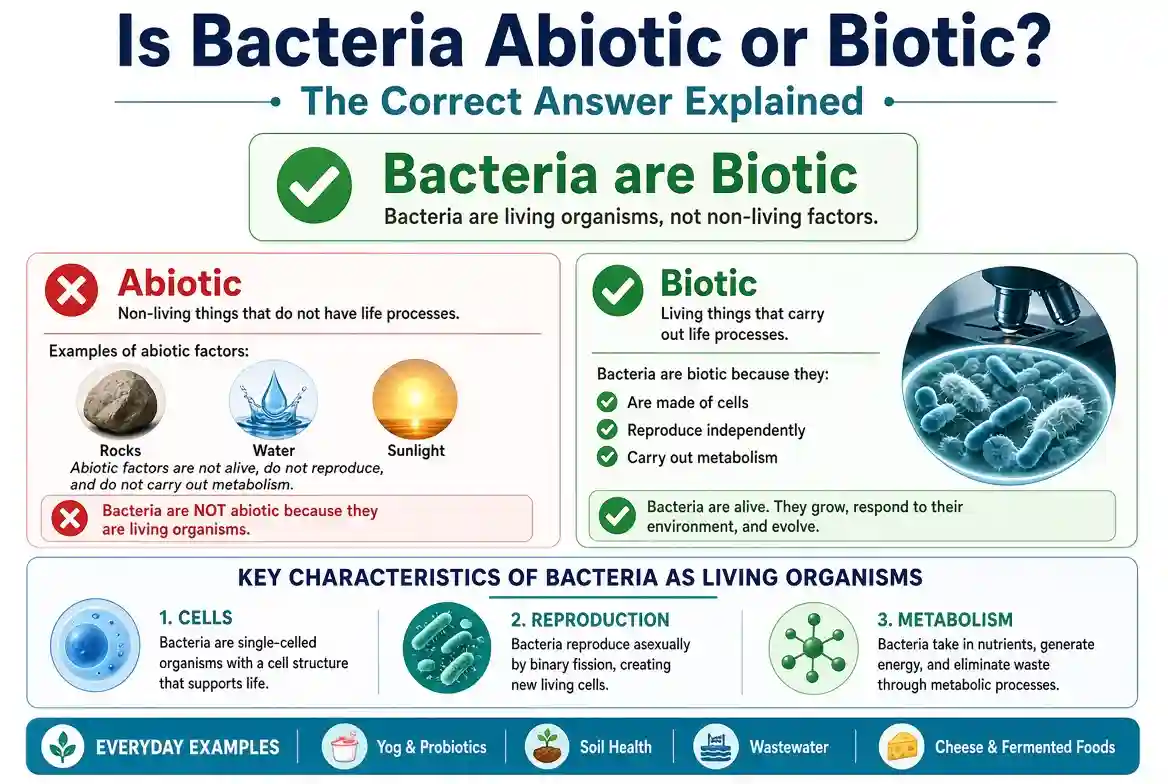
Is bacteria abiotic or biotic? This question often confuses students learning about ecosystems. The simple answer is that bacteria are biotic because they are living organisms. They can grow, reproduce, use energy, and respond to their surroundings. Abiotic factors are nonliving parts of an environment. Examples include water, sunlight, temperature, air, rocks, and minerals. Bacteria belong to the living part of an ecosystem.
They can also interact with plants, animals, fungi, and other microorganisms. Some bacteria help ecosystems by decomposing organic matter. Other bacteria can cause diseases or support nutrient cycles. Understanding this difference makes ecosystem questions much easier. In this guide, we explain is bacteria abiotic or biotic with simple examples, comparisons, common mistakes, and useful memory tricks.
⭐ Quick Answer (for Google Snippet)
Bacteria are biotic because they are living organisms. They can grow, reproduce, use energy, and interact with other organisms.
Example: Bacteria in soil are biotic, while the soil’s minerals, water, and temperature are abiotic.
🦠 Meaning of Bacteria
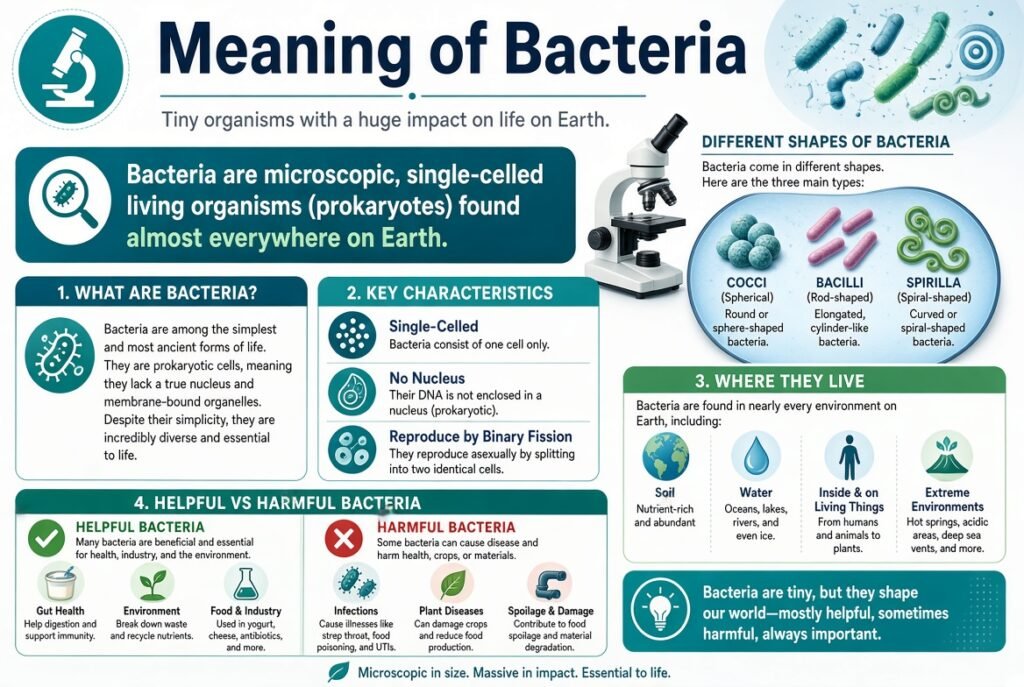
Bacteria are microscopic living organisms made of single cells. Most bacteria are prokaryotes, meaning their cells do not have a membrane-bound nucleus.
Bacteria live in many environments, including soil, water, food, and living organisms.
Examples
- E. coli is a type of bacterium found in the intestines of humans and animals.
- Rhizobium bacteria live near plant roots and help with nitrogen fixation.
Bacteria are therefore part of the living, or biotic, component of an ecosystem.
🌱 Meaning of Biotic
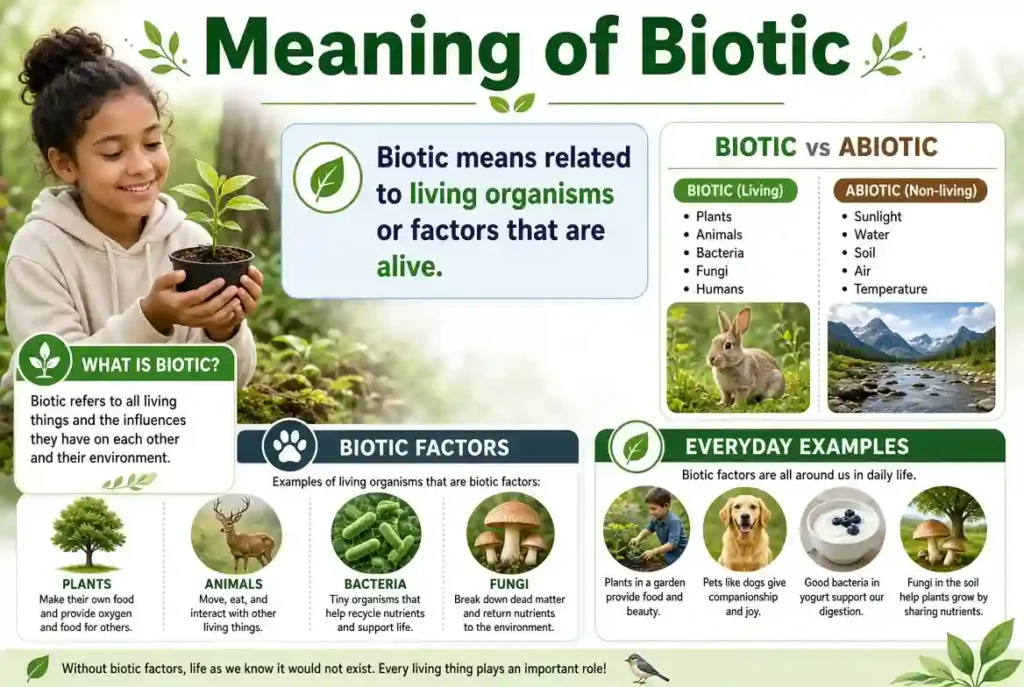
Biotic means related to living organisms or living parts of an ecosystem.
Biotic components include organisms that are alive. These include bacteria, plants, animals, fungi, algae, and many other organisms.
Examples
- Bacteria are biotic because they are living organisms.
- Grass is biotic because it grows and carries out life processes.
Bacteria can also influence other organisms through competition, decomposition, disease, or helpful relationships.
🌍 Meaning of Abiotic
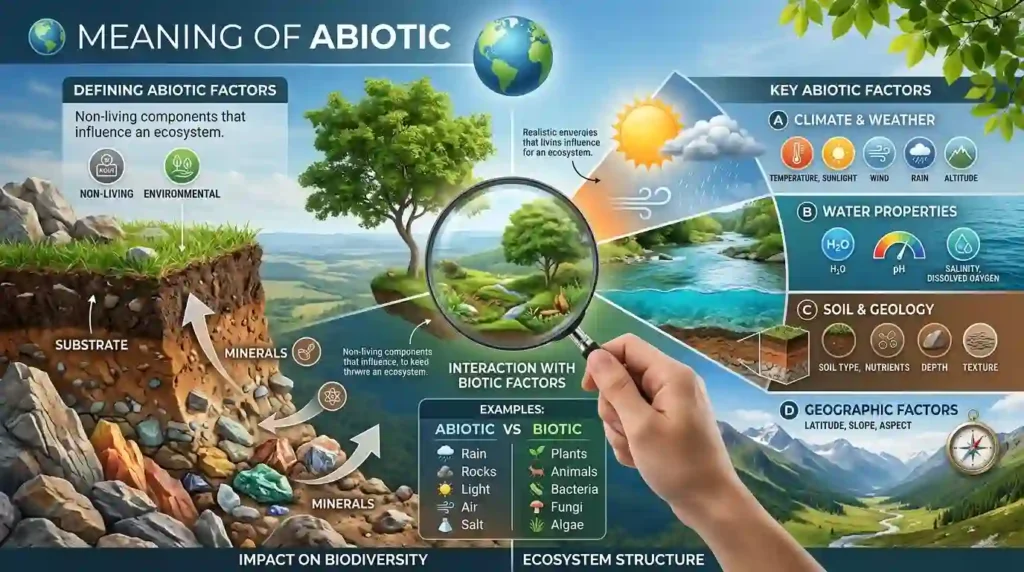
Abiotic means nonliving. Abiotic factors are physical and chemical parts of an ecosystem.
Common abiotic factors include:
- Water
- Sunlight
- Temperature
- Air
- Soil minerals
- Rocks
- Salinity
- pH
- Wind
Examples
- Sunlight is abiotic because it is not alive.
- Water is abiotic because it does not grow or reproduce.
Abiotic factors can strongly affect bacterial growth and survival.
📊 Key Differences: Biotic vs Abiotic
| Feature | Biotic | Abiotic |
|---|---|---|
| Meaning | Living part of an ecosystem | Nonliving part of an ecosystem |
| Tone | Biological and living | Physical or chemical |
| Usage | Used for organisms and life | Used for environmental conditions |
| Popularity | Common in biology and ecology | Common in biology and ecology |
| Examples | Bacteria, plants, animals | Water, sunlight, rocks |
| Can reproduce? | Living organisms can reproduce | No |
| Can carry out life processes? | Yes | No |
Is Bacteria Abiotic or Biotic?
Bacteria clearly belong to the biotic category.
They are living organisms, even though most bacteria are too small to see without a microscope.
📜 Origin & History of Biotic and Abiotic
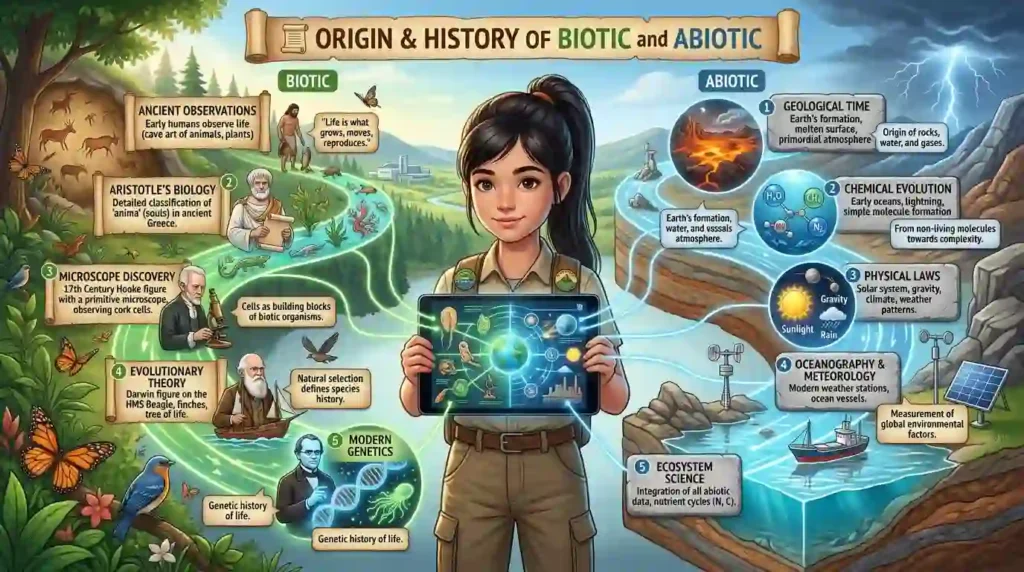
The terms biotic and abiotic come from scientific language based on Greek roots.
The word biotic relates to life. The word abiotic uses the prefix a-, meaning without.
Scientists use these terms to describe the two major parts of ecosystems.
Similar Word Examples
- Biotic → living
- Abiotic → nonliving
- Biology → study of life
- Biosphere → region containing life
- Microbiotic → relating to microorganisms
- Abiogenesis → origin of life from nonliving matter
These terms help scientists describe how living organisms interact with their environment.
🇬🇧 British English vs American English Spelling
There is no major spelling difference between biotic, abiotic, and bacteria in British and American English.
The scientific terms are spelled the same in both varieties.
However, surrounding words may sometimes have different spellings.
British vs American English
| Term | British English | American English |
|---|---|---|
| Biotic | biotic | biotic |
| Abiotic | abiotic | abiotic |
| Bacteria | bacteria | bacteria |
| Organism | organism | organism |
| Behaviour | behaviour | behavior |
| Colour | colour | color |
🧬 When to Use “Biotic”
Use biotic when you are describing something connected to living organisms.
Examples
- Bacteria are biotic components of ecosystems.
- Plants are important biotic factors.
- Animals interact with other biotic factors.
- Fungi are also biotic organisms.
- Bacteria can affect other living organisms.
Simple Rule
If something is alive or comes from living organisms, the term biotic may apply.
💧 When to Use “Abiotic”
Use abiotic when you describe a nonliving environmental factor.
Examples
- Temperature is an abiotic factor.
- Sunlight is an abiotic component.
- Water is an important abiotic factor.
- Rocks are abiotic parts of an ecosystem.
- Soil minerals can act as abiotic factors.
Simple Rule
If something is not alive, it may be considered abiotic.
⚠️ Common Mistakes
Mistake 1: Calling bacteria abiotic
❌ Incorrect: Bacteria are abiotic factors.
✅ Correct: Bacteria are biotic components of an ecosystem.
Mistake 2: Calling water biotic
❌ Incorrect: Water is a biotic factor.
✅ Correct: Water is an abiotic factor.
Mistake 3: Thinking microscopic means nonliving
❌ Incorrect: Bacteria are abiotic because they are microscopic.
✅ Correct: Bacteria are biotic because they are living organisms.
Mistake 4: Confusing environmental conditions with organisms
❌ Incorrect: Temperature is a biotic organism.
✅ Correct: Temperature is an abiotic factor.
Mistake 5: Thinking all microorganisms are nonliving
❌ Incorrect: All microorganisms are abiotic.
✅ Correct: Many microorganisms, including bacteria, are living and therefore biotic.
🧠 Easy Trick to Remember
Use this simple memory trick:
BIO = LIFE
The word biotic contains bio, which relates to life.
So remember:
Biotic = Life
Abiotic = No Life
Therefore:
Bacteria → Biotic ✅
Water → Abiotic ✅
Sunlight → Abiotic ✅
Plants → Biotic ✅
This trick makes ecosystem questions easier to remember.
🌿 Everyday Life Examples
1. Bacteria in Soil
Soil contains many microorganisms.
Bacteria are biotic, while soil minerals and water are abiotic.
Primary keyword: is bacteria abiotic or biotic
Secondary keyword: bacteria biotic factor
2. Bacteria in Water
Bacteria can live in freshwater, oceans, rivers, and other aquatic environments.
The bacteria are biotic, while water temperature and minerals are abiotic.
Primary keyword: is bacteria abiotic or biotic
Secondary keyword: biotic and abiotic factors
3. Bacteria on Food
Some bacteria grow on food under suitable conditions.
The bacteria are living organisms, so they are biotic.
Temperature, moisture, and oxygen availability are environmental factors.
Primary keyword: is bacteria abiotic or biotic
Secondary keyword: bacteria living organisms
4. Helpful Bacteria
Some bacteria provide important benefits.
For example, certain bacteria help plants obtain usable nitrogen.
The bacteria are biotic components of the ecosystem.
Primary keyword: is bacteria abiotic or biotic
Secondary keyword: bacteria in ecosystems
5. Bacteria and Disease
Some bacteria can cause infections in humans and animals.
These bacteria are still biotic because they are living organisms.
The human body provides environmental conditions that affect bacterial growth.
Primary keyword: is bacteria abiotic or biotic
Secondary keyword: bacteria living or nonliving
🔎 Related Keywords
Here are useful keyword variations for this topic:
- Is bacteria biotic or abiotic?
- Are bacteria biotic factors?
- Is bacteria a living organism?
- Are bacteria living or nonliving?
- Bacteria biotic factor
- Biotic and abiotic factors
- Examples of biotic factors
✅ Final Verdict
Bacteria are biotic, not abiotic.
Bacteria are living organisms. They can perform life processes and interact with other organisms.
Abiotic factors are nonliving parts of an ecosystem. Examples include water, sunlight, temperature, rocks, and minerals.
So, when asked “Is bacteria abiotic or biotic?”, choose:
Bacteria = Biotic ✅
Remember the simple rule:
Biotic means living. Abiotic means nonliving.
📈 Google Trends & Usage Data: USA, UK, Australia, India, Pakistan

Search interest for this topic is closely connected to biology, ecology, and school science questions. Exact Google Trends scores change by date, location, and selected search period. Search results also show repeated educational interest in whether bacteria are biotic or abiotic.
Bacteria are widely treated as biotic components, while temperature, water, sunlight, and minerals are abiotic factors.
🌎 Country-Level SEO Insight
| Country | Likely Search Intent | Main Keyword Opportunity |
|---|---|---|
| 🇺🇸 USA | School biology and ecology | Is bacteria abiotic or biotic |
| 🇬🇧 UK | Science education | Are bacteria biotic |
| 🇦🇺 Australia | Ecosystem questions | Biotic and abiotic factors |
| 🇮🇳 India | Biology exam preparation | Is bacteria biotic or abiotic |
| 🇵🇰 Pakistan | School and college biology | Bacteria living or nonliving |
📊 Keyword Variations Comparison
| Keyword Variation | Search Intent | SEO Value |
|---|---|---|
| Is bacteria abiotic or biotic | Direct question | Very High |
| Is bacteria biotic or abiotic | Direct question | Very High |
| Are bacteria biotic factors | Conceptual | High |
| Is bacteria a living organism | Educational | High |
| Are bacteria living or nonliving | Beginner biology | High |
| Bacteria biotic factor | Informational | Medium-High |
| Biotic and abiotic factors | Broader topic | High |
SEO insight: The strongest strategy is to target the exact question first. Then cover related questions about biotic factors, abiotic factors, and living organisms.
❓ FAQ’s
Is it correct to say bacteria are biotic?
Yes. Bacteria are living organisms, so they are classified as biotic components.
What is the difference between biotic and abiotic?
Biotic refers to living components. Abiotic refers to nonliving components of an ecosystem.
Which is more common, biotic or abiotic?
Both terms are common in biology. Their use depends on whether the subject is living or nonliving.
Is “bacteria” a formal biological term?
Yes. Bacteria is a standard scientific term for a major group of microscopic organisms.
Why does confusion about bacteria exist?
Bacteria are microscopic, so some people assume they are nonliving. However, microscopic size does not mean something is abiotic.
📝 Conclusion
Is bacteria abiotic or biotic? Bacteria are biotic because they are living organisms. They can grow, reproduce, use energy, and interact with their environment. Abiotic factors are nonliving parts of ecosystems. Water, sunlight, temperature, rocks, and minerals are common examples.
Bacteria can live in many environments, including soil, water, food, and living organisms. Some bacteria support ecosystems through nutrient cycling and decomposition. Others can cause diseases. Their size does not change their biological classification. The easiest way to remember the answer is BIO = LIFE. Therefore, bacteria belong to the biotic part of an ecosystem. If you see bacteria in a biology question, choose biotic, not abiotic.

Daniel Foster is a comparison analyst and content strategist at Comparelly.com. He specializes in researching products, services, tools, and industry trends to create clear, unbiased comparison guides. With a focus on accuracy and practical insights, Daniel helps readers understand key differences and make informed decisions with confidence. His goal is to simplify complex choices through trustworthy, easy-to-understand content.