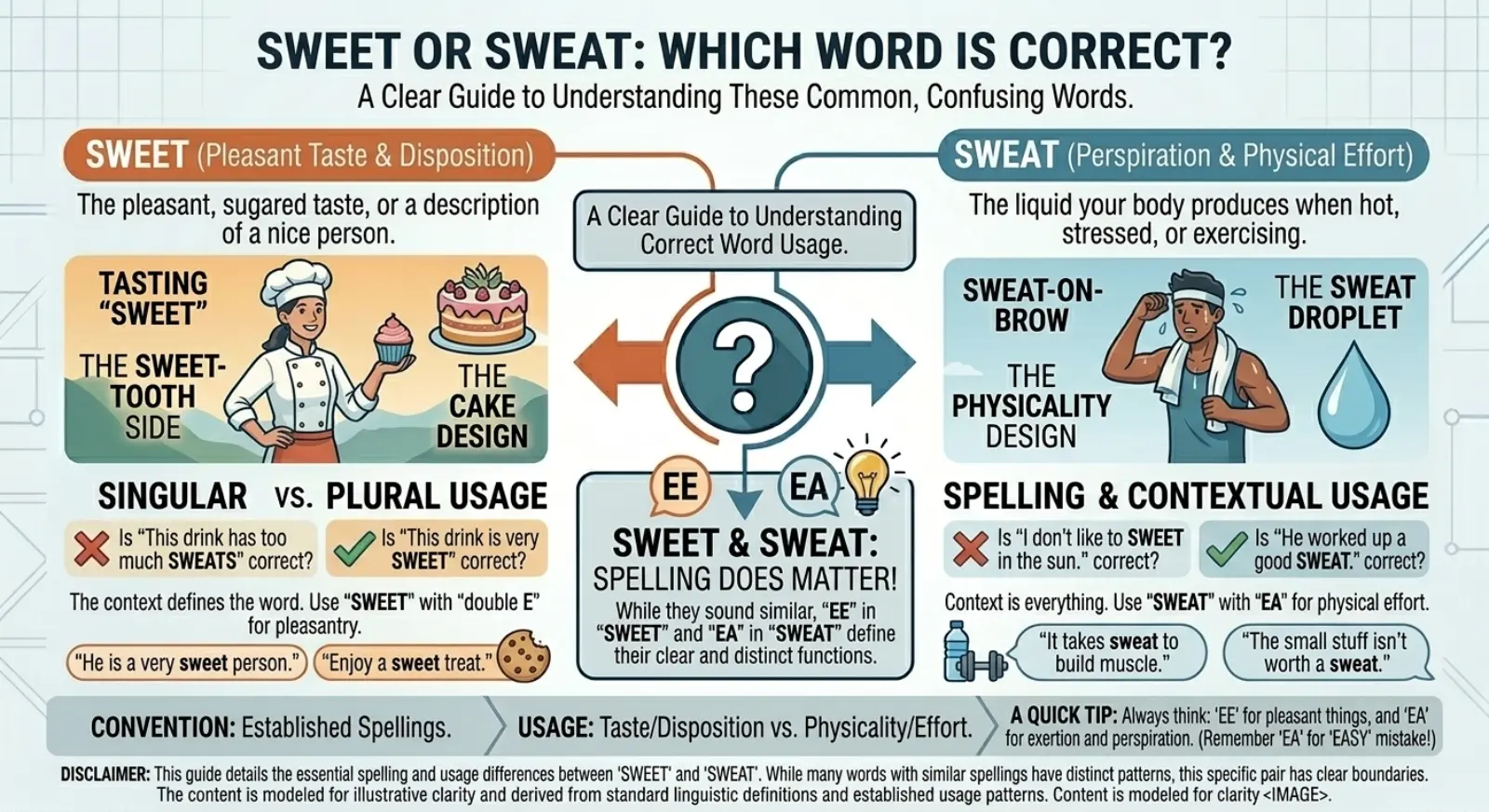
Sweet Or Sweat can confuse English learners because both words sound similar in some accents. However, they have completely different meanings. Sweet describes something pleasant, sugary, kind, or enjoyable.
Sweat refers to the liquid your body produces when you feel hot or exercise. These words also have different grammatical uses. Sweet can work as an adjective, noun, or informal term of affection. Sweat can work as a noun or verb. You might eat a sweet dessert after dinner. You might also sweat during a workout.
The correct word depends entirely on your sentence. Understanding their meanings makes the difference easy to remember. This guide explains sweet vs sweat, their definitions, differences, origins, examples, common mistakes, and everyday usage. It also covers British and American English spelling. By the end, choosing between sweet and sweat will be simple.
Quick Answer (for Google snippet)
Sweet means sugary, pleasant, or kind. Sweat means the liquid produced by your body when you become hot or exercise.
Example: The sweet dessert made me smile, while the workout made me sweat.
Meaning of Sweet
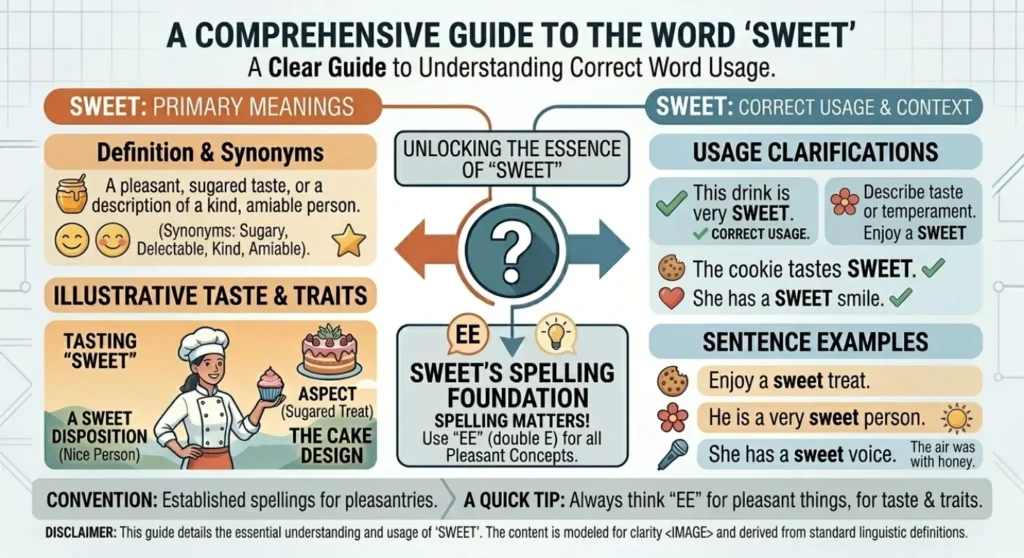
Sweet has several common meanings.
It can describe something that tastes like sugar.
It can also describe someone or something that seems kind, pleasant, or lovable.
As an adjective
Sweet means having a sugary taste or being pleasant and kind.
Examples:
- The cake tastes very sweet.
- She gave me a sweet smile.
As a noun
A sweet can mean a small piece of candy.
Example:
The children received a sweet after dinner.
Common phrases with Sweet
- sweet taste
- sweet food
- sweet smell
- sweet voice
- sweet person
- sweet dreams
- sweet smile
- sweet treat
Meaning of Sweat
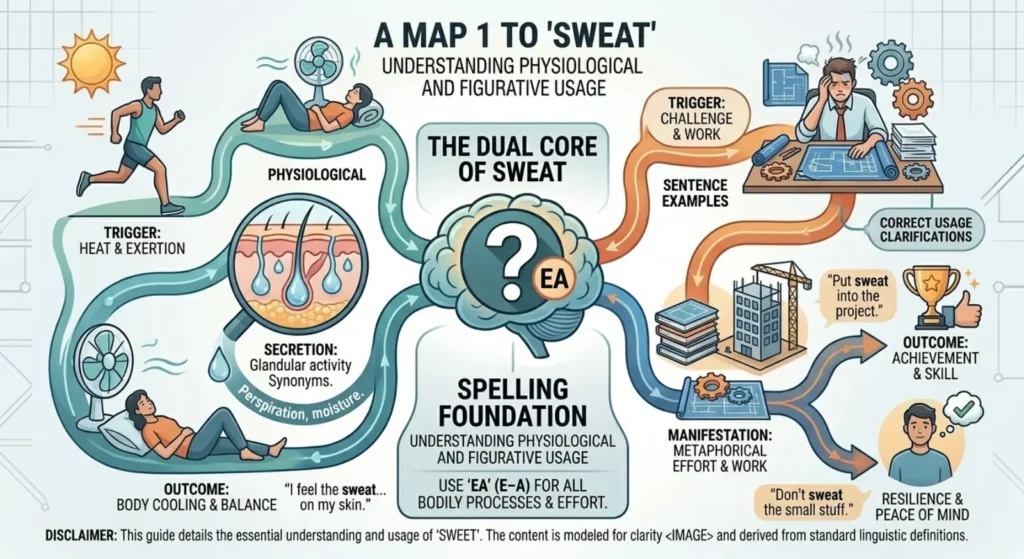
Sweat refers to the liquid produced by glands in your skin.
Your body produces sweat to help regulate its temperature.
Sweat can also work as a verb.
As a noun
Example:
The runner wiped the sweat from his forehead.
As a verb
Example:
I always sweat during intense exercise.
Common phrases with Sweat
- sweat heavily
- break a sweat
- cold sweat
- sweat glands
- sweat drops
- sweat during exercise
- wipe away sweat
Key Differences: Sweet vs Sweat
| Feature | Sweet | Sweat |
|---|---|---|
| Meaning | Sugary, pleasant, or kind | Body fluid produced by heat or exercise |
| Part of speech | Adjective, noun, informal noun | Noun and verb |
| Tone | Pleasant or descriptive | Physical and practical |
| Usage | Food, personality, experiences | Exercise, heat, stress, body |
| Popularity | Very common | Very common |
| Example | A sweet dessert | Sweat after running |
| Related word | Sweetness | Sweaty |
The words differ in both spelling and meaning.
Sweet relates to taste, kindness, or pleasantness.
Sweat relates to body temperature and physical effort.

Origin & History
Sweet comes from Old English swēte.
It has been used for centuries to describe pleasant tastes, smells, sounds, and experiences.
Over time, sweet gained figurative meanings.
It can now describe kindness, beauty, affection, and pleasant experiences.
Sweat also has Old English roots.
It comes from the Old English word swǣtan, meaning to sweat.
The word has kept its basic physical meaning for centuries.
Similar Word Examples
English contains many words with similar sounds but different meanings.
Examples include:
- sweet / sweat
- meet / meat
- sea / see
- flower / flour
- right / write
- peace / piece
- weak / week
These words require context to understand correctly.
🇬🇧 British English vs 🇺🇸 American English Spelling
Sweet has the same spelling in British and American English.
Sweat also has the same spelling in both varieties.
Their meanings and standard spellings remain unchanged.
British vs American English Comparison
| Feature | British English | American English |
|---|---|---|
| Sweet | Sweet | Sweet |
| Sweat | Sweat | Sweat |
| Spelling difference | None | None |
| Meaning | Same | Same |
| Food usage | Common | Common |
| Exercise usage | Common | Common |
Unlike some regional spelling differences, sweet and sweat do not change between British and American English.
When to Use Sweet
Use sweet when discussing sugary taste, kindness, affection, or something pleasant.
Examples
- This tea is too sweet.
- She bought a sweet dessert.
- That was a sweet message.
- He is a very sweet child.
- The flowers have a sweet fragrance.
Use sweet when the meaning connects with:
- sugar
- kindness
- affection
- pleasantness
- enjoyable experiences
- desserts
Example
The sweet cake was delicious.
Here, sweet describes the taste.
When to Use Sweat
Use sweat when discussing perspiration.
It commonly appears in conversations about exercise, heat, work, and physical activity.
Examples
- I began to sweat during the workout.
- His shirt was covered in sweat.
- She wiped the sweat from her face.
- The hot weather made everyone sweat.
- You may sweat more during intense exercise.
Use sweat when the meaning connects with:
- heat
- exercise
- physical effort
- perspiration
- body temperature
- nervousness
Example
I started to sweat after running for ten minutes.
Common Mistakes
Mistake 1: Using “Sweat” for Sugary Food
❌ The cake is very sweat.
✅ The cake is very sweet.
Use sweet for sugary taste.
Mistake 2: Using “Sweet” for Perspiration
❌ I was sweet after exercising.
✅ I was sweaty after exercising.
Use sweat as the noun or verb.
Mistake 3: Confusing Sweet With Sweaty
❌ My shirt became sweet after running.
✅ My shirt became sweaty after running.
Sweaty means covered with or affected by sweat.
Mistake 4: Writing “Sweet” When You Mean “Sweat”
❌ I need to wipe the sweet from my face.
✅ I need to wipe the sweat from my face.
The liquid on your skin is sweat.
Mistake 5: Writing “Sweat” for Kindness
❌ That was a sweat thing to do.
✅ That was a sweet thing to do.
Use sweet when describing kindness.
Easy Trick to Remember
Use this simple memory trick:
Sweet = Sugar
Both words connect with pleasant taste.
Sweet → sugar → dessert
Sweat = Exercise
Think about physical activity.
Sweat → exercise → perspiration
Remember:
Sweet tastes good. Sweat comes from your skin.
This quick trick can prevent most spelling mistakes.

Everyday Life Examples
1. Sweet Dessert
Desserts often contain sugar.
Example:
The chocolate cake was too sweet for me.
- Primary keyword: sweet
- Secondary keyword: sweet dessert
2. Exercise and Sweat
Physical activity often causes perspiration.
Example:
I started to sweat after running around the park.
- Primary keyword: sweat
- Secondary keyword: sweat during exercise
3. A Sweet Person
Sweet can describe someone who behaves kindly.
Example:
She is a sweet person who always helps others.
- Primary keyword: sweet
- Secondary keyword: sweet person
4. Sweat From Heat
Hot weather can cause sweating.
Example:
The intense heat made everyone sweat.
- Primary keyword: sweat
- Secondary keyword: sweating in hot weather
5. A Sweet Message
Sweet can describe a kind or affectionate message.
Example:
He sent his mother a sweet birthday message.
- Primary keyword: sweet
- Secondary keyword: sweet message
Related Keywords
Use these keyword variations naturally:
- sweet or sweat
- sweet vs sweat
- sweat vs sweet
- sweet meaning
- sweat meaning
- sweet spelling
- sweat spelling
- sweet and sweat difference
- is it sweet or sweat
- sweet vs sweaty
- sweet word meaning
- sweat word meaning
Google Trends & Usage Data
Search interest for sweet is generally broader because the word has many meanings.
Sweat receives strong interest around exercise, fitness, heat, and health-related topics.
Country-level interest can change based on season, culture, and search behavior.
For SEO, use sweet for food and emotional meanings, and sweat for fitness and physical activity.
Usage Insight by Country
| Country | Sweet Usage | Sweat Usage | SEO Insight |
|---|---|---|---|
| 🇺🇸 USA | Very common | Very common | Food and fitness searches are strong |
| 🇬🇧 UK | Very common | Very common | Both words have broad everyday use |
| 🇦🇺 Australia | Very common | Very common | Food and outdoor activity support both |
| 🇮🇳 India | Very common | Very common | Both appear widely in general English |
| 🇵🇰 Pakistan | Very common | Very common | Both are familiar in everyday English |
Key SEO Insight
Sweet has broader search intent because it covers food, personality, taste, and emotions.
Sweat has strong fitness and physical activity intent.
The phrase sweet or sweat targets spelling confusion.
Use all three search intents naturally within related content.
📊 Comparison Table: Keyword Variations
| Keyword Variation | Search Intent | Best Content Angle |
|---|---|---|
| sweet or sweat | Comparison | Spelling guide |
| sweet vs sweat | Comparison | Difference article |
| sweat vs sweet | Comparison | Vocabulary guide |
| sweet meaning | Informational | Definition |
| sweat meaning | Informational | Definition |
| sweet spelling | Spelling | Word guide |
| sweat spelling | Spelling | Word guide |
| sweet and sweat difference | Comparison | Grammar guide |
| is it sweet or sweat | Spelling | Confusion guide |
| sweet vs sweaty | Comparison | Word usage guide |
FAQ
1. Is “sweet” a correct word?
Yes. Sweet is a standard English word. It can describe taste, kindness, affection, or pleasant qualities.
2. What is the difference between sweet and sweat?
Sweet describes sugary, pleasant, or kind things. Sweat refers to perspiration or the act of producing it.
3. Which is more common, sweet or sweat?
Both are common words. Sweet has broader meanings and appears in more types of contexts.
4. Is “sweet” formal English?
Yes. Sweet is standard English and works in formal and informal writing. Its exact tone depends on the context.
5. Why does confusion between sweet and sweat exist?
The words look and sound similar. Their close pronunciation can cause spelling mistakes, especially for English learners.
Conclusion
Sweet Or Sweat compares two common English words with very different meanings. Sweet can describe sugary food, kindness, affection, or something pleasant. Sweat means the liquid produced by your body when you become hot or physically active. The words have different spellings and grammatical uses. They also keep the same spellings in British and American English. The easiest way to remember them is simple. Sweet connects with sugar, while sweat connects with exercise and perspiration. Context will usually make the correct choice clear. If you describe a dessert or kind person, use sweet. If you describe perspiration or physical effort, use sweat. Learning this difference can improve both your spelling and everyday English communication.


Daniel Foster is a comparison analyst and content strategist at Comparelly.com. He specializes in researching products, services, tools, and industry trends to create clear, unbiased comparison guides. With a focus on accuracy and practical insights, Daniel helps readers understand key differences and make informed decisions with confidence. His goal is to simplify complex choices through trustworthy, easy-to-understand content.