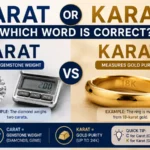
Carat Or Karat is a common spelling question in the world of jewelry. Both words sound alike, but they have different uses. Carat usually measures the weight of diamonds and other gemstones. Karat measures the purity of gold, especially in American English.
This small spelling difference can create confusion when reading jewelry descriptions. For example, a diamond may weigh two carats. A gold ring may contain 18 karats of gold. British English often uses carat when discussing gold purity as well. American English usually keeps carat for gemstones and karat for gold.
Knowing this difference helps you understand jewelry prices and product descriptions. It also makes your writing more accurate. This guide explains the meanings, history, regional usage, common mistakes, and correct examples of carat and karat.
Quick Answer
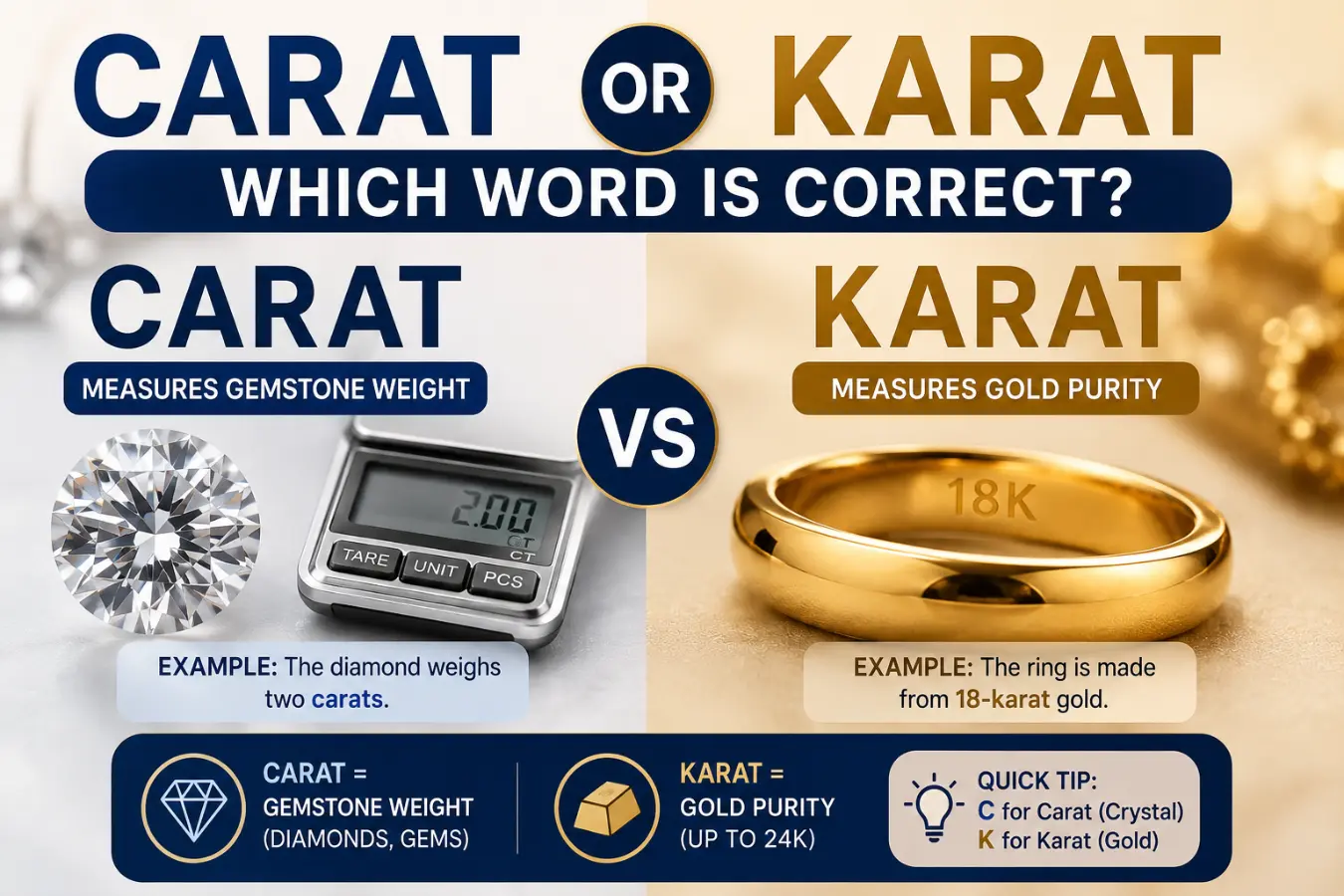
Carat measures the weight of diamonds and other gemstones. Karat measures gold purity, mainly in American English.
Example: The diamond weighs two carats, while the ring is made from 18-karat gold.
Meaning of Carat
Carat is a unit used to measure the weight of diamonds and other gemstones.
One carat equals 200 milligrams, or 0.2 grams.
Jewelry sellers use carats to describe gemstone weight.
Examples
- She bought a one-carat diamond.
- The ruby weighs three carats.
Simple Meaning
👉 Carat = The weight of a gemstone
A diamond’s carat weight does not directly describe its physical size.
Cut, shape, and proportions can affect how large the stone looks.
Meaning of Karat
Karat is a measurement of gold purity.
The karat scale goes up to 24 karats.
Pure gold is generally described as 24-karat gold.
Lower numbers indicate that the gold contains other metals.
Examples
- He bought an 18-karat gold necklace.
- The bracelet is made from 22-karat gold.
Simple Meaning
👉 Karat = The purity of gold
For example, 18-karat gold contains 18 parts gold out of 24.
Key Differences: Carat vs Karat
| Feature | Carat | Karat |
|---|---|---|
| Meaning | Measures gemstone weight | Measures gold purity |
| Tone | Jewelry measurement | Gold purity measurement |
| Usage | Diamonds and gemstones | Gold |
| Main measurement | Weight | Purity |
| Example | 2-carat diamond | 18-karat gold |
| Popularity | Very common | Common in gold-related writing |
The Main Difference
Carat tells you how much a gemstone weighs.
Karat tells you how pure gold is.
Therefore, the two terms should not be used interchangeably in American English.
Origin & History
The words carat and karat share a historical connection.
Their history traces back to the Greek word keration, meaning carob seed.
Carob seeds were once associated with small units of weight.
The term later developed through several languages and entered European trade vocabulary.
Over time, carat became strongly associated with gemstones.
Karat developed as a spelling used for gold purity, especially in American English.
Similar Word Examples
English has many terms with related forms or confusing spellings.
Examples include:
- carat / karat
- color / colour
- jewelry / jewellery
- meter / metre
- center / centre
- check / cheque
Regional spelling can affect which form you should choose.
🇬🇧 British English vs 🇺🇸 American English Spelling
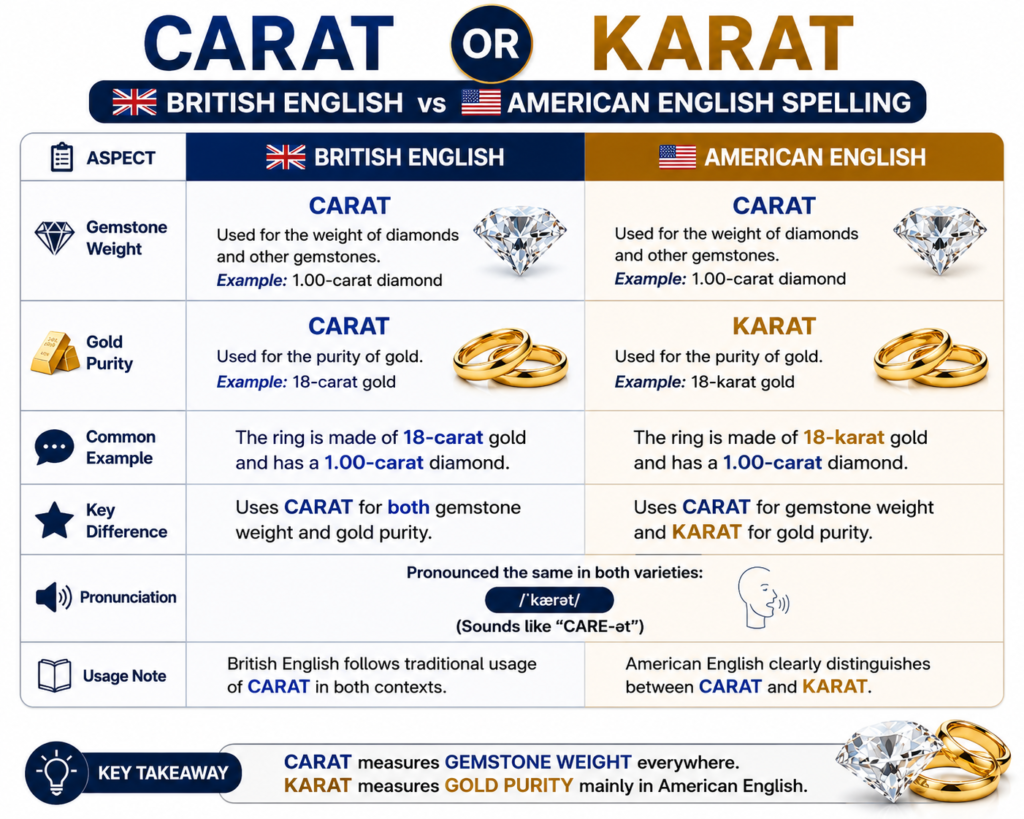
British English commonly uses carat for both gemstones and gold purity.
American English uses carat for gemstones and karat for gold purity.
The difference is mainly a spelling convention, not a difference in the actual measurement.
Comparison Table: British vs American English
| Usage | British English | American English |
|---|---|---|
| Diamond weight | Carat | Carat |
| Gemstone weight | Carat | Carat |
| Gold purity | Carat | Karat |
| Pure gold | 24-carat gold | 24-karat gold |
| 18-unit gold | 18-carat gold | 18-karat gold |
Tip: Follow your audience’s regional style when writing about gold.
When to Use Carat
Use carat when describing the weight of a diamond or gemstone.
You will commonly see this term in jewelry stores and product descriptions.
Examples
- The engagement ring has a 1.5-carat diamond.
- This emerald weighs four carats.
- The earrings feature half-carat diamonds.
- The jeweler showed us a two-carat sapphire.
Use Carat When Talking About:
- diamonds
- rubies
- emeralds
- sapphires
- other gemstones
Remember: Carat describes weight.
When to Use Karat
Use karat when describing gold purity in American English.
The number tells you how much gold exists in the 24-part mixture.
Examples
- She wears an 18-karat gold ring.
- The store sells 22-karat gold jewelry.
- The necklace contains 14-karat gold.
- He prefers 24-karat gold.
Remember: Karat describes gold purity.
Common Mistakes
Mistake 1: Using Karat for a Diamond
❌ She bought a two-karat diamond.
✅ She bought a two-carat diamond.
Use carat for gemstone weight.
Mistake 2: Using Carat for American Gold Writing
❌ He bought an 18-carat gold ring.
✅ He bought an 18-karat gold ring.
American English normally uses karat for gold purity.
Mistake 3: Thinking Carat Means Diamond Size
❌ Carat directly tells you the diamond’s physical size.
✅ Carat tells you the diamond’s weight.
A diamond’s appearance also depends on its cut and shape.
Mistake 4: Thinking Karat Means Gold Weight
❌ This gold bracelet is heavy, so it has more karats.
✅ Karat describes the gold’s purity.
Weight and purity are separate measurements.
Mistake 5: Applying American Usage Everywhere
❌ Karat is always the only correct spelling for gold.
✅ American English uses karat, while British English often uses carat.
Regional style affects the preferred spelling.
Easy Trick to Remember
Use this simple memory trick:
💎 C = Carat = Crystal
Think of crystals and gemstones.
👉 Carat = Gemstone weight
🥇 K = Karat = Gold
Think of Karat = gold purity.
👉 Karat = Gold purity
So remember:
Carat → Gemstones
Karat → Gold
This trick works especially well for American English.
Everyday Life Examples
1. Buying an Engagement Ring
Example:
She chose a 1.25-carat diamond for her engagement ring.
Primary keyword: Carat Or Karat
Secondary keyword: carat meaning
2. Shopping for a Gold Bracelet
Example:
He selected an 18-karat gold bracelet from the jewelry store.
Primary keyword: Carat Or Karat
Secondary keyword: karat meaning
3. Comparing Diamond Prices
Example:
A two-carat diamond usually weighs twice as much as a one-carat diamond.
Primary keyword: Carat Or Karat
Secondary keyword: carat vs karat
4. Checking Gold Purity
Example:
The stamp shows that the necklace is made from 22-karat gold.
Primary keyword: Carat Or Karat
Secondary keyword: gold karat meaning
5. Reading a Jewelry Description
Example:
The ring features a 0.75-carat diamond set in 14-karat gold.
Primary keyword: Carat Or Karat
Secondary keyword: carat and karat difference
Related Keywords
Here are useful keyword variations for this topic:
- carat or karat
- carat vs karat
- karat vs carat
- carat meaning
- karat meaning
- carat definition
- karat definition
- diamond carat meaning
- gold karat meaning
- carat and karat difference
Google Trends & Usage Data
Search interest for Carat Or Karat comes mainly from jewelry, gold, diamonds, and spelling questions.
Carat often attracts broader interest because it applies to diamonds and other gemstones.
Karat has strong relevance for searches about gold purity, especially in American English.
Search behavior can vary across the USA, UK, Australia, India, and Pakistan.
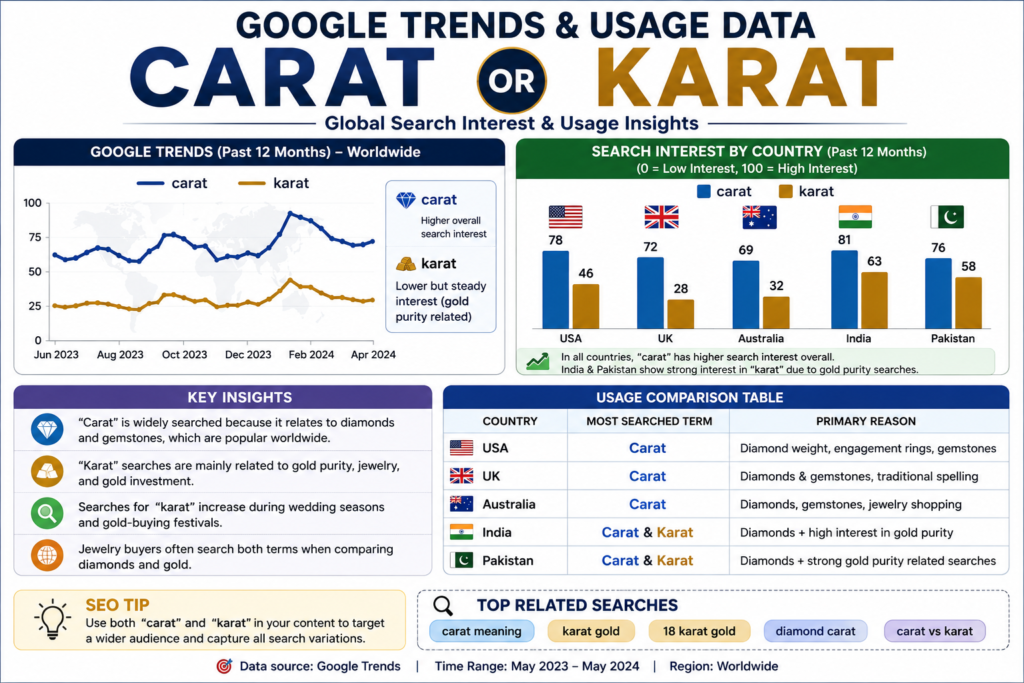
Usage Insight by Country
| Country | Common Usage | SEO Insight |
|---|---|---|
| 🇺🇸 USA | Carat for gems, karat for gold | Explain the distinction clearly |
| 🇬🇧 UK | Carat for gems and often gold | Mention British usage |
| 🇦🇺 Australia | Carat is widely understood | Include both forms |
| 🇮🇳 India | Strong gold-related usage | Focus on gold purity |
| 🇵🇰 Pakistan | Strong jewelry and gold usage | Explain both terms |
SEO insight: A comparison article should target both spellings because users search for both forms.
📊 Comparison Table: Keyword Variations
| Keyword Variation | Search Intent | Recommended Content |
|---|---|---|
| carat or karat | Comparison | Basic difference |
| carat vs karat | Comparison | Detailed comparison |
| karat vs carat | Comparison | Spelling guide |
| carat meaning | Informational | Gemstone definition |
| karat meaning | Informational | Gold definition |
| carat definition | Informational | Jewelry terminology |
| karat definition | Informational | Gold terminology |
| diamond carat meaning | Informational | Diamond weight |
| gold karat meaning | Informational | Gold purity |
| carat and karat difference | Comparison | Complete guide |
FAQ’s
1. Is “carat” a correct word?
Yes. Carat is the standard term for gemstone weight.
It is also used for gold purity in British English.
2. What is the difference between carat and karat?
Carat measures gemstone weight.
Karat measures gold purity, mainly in American English.
3. Which is more common, carat or karat?
Carat is generally more widely recognized.
It applies to gemstone weight and some British gold terminology.
4. Which word should I use in formal writing?
Use carat for gemstone weight.
Use karat for gold purity when following American English.
For British audiences, carat is commonly used for gold purity.
5. Why does confusion between carat and karat exist?
The words share historical roots and have similar pronunciations.
Their modern uses became separated by industry and regional spelling conventions.
Conclusion
Carat Or Karat can seem confusing because the words sound alike. Their meanings, however, are easy to separate. Carat measures the weight of diamonds and other gemstones. One carat equals 200 milligrams. Karat measures gold purity, especially in American English.
For example, 18-karat gold contains 18 parts gold out of 24. British English often uses carat for gold purity instead. The easiest memory trick is C for Carat and Crystal. Use carat when discussing gemstones. Use karat when discussing gold purity in American English. Always consider your target audience and style guide. Using the right term makes jewelry descriptions clearer. It also helps readers understand whether you are discussing gemstone weight or gold purity.

Daniel Foster is a comparison analyst and content strategist at Comparelly.com. He specializes in researching products, services, tools, and industry trends to create clear, unbiased comparison guides. With a focus on accuracy and practical insights, Daniel helps readers understand key differences and make informed decisions with confidence. His goal is to simplify complex choices through trustworthy, easy-to-understand content.