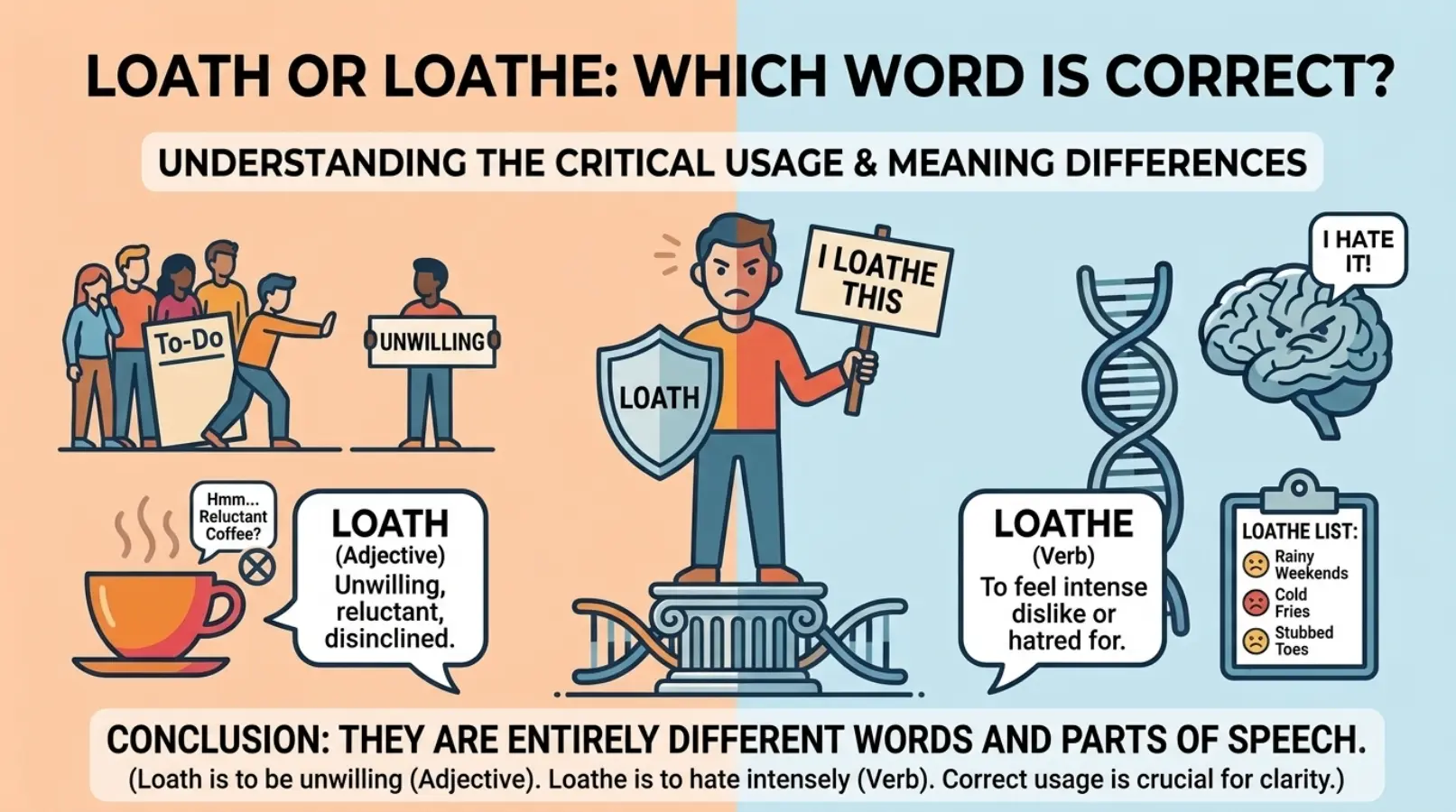
Loath Or Loathe is a common English spelling confusion. Both words relate to strong dislike, but they work differently in sentences. Loath is an adjective that means unwilling or reluctant to do something. Loathe is a verb that means to hate or dislike something intensely. The extra e changes the word’s function and meaning. For example, you can be loath to admit a mistake. However, you can loathe dishonest behavior.
Many writers confuse these words because they sound similar in everyday speech. Understanding their grammatical roles makes the difference much easier. This guide explains loath vs loathe, their meanings, origins, correct usage, common mistakes, and everyday examples. It also includes a simple memory trick. By the end, you will know exactly when to use loath and when to use loathe.
Quick Answer
Loath means unwilling or reluctant. Loathe means to hate or strongly dislike something.
Example: I am loath to complain, but I loathe unfair treatment.
Meaning of Loath
Loath is an adjective that means unwilling or reluctant to do something.
It usually appears before an infinitive phrase containing to.
Examples
- She was loath to leave the party early.
- He was loath to admit that he was wrong.
Common Uses of Loath
You can use loath when someone:
- feels reluctant
- does not want to act
- hesitates to do something
- struggles to accept an action
Simple meaning:
👉 Loath = Unwilling or reluctant.
Common Pattern
A useful structure is:
be loath to + verb
Examples:
- I am loath to complain.
- They were loath to change the plan.
- She is loath to give up.
Meaning of Loathe
Loathe is a verb that means to hate or strongly dislike someone or something.
It expresses a much stronger feeling than simply saying that you dislike something.
Examples
- I loathe dishonest behavior.
- She loathes being treated unfairly.
Common Uses of Loathe
You can use loathe when someone:
- strongly dislikes something
- hates a particular activity
- feels intense dislike
- strongly rejects a behavior or idea
Simple meaning:
👉 Loathe = Hate or strongly dislike.
Common Pattern
Use loathe + noun or loathe + -ing verb.
Examples:
- He loathes dishonesty.
- She loathes waiting in long lines.
- They loathe unfair rules.
Key Differences: Loath vs Loathe
| Feature | Loath | Loathe |
|---|---|---|
| Meaning | Unwilling or reluctant | Hate or strongly dislike |
| Part of speech | Adjective | Verb |
| Main use | Describes reluctance | Describes strong dislike |
| Tone | Formal | Strong and emotional |
| Usage | Usually followed by “to” | Usually followed by a noun or -ing form |
| Popularity | Less common | More common |
Quick Comparison
Loath: She was loath to criticize her manager.
Loathe: She loathes rude behavior.
The words have different meanings despite their similar sounds.
Origin & History
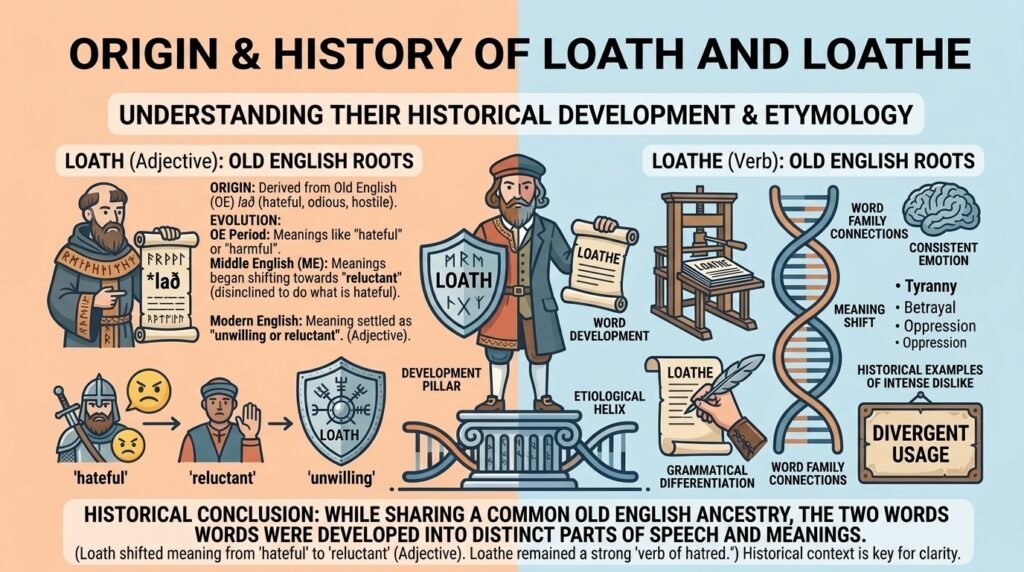
Loath comes from Old English lāth, meaning hateful, hostile, or reluctant.
Over time, its meaning developed toward being unwilling or reluctant.
Loathe developed from the same Old English word family. It became a verb meaning to hate or strongly dislike.
The words remain closely related but now have different grammatical roles.
Similar Word Examples
English contains many words that look or sound similar but differ in meaning.
Examples include:
- advice / advise
- breath / breathe
- cloth / clothe
- bath / bathe
- loose / lose
- affect / effect
Learning each word’s grammatical role can prevent confusion.
🇬🇧 British English vs 🇺🇸 American English Spelling
Loath and loathe have the same spelling in British and American English.
Their meanings and grammatical roles also remain the same.
The difference is between the words themselves, not regional spelling.
British vs American English Comparison
| Feature | British English | American English |
|---|---|---|
| Reluctant | Loath | Loath |
| Strongly dislike | Loathe | Loathe |
| Spelling | Same | Same |
| Meaning | Same | Same |
| Regional difference | None | None |
When to Use Loath
Use loath when you mean unwilling or reluctant.
It commonly appears in the structure loath to + verb.
Examples
- I am loath to interrupt the meeting.
- He was loath to sell his old car.
- She is loath to make a quick decision.
- They were loath to abandon the project.
Easy Question
Ask yourself:
“Is the person reluctant to do something?”
If yes, use loath.
When to Use Loathe
Use loathe when you mean hate or strongly dislike.
It functions as a verb.
Examples
- I loathe dishonesty.
- She loathes waking up early.
- He loathes unfair criticism.
- They loathe wasting food.
Easy Question
Ask yourself:
“Does the person strongly dislike something?”
If yes, use loathe.
Common Mistakes
Mistake 1: Using Loathe for Reluctance
❌ I loathe to complain about the service.
✅ I am loath to complain about the service.
The correct phrase is be loath to + verb.
Mistake 2: Using Loath for Strong Dislike
❌ I loath dishonest people.
✅ I loathe dishonest behavior.
The verb loathe means strongly dislike.
Mistake 3: Forgetting the Final “E”
❌ She loath unfair treatment.
✅ She loathes unfair treatment.
The verb changes to loathes with a third-person singular subject.
Mistake 4: Treating Loath and Loathe as Synonyms
❌ Loath and loathe mean exactly the same thing.
✅ Loath means reluctant, while loathe means strongly dislike.
Their meanings are related but different.
Mistake 5: Confusing Loath With Loathed
❌ He was loathed to leave.
✅ He was loath to leave.
Loathed means hated by someone.
Loath means unwilling.
Easy Trick to Remember
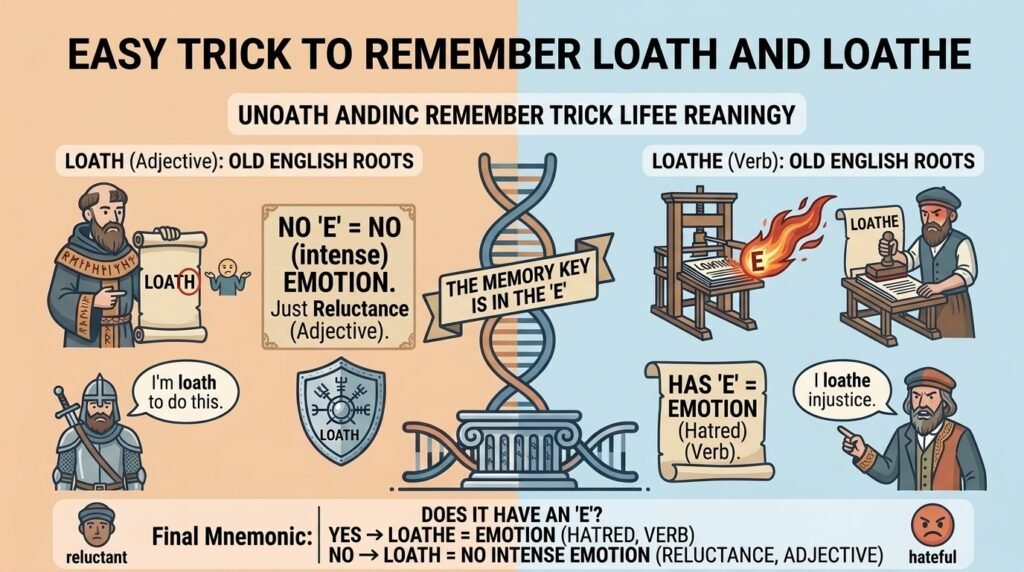
Use this simple memory trick:
Loath = Reluctant
Think:
Loath → “I am loath to do it.”
It describes unwillingness.
Loathe = Hate
The final E can remind you of an intense emotion.
Loathe → Hate
Remember:
👉 Loath = Unwilling
👉 Loathe = Strongly dislike
This quick distinction can prevent most spelling mistakes.
Everyday Life Examples
1. Refusing to Leave
Someone may feel reluctant to leave a favorite place.
Example:
She was loath to leave the beautiful beach.
- Primary keyword: loath
- Secondary keyword: loath meaning
2. Disliking Dishonesty
Someone may strongly dislike dishonest behavior.
Example:
He loathes dishonesty in the workplace.
- Primary keyword: loathe
- Secondary keyword: loathe meaning
3. Making a Difficult Decision
A person may hesitate before making an important choice.
Example:
I am loath to make such an important decision quickly.
- Primary keyword: loath
- Secondary keyword: loath to
4. Disliking Long Commutes
Someone may strongly dislike spending hours in traffic.
Example:
She loathes driving during rush hour.
- Primary keyword: loathe
- Secondary keyword: loathe meaning
5. Giving Up a Favorite Item
Someone may feel unwilling to part with something valuable.
Example:
He was loath to give away his old guitar.
- Primary keyword: loath
- Secondary keyword: loath vs loathe
Related Keywords
Here are useful keyword variations for this topic:
- loath or loathe
- loath vs loathe
- loathe vs loath
- loath meaning
- loathe meaning
- loath definition
- loathe definition
- loath to meaning
- is loath a word
- is loathe a word
Google Trends & Usage Data
Search interest for loath or loathe mainly comes from spelling and word-choice questions.
Loathe appears more often in everyday vocabulary because it functions as a common verb.
Loath is less common and often appears in the phrase “loath to.”
Search behavior can vary across the USA, UK, Australia, India, and Pakistan.
Usage Insight by Country
| Country | Common Search Context | SEO Insight |
|---|---|---|
| 🇺🇸 USA | Vocabulary and spelling | Target both forms |
| 🇬🇧 UK | English usage and grammar | Include phrase examples |
| 🇦🇺 Australia | General English | Explain the meaning clearly |
| 🇮🇳 India | English learning | Use simple examples |
| 🇵🇰 Pakistan | English learning and spelling | Focus on common mistakes |
Key SEO Insight
Loath or loathe has strong spelling-comparison intent.
Loath meaning targets readers who need the definition of reluctance.
Loathe meaning targets readers learning the verb for strong dislike.
Using both forms naturally helps cover different search intents.
📊 Comparison Table: Keyword Variations
| Keyword Variation | Search Intent | Best Content Angle |
|---|---|---|
| loath or loathe | Comparison | Spelling guide |
| loath vs loathe | Comparison | Word difference |
| loathe vs loath | Comparison | Usage guide |
| loath meaning | Informational | Definition |
| loathe meaning | Informational | Definition |
| loath definition | Informational | Vocabulary |
| loathe definition | Informational | Vocabulary |
| loath to meaning | Informational | Phrase meaning |
| is loath a word | Informational | Correctness |
| loath or loathe spelling | Spelling | Quick answer |
FAQ’s
1. Is “loath” a correct word?
Yes. Loath is a correct adjective meaning unwilling or reluctant.
2. What is the difference between loath and loathe?
Loath means unwilling. Loathe means to hate or strongly dislike something.
3. Which is more common, loath or loathe?
Loathe is generally more common. Loath often appears in the phrase “loath to.”
4. Is “loath” formal usage?
Yes. Loath often appears in formal or literary writing. The phrase “loath to” is especially common.
5. Why does confusion between loath and loathe exist?
The words look and sound very similar. Their related origins also contribute to the confusion.
Conclusion
Loath Or Loathe can confuse even experienced English writers. Both words are correct, but they have different meanings. Loath is an adjective that means unwilling or reluctant. It commonly appears in the phrase “loath to” followed by a verb. Loathe is a verb that means to hate or strongly dislike something.
For example, you can be loath to leave, but you can loathe dishonesty. The easiest way to remember them is simple. Loath means reluctant, while loathe means strongly dislike. Neither word has a different British or American spelling. Their distinction depends on meaning and grammar. Always check what you want to express before choosing the word. With this simple rule, you can use loath and loathe correctly.

Daniel Foster is a comparison analyst and content strategist at Comparelly.com. He specializes in researching products, services, tools, and industry trends to create clear, unbiased comparison guides. With a focus on accuracy and practical insights, Daniel helps readers understand key differences and make informed decisions with confidence. His goal is to simplify complex choices through trustworthy, easy-to-understand content.