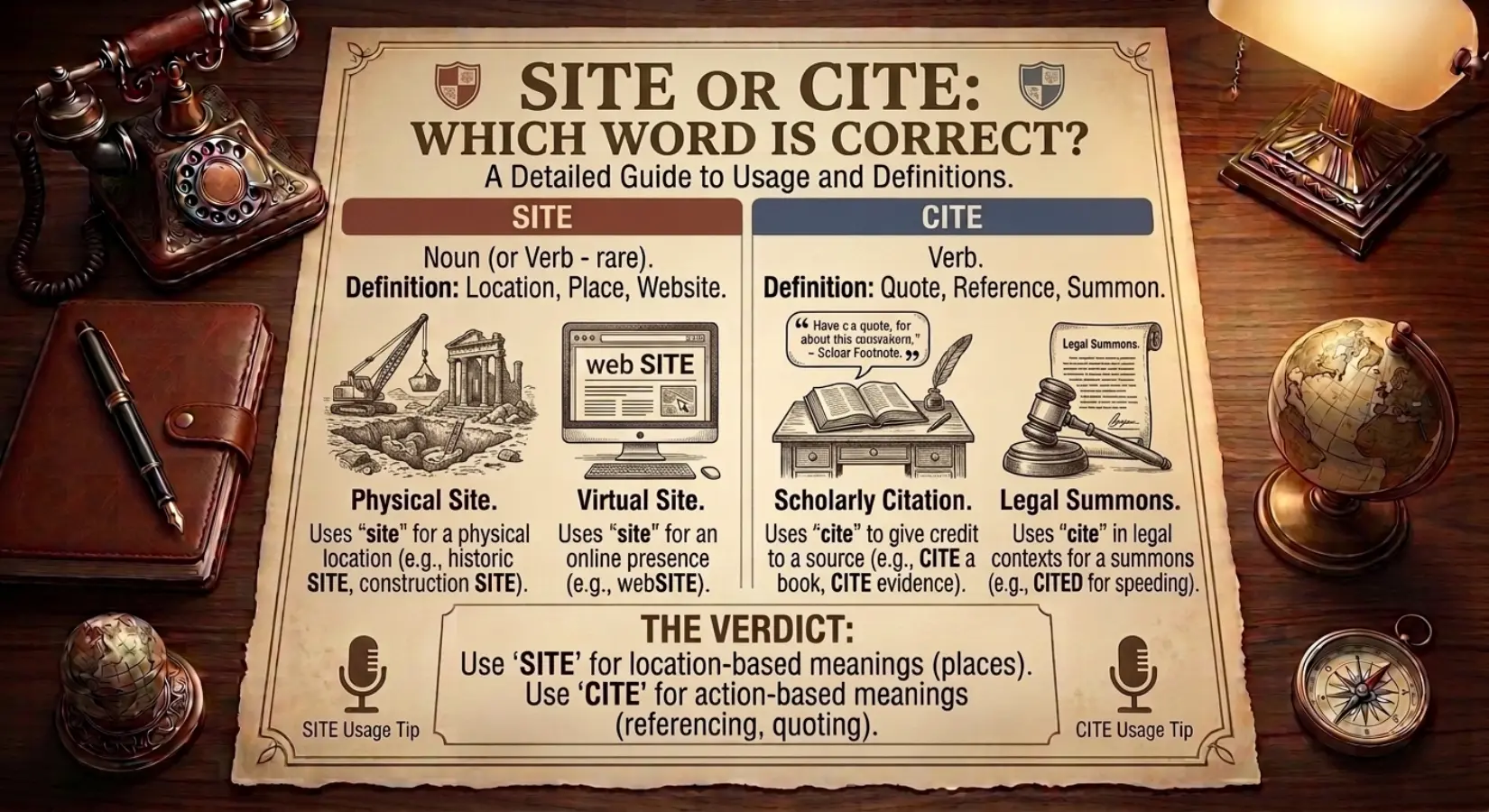
Site Or Cite is a common English word confusion. Both words sound alike, but they have different meanings and uses. Site usually refers to a place, location, or position. You can visit a construction site, website, or historical site. Cite usually means to mention or refer to a source, example, or authority.
Students often cite books in essays. Writers cite research to support their claims. These words are homophones, so they sound the same but have different spellings and meanings. Choosing the right word depends on what you want to say. Site relates to a place, while cite relates to mentioning or referencing something.
This guide explains site vs cite, their meanings, differences, origins, common mistakes, and everyday examples. It also provides a simple memory trick to help you remember which spelling to use.
Quick Answer (for Google snippet)
Site means a place or location. Cite means to mention, quote, or refer to a source.
Example: The company chose a new site for its office, and the report cited three studies.
Meaning of Site
Site usually means a place or location where something exists or happens.
It can describe physical places and digital locations.
Examples
- The workers arrived at the construction site early.
- I found the information on the company’s website.
Common Uses of Site
You may use site when talking about:
- construction sites
- websites
- historical sites
- accident sites
- camping sites
- business locations
- archaeological sites
Simple meaning:
👉 Site = Place or location.
Example Sentences
- The school selected a new site for its building.
- We visited an ancient historical site.
Meaning of Cite
Cite means to mention or refer to something as evidence or support.
It commonly appears in academic, legal, and professional writing.
Examples
- The student cited two sources in her essay.
- The report cited recent research to support its conclusion.
Common Uses of Cite
You may use cite when talking about:
- academic sources
- research papers
- books
- laws
- court decisions
- evidence
- examples
Simple meaning:
👉 Cite = Mention or refer to a source.
Example Sentences
- Please cite your sources correctly.
- The lawyer cited an earlier court decision.
Key Differences: Site vs Cite
| Feature | Site | Cite |
|---|---|---|
| Meaning | Place or location | Mention or reference |
| Part of speech | Usually noun | Usually verb |
| Main use | Places and locations | Sources and evidence |
| Tone | Everyday and general | Academic, legal, or professional |
| Popularity | Very common | Common |
| Example | Visit the site | Cite the source |
Quick Comparison
Site: The team visited the building site.
Cite: The researcher cited a scientific study.
Origin & History
Site comes from Latin situs, meaning position or place. It entered English through Old French.
Cite comes from Latin citare, meaning to summon or call. It later developed the meaning of referring to an authority or source.
Although these words sound identical, they developed from different roots.
Similar Word Examples
English contains many homophones with different meanings.
Examples include:
- site / cite / sight
- right / write
- hear / here
- plain / plane
- brake / break
- sea / see
Learning the meaning of each word helps prevent spelling mistakes.
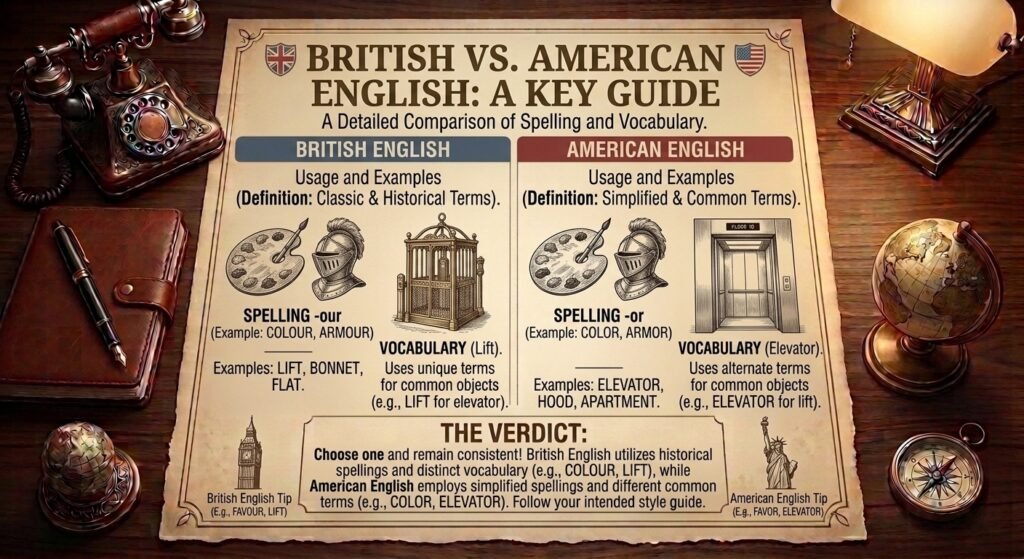
🇬🇧 British English vs 🇺🇸 American English Spelling
Site and cite have the same spelling in British and American English.
Their meanings also remain the same across both varieties.
The difference comes from meaning, not regional spelling.
British vs American English Comparison
| Feature | British English | American English |
|---|---|---|
| Place | Site | Site |
| Refer to a source | Cite | Cite |
| Spelling | Same | Same |
| Meaning | Same | Same |
| Regional difference | None | None |
When to Use Site
Use site when referring to a place or location.
Examples
- The company purchased a new site.
- Workers cleaned the construction site.
- We visited the historical site.
- The website has useful information.
Easy Question
Ask yourself:
“Am I talking about a place?”
If yes, site is probably the correct word.
Use cite when referring to or mentioning a source.
When to Use Cite
Examples
- Students should cite their sources.
- The article cites several research studies.
- The lawyer cited the relevant law.
- Please cite the book in your assignment.
Easy Question
Ask yourself:
“Am I referring to a source or authority?”
If yes, use cite.
Common Mistakes
Mistake 1: Using Cite for a Location
❌ The company selected a new cite for its factory.
✅ The company selected a new site for its factory.
A factory needs a site, or physical location.
Mistake 2: Using Site for a Source
❌ You should site your sources in the essay.
✅ You should cite your sources in the essay.
You cite sources.
Mistake 3: Confusing Site With Sight
❌ The mountain was a beautiful site.
✅ The mountain was a beautiful sight.
Sight means something seen or viewed.
Mistake 4: Using Cite as a Noun
❌ Add the cite at the end of your essay.
✅ Add the citation at the end of your essay.
Cite usually functions as a verb.
Mistake 5: Choosing by Sound
❌ Site and cite can be used interchangeably.
✅ Site and cite sound alike but have different meanings.
Always consider the context.
Easy Trick to Remember
Use this simple trick:
📍 Site = Situation or Place
Think of a site as a location.
Site → Place
📚 Cite = Citation
Think of cite as the beginning of citation.
Cite → Citation → Source
Remember:
Site = Where
Cite = Reference
This quick trick makes the difference easier to remember.
Everyday Life Examples
1. Construction Project
Construction projects happen at specific sites.
Example:
The engineers inspected the construction site before work began.
- Primary keyword: site
- Secondary keyword: construction site
2. Academic Writing
Students cite sources to support their ideas.
Example:
You should cite every source used in your research paper.
- Primary keyword: cite
- Secondary keyword: cite sources
3. Website
A website is a digital site where information appears.
Example:
The company launched a new site for its customers.
- Primary keyword: site
- Secondary keyword: website
4. Legal Writing
Lawyers often cite laws and court decisions.
Example:
The attorney cited an earlier court ruling.
- Primary keyword: cite
- Secondary keyword: legal citation
5. Historical Location
Historical places are often called historical sites.
Example:
Tourists visited the ancient historical site.
- Primary keyword: site
- Secondary keyword: historical site
Related Keywords
Here are useful keyword variations for this topic:
- site or cite
- site vs cite
- cite vs site
- site meaning
- cite meaning
- cite sources
- site definition
- cite definition
- site and cite difference
- site or cite spelling
Google Trends & Usage Data
Search interest for site is broad because it covers locations, websites, and other contexts.
Cite has stronger informational intent around academic writing, research, and citations.
Search behavior can vary across countries and user groups.
For SEO, use both terms while clearly separating their meanings.
Usage Insight by Country
| Country | Common Search Context | SEO Insight |
|---|---|---|
| 🇺🇸 USA | Websites and academic writing | Target both meanings |
| 🇬🇧 UK | Websites and education | Include spelling examples |
| 🇦🇺 Australia | General English and education | Use clear comparisons |
| 🇮🇳 India | English learning and academic writing | Focus on simple explanations |
| 🇵🇰 Pakistan | English learning and student writing | Include practical examples |
Key SEO Insight
Site or cite has strong comparison and spelling intent.
Site meaning often relates to places or websites.
Cite meaning often relates to academic and professional references.
Targeting both terms naturally can cover multiple search intents.
📊 Comparison Table: Keyword Variations
| Keyword Variation | Search Intent | Best Content Angle |
|---|---|---|
| site or cite | Comparison | Spelling guide |
| site vs cite | Comparison | Word difference |
| cite vs site | Comparison | Vocabulary guide |
| site meaning | Informational | Definition |
| cite meaning | Informational | Definition |
| site definition | Informational | Vocabulary |
| cite definition | Informational | Vocabulary |
| cite sources | Informational | Academic writing |
| site or cite spelling | Spelling | Quick answer |
| site and cite difference | Comparison | Detailed explanation |
FAQ’s
1. Is “site” a correct word?
Yes. Site is a standard English word that usually means a place or location.
2. What is the difference between site and cite?
Site refers to a place. Cite means to mention or refer to a source, authority, or example.
3. Which is more common, site or cite?
Site is more common in general English. It has several everyday uses, including websites and locations.
4. Is “cite” formal usage?
Cite is common in formal writing. It frequently appears in academic, legal, and professional contexts.
5. Why does confusion between site and cite exist?
They are homophones. They sound the same but have different spellings and meanings.
Conclusion
Site Or Cite is a common English spelling confusion. Both words are correct, but they serve different purposes. Site usually means a place or location. You can visit a construction site, historical site, or website. Cite means to mention or refer to a source, authority, law, or example. Students often cite sources in academic writing.
Lawyers also cite laws and court decisions. The easiest memory trick is simple. Site means place, while cite means reference. These words have the same spelling in British and American English. Their meanings also remain unchanged across both varieties. Always consider the context before choosing the spelling. If you mean a location, choose site. If you mean referring to a source, choose cite. This simple distinction will make your writing clearer and more accurate.

Daniel Foster is a comparison analyst and content strategist at Comparelly.com. He specializes in researching products, services, tools, and industry trends to create clear, unbiased comparison guides. With a focus on accuracy and practical insights, Daniel helps readers understand key differences and make informed decisions with confidence. His goal is to simplify complex choices through trustworthy, easy-to-understand content.