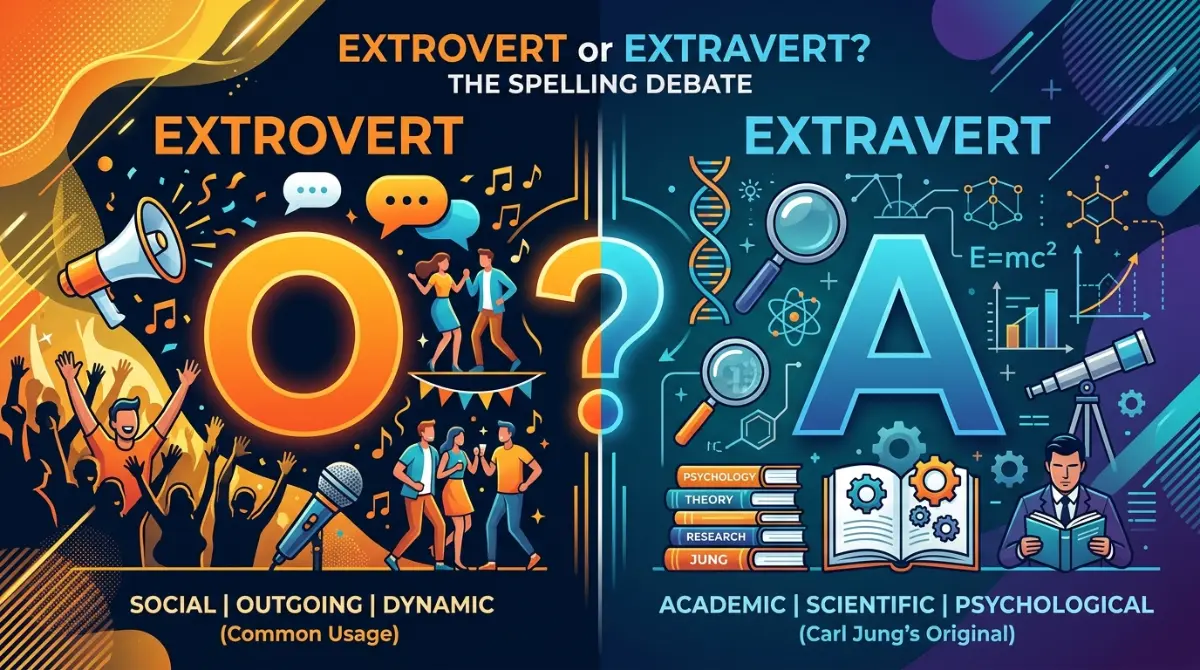
Extravert Or Extrovert is a common spelling question in English. Both words describe a person who tends to enjoy social interaction. They often feel comfortable around other people and may gain energy from social activities. Extrovert is the spelling most people use today. Extravert is also correct and has a long history in psychology.
The two words have the same basic meaning. Their difference mainly involves spelling and usage preference. You may see extravert in psychological writing or discussions of personality theory. However, extrovert is much more common in everyday English. Knowing this difference can help you choose the right word for your audience.
This guide explains extravert vs extrovert, their meanings, history, usage, common mistakes, and everyday examples. It also includes a simple memory trick for remembering both forms.
Quick Answer
Extravert and extrovert are both correct. They describe someone who tends to be outgoing and enjoys social interaction.
Extrovert is more common in modern everyday English.
Example: She is an extrovert who enjoys meeting new people.
Meaning of Extravert
Extravert is a noun or adjective describing a person who tends to focus on the outside world and social interaction.
The term is especially associated with psychological discussions of personality.
An extravert often enjoys social activities, conversation, and interaction with others.
Examples
- The psychologist described him as an extravert.
- As an extravert, she enjoys working with large groups.
Common Uses of Extravert
You may see extravert in:
- psychology
- personality research
- academic writing
- personality discussions
- professional assessments
Simple meaning:
👉 Extravert = A socially outgoing person.
Meaning of Extrovert
Extrovert has the same basic meaning as extravert.
It describes someone who tends to enjoy social interaction and activities involving other people.
The word is very common in everyday English.
Examples
- My brother is an extrovert who loves parties.
- She is an extrovert and easily starts conversations.
Common Uses of Extrovert
You may use extrovert when discussing:
- personality
- friendships
- social activities
- communication
- work environments
- everyday behavior
Simple meaning:
👉 Extrovert = A person who enjoys social interaction.
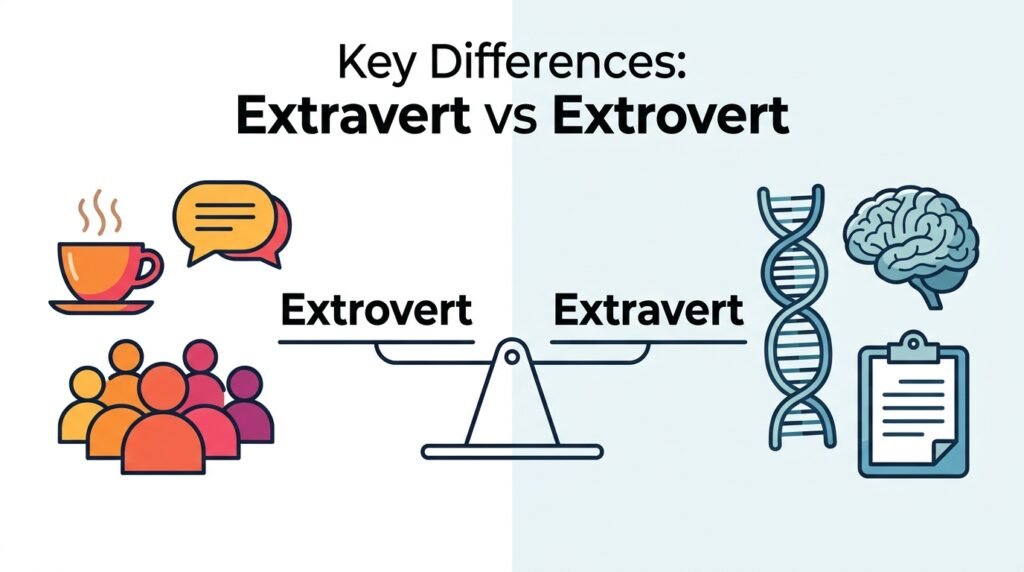
Key Differences: Extravert vs Extrovert
| Feature | Extravert | Extrovert |
|---|---|---|
| Meaning | Socially outgoing person | Socially outgoing person |
| Basic idea | Enjoys external social interaction | Enjoys external social interaction |
| Tone | More technical or psychological | General and conversational |
| Usage | Psychology and academic contexts | Everyday English |
| Popularity | Less common | More common |
| Correctness | Correct | Correct |
Quick Comparison
Extravert: The study examined how extraverts respond to social situations.
Extrovert: He is an extrovert who enjoys meeting new people.
The meaning remains essentially the same.
Origin & History
The word extravert is closely connected with the terminology of Swiss psychiatrist Carl Jung.
Jung used the term extraversion when discussing personality orientation.
The spelling extrovert later became much more common in general English.
Many people now use extrovert in everyday speech and writing.
Similar Word Examples
English contains several pairs with different spellings or preferred forms.
Examples include:
- extraversion / extroversion
- extravert / extrovert
- adviser / advisor
- ageing / aging
- travelling / traveling
- grey / gray
These differences may reflect historical development or regional preference.
🇬🇧 British English vs 🇺🇸 American English Spelling
Both extravert and extrovert can appear in British and American English.
Extrovert is the more familiar form in both varieties.
The choice is mainly based on usage preference rather than a strict regional spelling rule.
British vs American English Comparison
| Feature | British English | American English |
|---|---|---|
| Common form | Extrovert | Extrovert |
| Alternative | Extravert | Extravert |
| Meaning | Same | Same |
| Formal use | Extravert may appear | Extravert may appear |
| Everyday choice | Extrovert | Extrovert |
When to Use Extravert
Use extravert when discussing personality from a psychological or academic perspective.
It can also be useful when following terminology that uses extraversion.
Examples
- The researcher studied extraverts and introverts.
- The assessment measures extraversion and introversion.
- The psychologist described her as an extravert.
- Extraverts may enjoy frequent social interaction.
Best Choice for Technical Writing
Extravert can work well when your writing follows psychological terminology.
Always follow the terminology used by your chosen style guide or source.
When to Use Extrovert
Use extrovert for everyday writing and general conversations.
It is the most familiar spelling for most English readers.
Examples
- Tom is an extrovert who loves meeting people.
- She became more confident and extroverted.
- My friend is a natural extrovert.
- Extroverts often enjoy social gatherings.
Best Choice for General Audiences
Choose extrovert when writing:
- blog posts
- social media content
- general articles
- casual messages
- everyday communication
Common Mistakes
Mistake 1: Calling Extravert Incorrect
❌ Extravert is not a real English word.
✅ Extravert is a correct word and an established psychological term.
Both forms are valid.
Mistake 2: Assuming the Words Have Different Meanings
❌ An extravert is different from an extrovert.
✅ Extravert and extrovert have essentially the same meaning.
The main difference involves spelling and usage frequency.
Mistake 3: Using Extrovert as the Only Correct Form
❌ Extravert is always wrong.
✅ Extrovert is more common, but extravert is also correct.
Do not treat the less common spelling as incorrect.
Mistake 4: Confusing Extrovert With Constant Social Activity
❌ Every extrovert must enjoy parties all the time.
✅ Extroverts often enjoy social interaction, but individuals vary.
Personality traits exist on a spectrum.
Mistake 5: Assuming Extroverts Never Need Alone Time
❌ Extroverts never want to be alone.
✅ Extroverts can enjoy social interaction and still value time alone.
Avoid turning personality descriptions into strict rules.
Easy Trick to Remember
Think of the two words as having the same personality.
Extravert = Extrovert
Both describe someone who tends toward social interaction.
For everyday writing, remember:
👉 EXTROvert = the EXTRA familiar spelling
This is only a memory trick, not the historical origin of the word.
If you are unsure, choose extrovert for general audiences.
Everyday Life Examples
1. Meeting New People
An extrovert may enjoy introducing themselves to strangers.
Example:
Sara is an extrovert who easily makes new friends.
- Primary keyword: extrovert
- Secondary keyword: extrovert meaning
2. Workplace Communication
Some outgoing people enjoy group discussions.
Example:
As an extrovert, James enjoys leading team meetings.
- Primary keyword: extrovert
- Secondary keyword: extrovert personality
3. Psychology Research
Psychologists may use the term extravert in research.
Example:
The study compared extraverts and introverts.
- Primary keyword: extravert
- Secondary keyword: extravert personality
4. Social Events
Extroverts may enjoy busy social environments.
Example:
The extrovert spent the evening talking with new guests.
- Primary keyword: extrovert
- Secondary keyword: outgoing personality
5. Personality Descriptions
People often use extrovert when describing themselves.
Example:
I am an extrovert who enjoys meeting people and sharing ideas.
- Primary keyword: extrovert
- Secondary keyword: extrovert traits
Related Keywords
Here are useful keyword variations for this topic:
- extravert or extrovert
- extravert vs extrovert
- extrovert vs extravert
- extravert meaning
- extrovert meaning
- extravert definition
- extrovert definition
- extravert personality
- extrovert personality
- extrovert or extravert spelling
Google Trends & Usage Data
Searches for extrovert are generally broader because the word is common in everyday English.
Extravert attracts more specialized interest around psychology and personality terminology.
Search behavior can vary across the USA, UK, Australia, India, and Pakistan.
For SEO, targeting both spellings helps capture comparison and definition searches.
Usage Insight by Country
| Country | Common Search Context | SEO Insight |
|---|---|---|
| 🇺🇸 USA | Personality and everyday English | Lead with extrovert |
| 🇬🇧 UK | Psychology and general vocabulary | Include both forms |
| 🇦🇺 Australia | General English and personality | Use extrovert first |
| 🇮🇳 India | English learning and personality | Explain the spelling clearly |
| 🇵🇰 Pakistan | English learning and vocabulary | Include simple examples |
Key SEO Insight
Extravert or extrovert has strong spelling and comparison intent.
Extrovert meaning targets readers looking for a simple definition.
Extravert meaning can attract readers interested in psychological terminology.
Using both terms naturally gives the article broader topical coverage.
📊 Comparison Table: Keyword Variations
| Keyword Variation | Search Intent | Best Content Angle |
|---|---|---|
| extravert or extrovert | Comparison | Spelling guide |
| extravert vs extrovert | Comparison | Word difference |
| extrovert vs extravert | Comparison | Usage guide |
| extrovert meaning | Informational | Definition |
| extravert meaning | Informational | Psychology |
| extrovert definition | Informational | Vocabulary |
| extravert definition | Informational | Vocabulary |
| extrovert personality | Informational | Personality |
| extravert personality | Informational | Psychology |
| extrovert or extravert spelling | Spelling | Quick answer |
FAQ’s
1. Is “extravert” a correct word?
Yes. Extravert is a correct and established English word. It describes a person who tends toward social interaction.
2. What is the difference between extravert and extrovert?
They have essentially the same meaning. Extrovert is more common in everyday English, while extravert is often used in psychological contexts.
3. Which is more common, extravert or extrovert?
Extrovert is more common in modern general English. Most readers will recognize it immediately.
4. Is extravert formal usage?
It can be. Extravert is especially suitable when discussing psychological terminology or personality theory.
5. Why does confusion between extravert and extrovert exist?
The two spellings developed from the same personality concept. Extrovert became the more familiar everyday form.
Conclusion
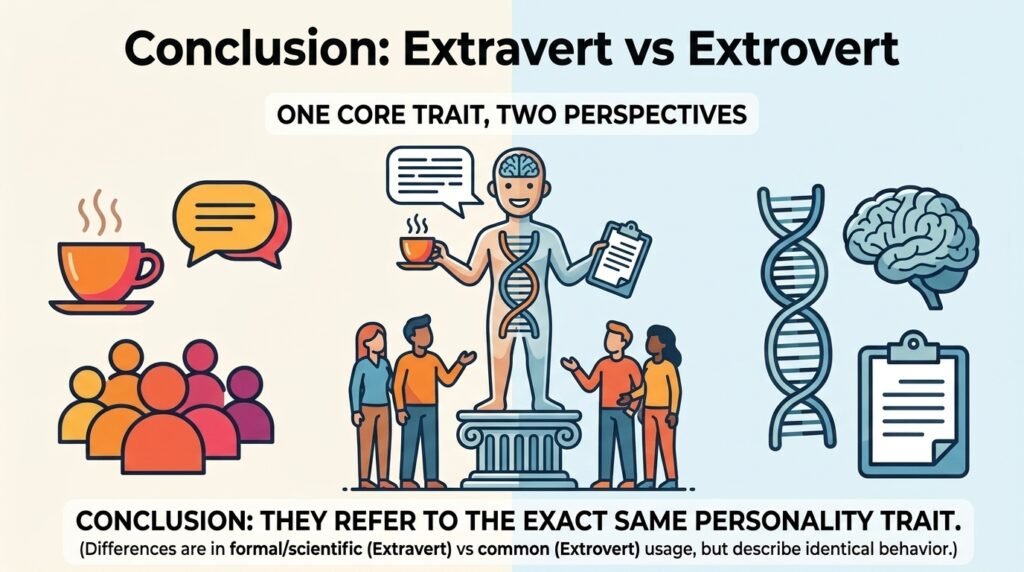
Extravert Or Extrovert can confuse writers because both spellings are correct. The two words have essentially the same meaning. They describe someone who tends toward social interaction and an outward focus. Extrovert is the more common form in everyday English. Extravert remains an established term, especially in psychological and academic contexts. The difference does not mainly come from British or American spelling.
Both forms can appear in both varieties of English. For blogs, casual writing, and general audiences, extrovert is usually the safest choice. For psychology-related writing, extravert may fit the terminology better. The most important point is consistency. Choose the form that suits your audience and context. Remember that extravert and extrovert share the same basic meaning.

Daniel Foster is a comparison analyst and content strategist at Comparelly.com. He specializes in researching products, services, tools, and industry trends to create clear, unbiased comparison guides. With a focus on accuracy and practical insights, Daniel helps readers understand key differences and make informed decisions with confidence. His goal is to simplify complex choices through trustworthy, easy-to-understand content.