
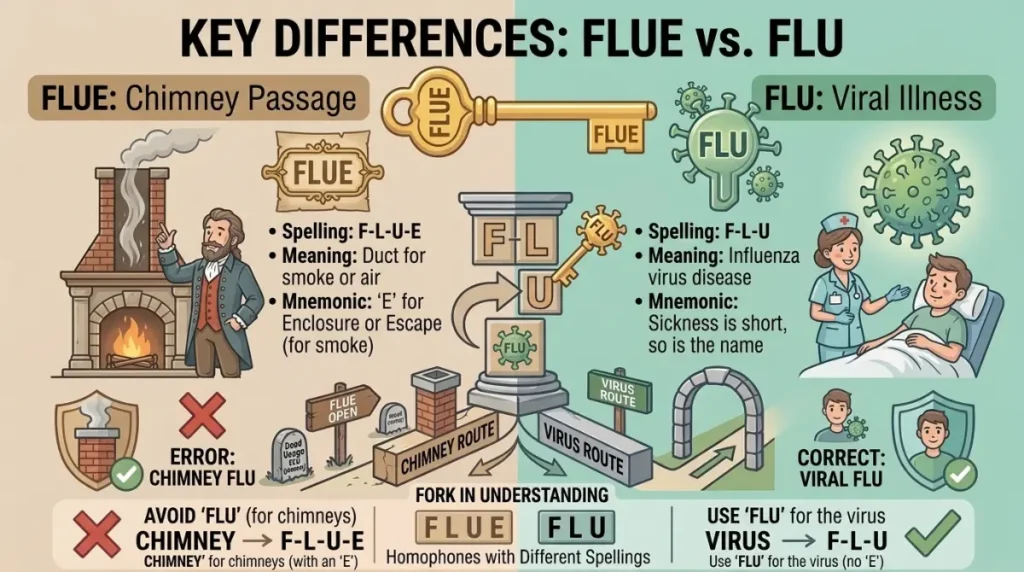
Flue Or Flu is a common English word confusion. Both words sound exactly the same, but they have completely different meanings. Flue is a noun related to chimneys, fireplaces, and heating systems. It refers to a passage that carries smoke or gases away from a building. Flu is a short form of influenza, a viral illness that can cause fever, cough, and body aches.
The spelling difference is small, but the meanings are unrelated. Writers often confuse these words because they are pronounced alike. Understanding their meanings makes the correct choice much easier.
This guide explains flue vs flu, their definitions, origins, correct usage, common mistakes, and everyday examples. It also provides a simple memory trick. By the end, you will know exactly when to use flue and flu.
Quick Answer
Flue means a passage that carries smoke or gases from a fireplace, furnace, or boiler. Flu means influenza, a viral respiratory illness.
Example: The chimney flue needs cleaning because I have the flu.
Meaning of Flue
Flue is a noun that means a passage or duct used to carry smoke, fumes, or gases.
You will often find a flue inside a chimney or heating system.
Examples
- The chimney flue needs cleaning before winter.
- Smoke escaped through the damaged flue.
Common Uses of Flue
You can use flue when talking about:
- chimneys
- fireplaces
- furnaces
- boilers
- heating systems
- smoke vents
- gas exhaust systems
Simple meaning:
👉 Flue = A passage that carries smoke or gases away.
Meaning of Flu
Flu is an informal short form of influenza.
Influenza is a viral infection that mainly affects the respiratory system.
It can cause symptoms such as:
- fever
- cough
- sore throat
- tiredness
- body aches
- chills
Examples
- She stayed home because she had the flu.
- Several students caught the flu this week.
Simple meaning:
👉 Flu = Influenza, a viral illness.
Key Differences: Flue vs Flu
| Feature | Flue | Flu |
|---|---|---|
| Meaning | Smoke or gas passage | Influenza |
| Part of speech | Noun | Noun |
| Tone | Technical | Everyday |
| Usage | Chimneys and heating systems | Health and illness |
| Pronunciation | Usually sounds like “flu” | Usually sounds like “flue” |
| Popularity | Less common | Very common |
Quick Comparison
Flue: The technician inspected the furnace flue.
Flu: I stayed home because I had the flu.
The words sound alike but describe completely different things.
Origin & History
Flue has historical connections with words describing channels or passages for airflow.
Its modern use developed around passages that carry smoke or gases.
Flu comes from influenza, a word that entered English through Italian.
The word influenza was once associated with the idea of an influence affecting health.
Over time, English speakers shortened influenza to flu.
Similar Word Examples
English has many homophones with different meanings.
Examples include:
- flower / flour
- brake / break
- pair / pear
- right / write
- sea / see
- hear / here
These words sound alike but have different spellings and meanings.
🇬🇧 British English vs 🇺🇸 American English Spelling
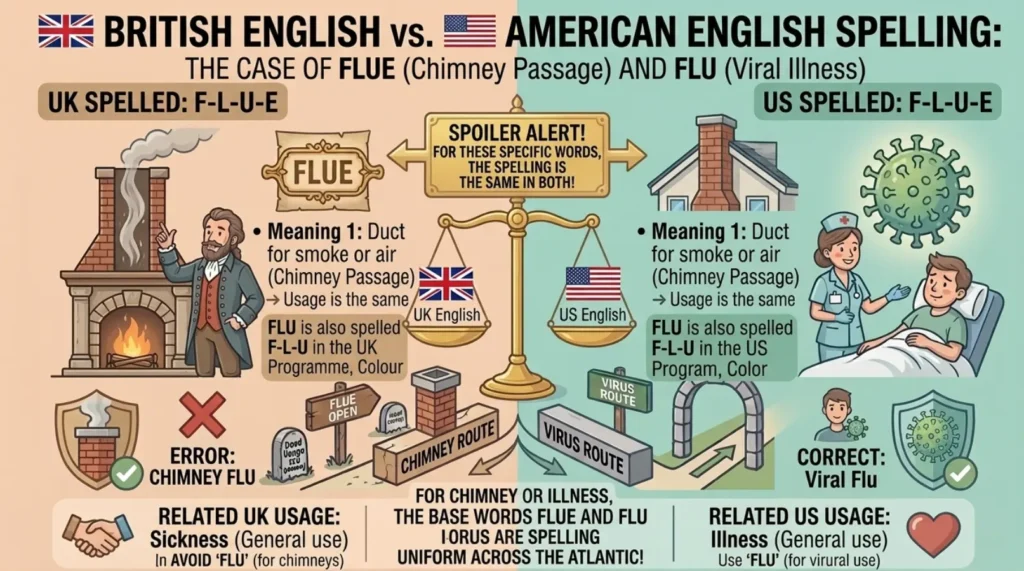
Flue has the same spelling in British and American English.
Flu also has the same spelling in both varieties.
The difference comes from meaning, not regional spelling.
British vs American English Comparison
| Feature | British English | American English |
|---|---|---|
| Chimney passage | Flue | Flue |
| Influenza | Flu | Flu |
| Spelling | Same | Same |
| Meaning | Same | Same |
| Regional difference | None | None |
When to Use Flue
Use flue when discussing a passage that carries smoke, fumes, or gases.
It commonly appears in home maintenance and heating contexts.
Examples
- The chimney flue needs regular inspection.
- A blocked flue can affect ventilation.
- The fireplace flue was damaged.
- The boiler has a separate flue.
Easy Question
Ask yourself:
“Am I talking about a chimney, fireplace, or gas passage?”
If yes, use flue.
When to Use Flu
Use flu when talking about influenza or the illness caused by influenza viruses.
Examples
- He missed work because of the flu.
- She developed a fever after catching the flu.
- The flu spread quickly through the school.
- I received a flu vaccine before winter.
Easy Question
Ask yourself:
“Am I talking about an illness?”
If yes, use flu.
Common Mistakes
Mistake 1: Using Flu for a Chimney
❌ The flu needs cleaning.
✅ The flue needs cleaning.
A chimney has a flue, not a flu.
Mistake 2: Using Flue for Influenza
❌ I caught the flue last week.
✅ I caught the flu last week.
The illness is called the flu.
Mistake 3: Confusing “Flu” With “Flue”
❌ The fireplace flu is blocked.
✅ The fireplace flue is blocked.
A fireplace uses a flue to carry smoke away.
Mistake 4: Using “Flue” in Health Writing
❌ The doctor said I have the flue.
✅ The doctor said I have the flu.
Use flu when discussing influenza.
Mistake 5: Assuming the Same Meaning
❌ Flue and flu are different spellings for the same thing.
✅ Flue and flu are homophones with different meanings.
Their pronunciation is similar, but their meanings differ.
Easy Trick to Remember
Use this simple memory trick:
Flue = Fuel and Fire
Think about:
🔥 Fire → Flue
A fireplace or furnace uses a flue to remove smoke and gases.
Flu = Feeling Unwell
Think:
🤒 Flu → Feeling sick
Remember:
👉 Flue = Smoke passage
👉 Flu = Influenza
This trick makes the spelling easier to remember.
Everyday Life Examples
1. Cleaning a Chimney
Example:
The chimney flue should be cleaned before you use the fireplace.
- Primary keyword: Flue Or Flu
- Secondary keyword: flue meaning
2. Catching an Illness
Example:
Tom stayed home because he had the flu.
- Primary keyword: Flue Or Flu
- Secondary keyword: flu meaning
3. Checking a Heating System
Example:
The engineer inspected the boiler flue during the annual service.
- Primary keyword: Flue Or Flu
- Secondary keyword: flue vs flu
4. Talking About Winter Illness
Example:
Many people become concerned about the flu during winter.
- Primary keyword: Flue Or Flu
- Secondary keyword: flu definition
5. Fixing a Fireplace
Example:
The fireplace flue was blocked, so the owner called a technician.
- Primary keyword: Flue Or Flu
- Secondary keyword: correct spelling of flue
Related Keywords
Here are useful keyword variations for this topic:
- flue or flu
- flue vs flu
- flu vs flue
- flue meaning
- flu meaning
- flue definition
- flu definition
- flue spelling
- flu spelling
- difference between flue and flu
Google Trends & Usage Data
Search interest for Flue Or Flu mainly comes from spelling confusion and homophone searches.
Flu has much wider everyday usage because people frequently discuss influenza and flu symptoms.
Flue has a narrower search audience interested in chimneys, fireplaces, boilers, and heating systems.
Across the USA, UK, Australia, India, and Pakistan, the spelling remains the same.
Usage Insight by Country
| Country | Common Search Context | SEO Insight |
|---|---|---|
| 🇺🇸 USA | Flu and home heating | Target both meanings |
| 🇬🇧 UK | Flu and chimney terms | Add British examples |
| 🇦🇺 Australia | Health and heating | Explain both words |
| 🇮🇳 India | English learning | Focus on homophones |
| 🇵🇰 Pakistan | English spelling | Highlight pronunciation |
📊 Comparison Table: Keyword Variations
| Keyword Variation | Search Intent | Best Content Angle |
|---|---|---|
| flue or flu | Comparison | Spelling guide |
| flue vs flu | Comparison | Meaning and usage |
| flu vs flue | Comparison | Homophone guide |
| flue meaning | Informational | Definition |
| flu meaning | Informational | Definition |
| flue definition | Informational | Home maintenance |
| flu definition | Informational | Health vocabulary |
| difference between flue and flu | Comparison | Detailed explanation |
| flue spelling | Spelling | Correct word |
| flu spelling | Spelling | Correct word |
FAQ
1. Is “flue” a correct word?
Yes. Flue is a correct word for a passage that carries smoke or gases.
2. What is the difference between flue and flu?
Flue refers to a smoke or gas passage. Flu refers to influenza.
3. Which is more common, flue or flu?
Flu is generally more common in everyday English. Flue has more specialized uses.
4. Is “flue” formal usage?
Yes. Flue is a standard technical term used in heating and ventilation contexts.
5. Why does confusion between flue and flu exist?
They are homophones. They sound alike but have different spellings and meanings.
Conclusion
Flue Or Flu is a classic English homophone confusion. Both words are correct, but they describe completely different things. Flue means a passage that carries smoke, fumes, or gases. You commonly see it with chimneys, fireplaces, furnaces, and boilers. Flu is the short form of influenza.
It refers to a viral illness that can cause symptoms such as fever, cough, and body aches. The easiest way to remember the difference is to connect flue with fire. Connect flu with feeling sick. Both words have the same spelling in British and American English. Always consider the context before choosing the word. If you are discussing a chimney, choose flue. If you are discussing an illness, choose flu.

Daniel Foster is a comparison analyst and content strategist at Comparelly.com. He specializes in researching products, services, tools, and industry trends to create clear, unbiased comparison guides. With a focus on accuracy and practical insights, Daniel helps readers understand key differences and make informed decisions with confidence. His goal is to simplify complex choices through trustworthy, easy-to-understand content.