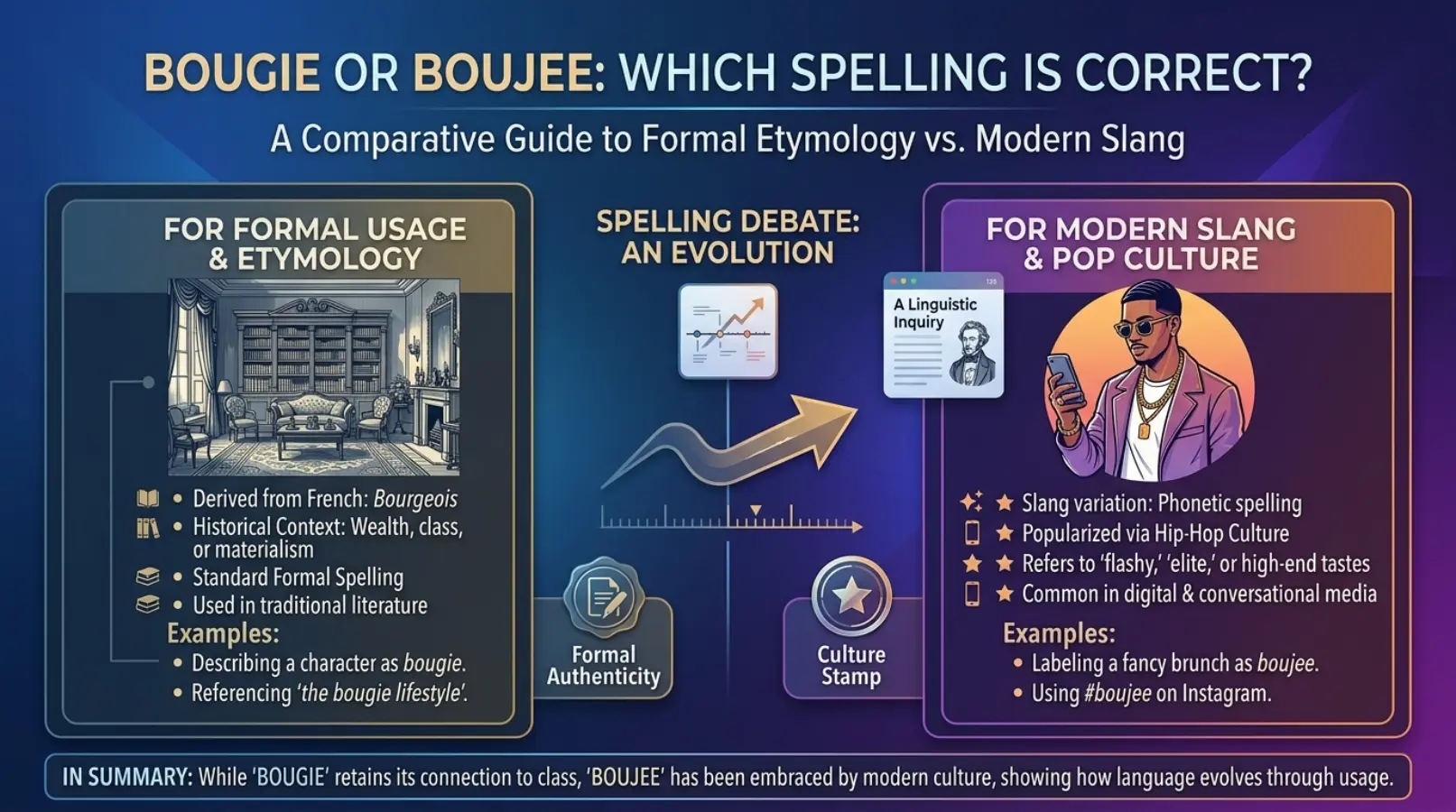
Bougie Or Boujee is a common spelling confusion in modern English. Both forms appear online, especially in social media and casual conversations. However, they have slightly different histories and uses.
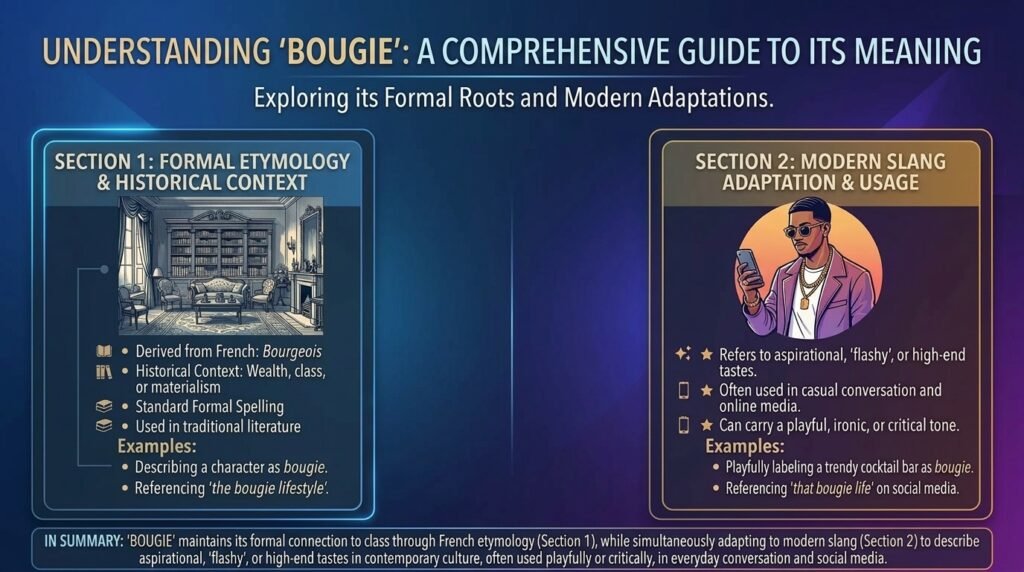
Bougie is the more established spelling. It comes from the French word bourgeois, which relates to middle-class life. Today, bougie often describes something luxurious, expensive, sophisticated, or overly concerned with status.
Boujee is a popular informal spelling. It became especially common through music, internet culture, and social media. People often use it to describe someone who enjoys luxury or stylish experiences.
The two forms can communicate a similar idea. However, bougie is generally the better choice in standard writing. Boujee works well in casual and playful contexts.
Understanding this difference helps you choose the right spelling for your audience and writing style.
Quick Answer
Bougie is the standard and more established spelling. Boujee is an informal variant often used in social media and popular culture.
Example:
“She loves bougie restaurants.”
“That hotel looks really boujee.”
Meaning of Bougie
Bougie is an informal adjective that describes something luxurious, expensive, stylish, or associated with an upper-class lifestyle.
It can describe people, places, food, fashion, products, or experiences.
The word can also carry a playful or slightly critical tone.
Examples of Bougie
- We found a bougie restaurant downtown.
- She loves buying bougie candles for her home.
Simple Meaning
Bougie = luxurious, fancy, stylish, or expensive.
It often suggests that someone enjoys a comfortable or high-end lifestyle.
Meaning of Boujee
Boujee is an informal spelling of bougie. It usually carries the same basic meaning.
It often describes someone or something that appears luxurious, fashionable, expensive, or status-conscious.
The spelling feels more playful and is strongly associated with casual internet language and popular culture.
Examples of Boujee
- That hotel looks incredibly boujee.
- He ordered a boujee coffee with several extras.
Simple Meaning
Boujee = fancy, luxurious, stylish, or high-end.
The spelling often gives the word a more playful or trendy feeling.
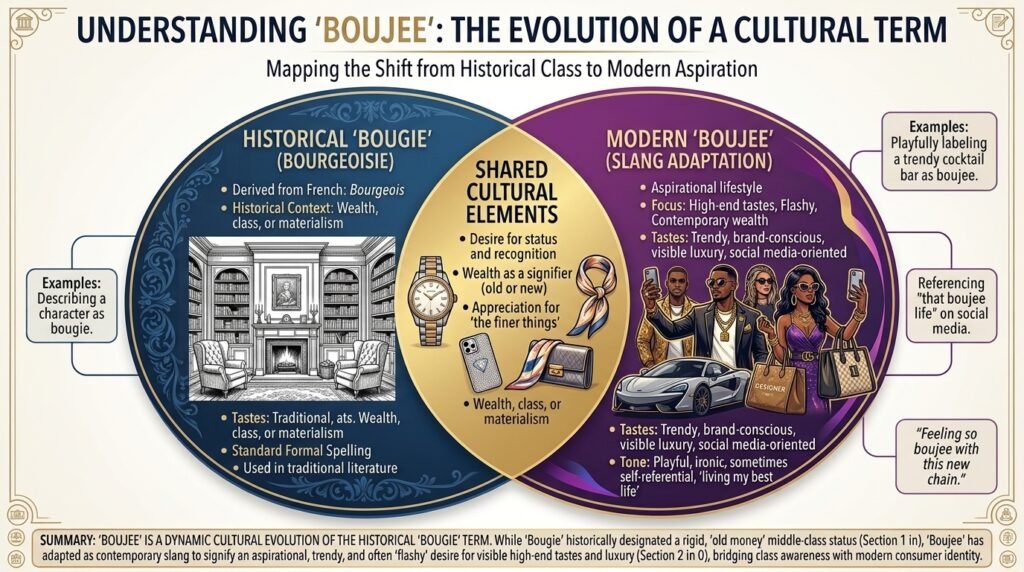
Bougie Or Boujee: Key Differences
| Feature | Bougie | Boujee |
|---|---|---|
| Meaning | Fancy, luxurious, status-conscious | Usually the same |
| Tone | Informal, playful, sometimes critical | Very informal and playful |
| Usage | General writing and casual speech | Social media, slang, casual speech |
| Popularity | More established spelling | Popular informal variant |
| Style | More standard | More trendy |
| Best use | General audience | Casual online contexts |
Bougie is usually the safer spelling for general writing.
Boujee works especially well when you want a casual or humorous tone.
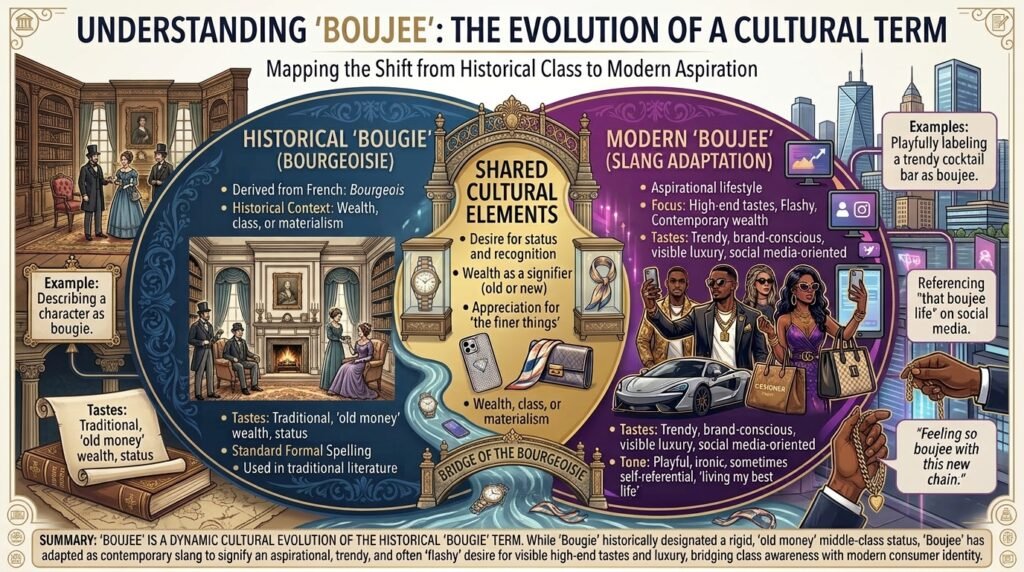
Origin & History of Bougie and Boujee
The word bougie comes from bourgeois, a French term connected with the middle class.
Over time, English speakers shortened and reshaped the term. Modern slang gave bougie a new meaning related to luxury, comfort, and status.
The spelling boujee developed as an informal variant. Music and popular culture helped spread this version widely.
Today, both forms appear in informal English.
Similar Word Examples
Modern slang often develops alternate spellings:
- Bougie / Boujee
- Doughnut / Donut
- Thru / Through
- Gonna / Going to
- Wanna / Want to
These forms may differ in style or formality.
British English vs American English Spelling
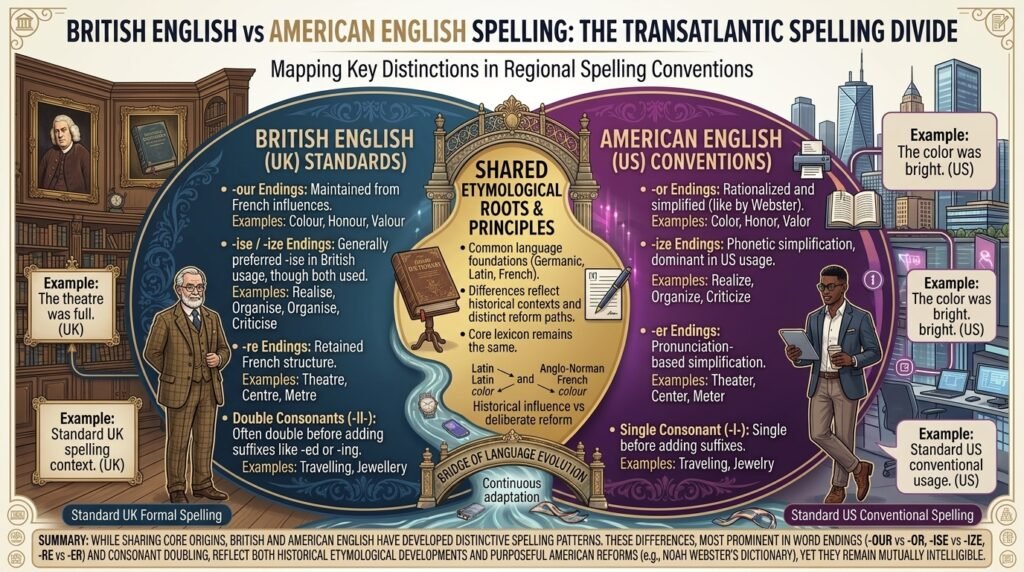
There is no major British-American spelling difference between bougie and boujee.
Both spellings can appear in informal English in different English-speaking regions.
The main difference involves style, usage, and cultural context rather than national spelling rules.
British vs American English
| Feature | British English | American English |
|---|---|---|
| Bougie | Used informally | Used informally |
| Boujee | Used informally | Used informally |
| Standard spelling | Bougie | Bougie |
| Informal variant | Boujee | Boujee |
| Main difference | Context and style | Context and style |
When to Use Bougie
Use bougie when you want the more established spelling.
It works well when describing luxury, sophistication, or expensive tastes.
1. Describing Restaurants
We found a bougie restaurant near the city center.
2. Describing Hotels
They stayed at a bougie hotel during their vacation.
3. Describing Lifestyle
She enjoys a bougie lifestyle filled with luxury.
4. Describing Food
He ordered a bougie brunch with champagne and pastries.
5. Describing Products
These bougie skincare products cost a fortune.
Tip: Choose bougie when you want a widely recognized spelling.
When to Use Boujee
Use boujee in casual, playful, or social-media-focused writing.
It can make a sentence sound more trendy or humorous.
1. Social Media Captions
Feeling boujee after a luxury spa day.
2. Casual Messages
This coffee shop is so boujee!
3. Humorous Writing
My cat has become way too boujee for ordinary food.
4. Popular Culture
The outfit gives serious boujee vibes.
5. Casual Conversations
We went somewhere boujee for dinner last night.
Tip: Choose boujee when the writing intentionally uses casual slang.
Common Mistakes
Mistake 1: Assuming Boujee Is the Only Correct Spelling
❌ Boujee is the only correct spelling.
✅ Bougie is the more established spelling, while boujee is an informal variant.
Mistake 2: Calling Bougie Incorrect
❌ Bougie is a spelling mistake.
✅ Bougie is a recognized informal English word.
Mistake 3: Using Boujee in Formal Writing
❌ The company offers a boujee corporate experience.
✅ The company offers a luxurious corporate experience.
Boujee is strongly informal. Formal writing usually benefits from clearer alternatives.
Mistake 4: Assuming the Words Have Completely Different Meanings
❌ Bougie and boujee describe completely different things.
✅ Both usually describe luxury, sophistication, or expensive tastes.
The main difference involves spelling, tone, and context.
Mistake 5: Using Bougie Without Understanding Its Tone
❌ The word bougie always means something positive.
✅ Bougie can sound positive, playful, or slightly critical.
Context determines the intended tone.
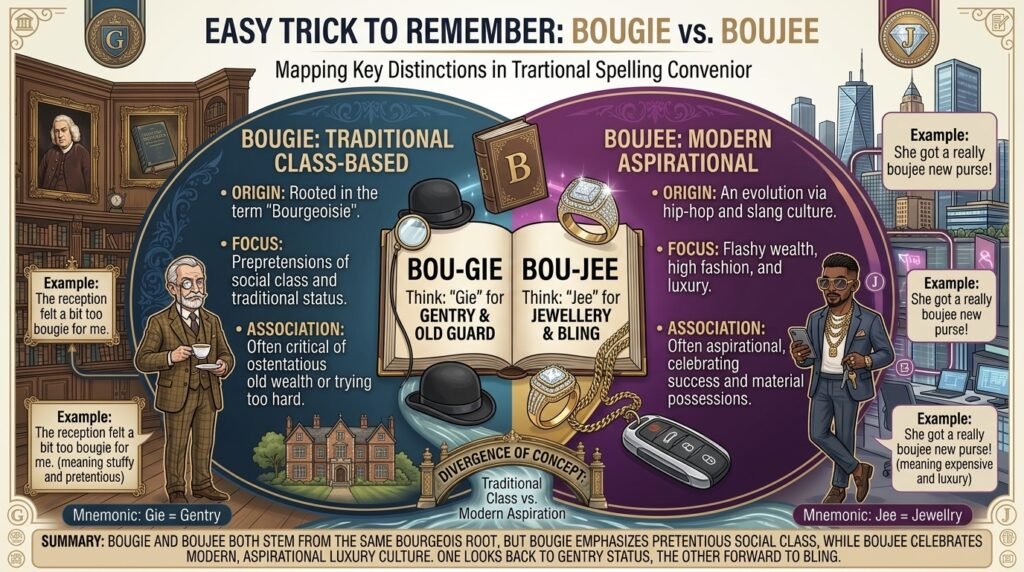
Easy Trick to Remember
Use this simple trick:
Bougie = Established
Think of bougie as the more established spelling.
Boujee = Extra E
The extra e makes boujee look more playful and informal.
Remember:
Bougie → standard informal spelling
Boujee → trendy informal variant
If you are unsure, choose bougie.
Everyday Life Examples
1. At a Restaurant
The restaurant has expensive dishes and elegant decorations.
This place is so bougie!
Here, bougie describes the luxurious atmosphere.
Primary keyword: Bougie
Secondary keyword: Boujee
2. At a Coffee Shop
A café offers expensive specialty drinks.
This coffee shop feels really boujee.
Here, boujee adds a casual and playful tone.
Primary keyword: Boujee
Secondary keyword: Bougie
3. During a Vacation
Someone stays at an expensive resort.
Our hotel was surprisingly bougie.
The word describes the luxurious experience.
Primary keyword: Bougie
Secondary keyword: Boujee
4. Talking About Fashion
Someone wears designer clothes and expensive accessories.
Her outfit looks incredibly boujee.
Here, boujee creates a trendy, casual tone.
Primary keyword: Boujee
Secondary keyword: Bougie
5. Describing Home Decor
Someone decorates their home with expensive furniture.
Their living room looks very bougie.
Here, bougie describes a stylish and luxurious setting.
Primary keyword: Bougie
Secondary keyword: Boujee
Related Keywords
Use these related keyword variations naturally:
- Bougie or boujee meaning
- Bougie vs boujee
- Is bougie correct?
- Is boujee a word?
- Bougie meaning
- Boujee meaning
- Difference between bougie and boujee
These variations help address different search intents.
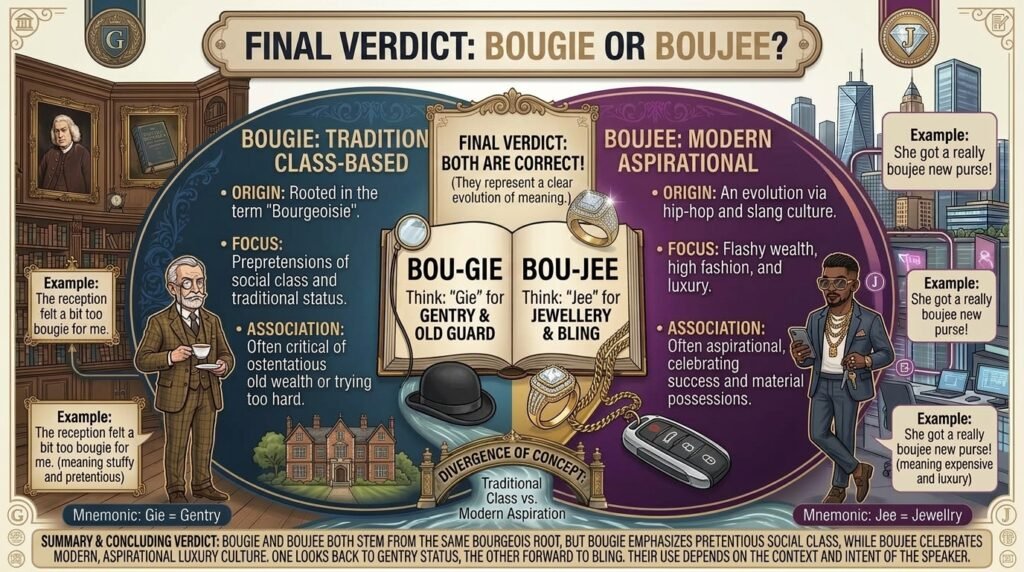
Final Verdict
Bougie is the better choice when you want the more established spelling.
Boujee is a popular informal variant. It works well in social media posts, casual messages, and playful conversations.
Both usually describe something luxurious, fancy, stylish, or status-conscious.
Choose based on your audience:
- General writing: Use bougie.
- Casual writing: Either can work.
- Social media: Boujee can create a trendy tone.
- Formal writing: Consider luxurious, upscale, or sophisticated instead.
In short, bougie is the safer choice. Boujee is more playful.
Google Trends & Usage Data
Search interest for bougie and boujee changes across countries and time periods. Google Trends measures relative search interest, not fixed search volume.
In the USA, both forms have strong connections with slang and popular culture. The UK and Australia also use both forms in informal English.
In India and Pakistan, searches may focus more on spelling, meaning, and English-language usage.
Insight: Bougie is the stronger choice for general SEO content, while boujee captures informal and social-media-oriented searches.
Comparison Table: Keyword Variations
| Keyword | Search Intent | Best Content Angle |
|---|---|---|
| Bougie or boujee | Comparison | Explain both forms |
| Bougie vs boujee | Difference | Compare spelling and tone |
| Bougie meaning | Definition | Explain luxury-related meaning |
| Boujee meaning | Definition | Explain informal variant |
| Is bougie a word? | Spelling | Confirm correct usage |
| Is boujee a word? | Spelling | Explain informal usage |
| Bougie lifestyle | Meaning | Luxury and status |
| Boujee lifestyle | Slang | Casual luxury culture |
Frequently Asked Questions
1. Is “bougie” correct?
Yes. Bougie is a recognized informal English word. It commonly describes luxury, expensive tastes, or an upper-class style.
2. What is the difference between bougie and boujee?
They usually have the same basic meaning. Bougie is the more established spelling. Boujee is a popular informal variant.
3. Which is more common, bougie or boujee?
Bougie is generally the more established form. Boujee is also widely used in casual online language.
4. Is bougie formal?
No. Bougie is informal slang. In formal writing, use words such as luxurious, upscale, or sophisticated.
5. Why do people confuse bougie and boujee?
Both spellings represent the same modern slang idea. Their pronunciation is similar, and social media has popularized both forms.
Conclusion
Bougie Or Boujee is mainly a question of spelling, style, and context. Bougie is the more established form and works well for general informal writing. Boujee is a popular variant that feels more playful and trendy. Both words can describe luxury, expensive tastes, fashionable lifestyles, or status-conscious behavior.
When writing for a broad audience, bougie is usually the safer choice. Use boujee when you want a casual social-media tone. Neither word is ideal for highly formal writing. In those situations, choose terms such as luxurious, upscale, or sophisticated. Understanding the tone behind each spelling helps you create clearer and more natural content.

Daniel Foster is a comparison analyst and content strategist at Comparelly.com. He specializes in researching products, services, tools, and industry trends to create clear, unbiased comparison guides. With a focus on accuracy and practical insights, Daniel helps readers understand key differences and make informed decisions with confidence. His goal is to simplify complex choices through trustworthy, easy-to-understand content.