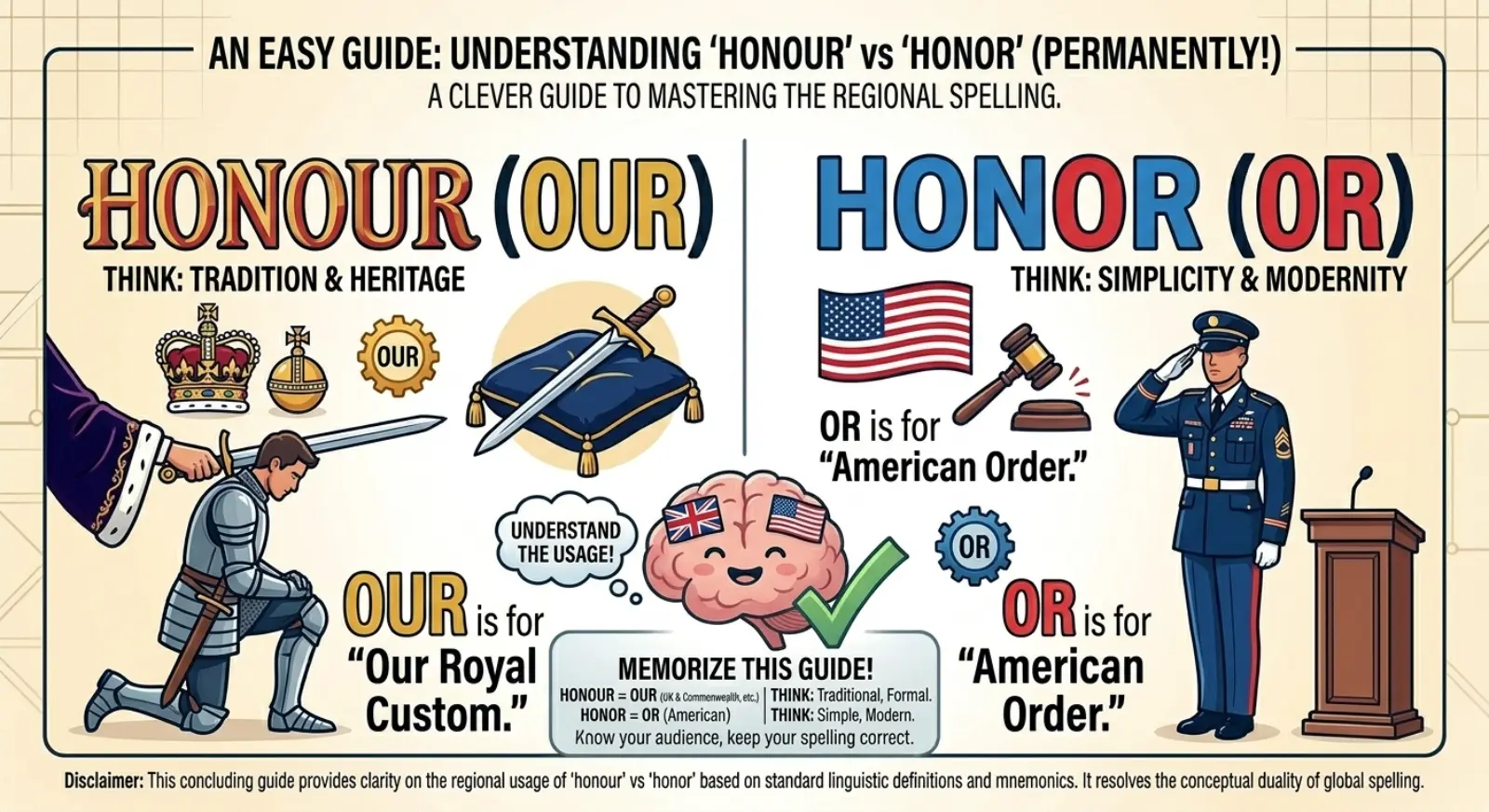
Honour Or Honor often confuses English learners because both spellings are correct. The difference comes from regional English conventions. Honour is the standard spelling in British English. Honor is the standard spelling in American English.
Both words have the same meaning. They can describe respect, dignity, recognition, or a special award. You may also use honour or honor as a verb. For example, someone may honour a promise or honor a promise. British English keeps the u in the word. American English usually removes it. Other words follow the same pattern, such as colour/color and favour/favor.
Knowing this difference helps you choose the right spelling. Your target audience should guide your choice. This article explains the meanings, history, usage, examples, common mistakes, and regional spelling differences.
Quick Answer (for Google snippet)
Honour is the British English spelling, while honor is the American English spelling. Both words have the same meaning and are correct.
Example: We honour our teachers. / We honor our teachers.
Meaning of Honour
Honour means showing respect, admiration, or recognition toward someone or something.
It can also describe personal integrity and a strong sense of what is right.
As a verb, honour means to show respect or fulfill an obligation.
Examples
- The community held a ceremony to honour the firefighter.
- She always tries to honour her promises.
Common Uses of Honour
- honour a person
- honour a tradition
- honour a promise
- honour someone’s memory
- honour an achievement
- sense of honour
- honour and respect
Honour is the preferred spelling in British English.
Meaning of Honor
Honor has exactly the same basic meanings as honour.
It means respect, dignity, recognition, or moral integrity.
As a verb, honor can mean respecting someone or keeping a promise.
Examples
- The school held an event to honor outstanding students.
- He promised to honor his agreement.
Common Uses of Honor
- honor a person
- honor a tradition
- honor a promise
- honor someone’s memory
- honor an achievement
- code of honor
- honor and respect
Honor is the preferred spelling in American English.
Key Differences: Honour vs Honor
| Feature | Honour | Honor |
|---|---|---|
| Meaning | Respect, dignity, recognition | Respect, dignity, recognition |
| Spelling | British English | American English |
| Tone | Formal and respectful | Formal and respectful |
| Usage | UK and many British-style varieties | United States |
| Popularity | Common internationally | Very common in the US |
| Extra letter | Contains u | No u |
| Example | Honour a hero | Honor a hero |
The meanings are the same.
The main difference is the spelling convention.

Origin & History
The word honour comes from Old French honor and ultimately traces to Latin honor.
English spelling later developed different regional forms.
British English generally kept the u.
American English adopted the shorter honor spelling.
The difference became part of a broader pattern in American English spelling.
Similar British and American Spelling Pairs
| British English | American English |
|---|---|
| honour | honor |
| colour | color |
| favour | favor |
| labour | labor |
| neighbour | neighbor |
| behaviour | behavior |
| humour | humor |
These words have the same meanings across both varieties.
🇬🇧 British English vs 🇺🇸 American English Spelling
Honour is the standard British English spelling.
Honor is the standard American English spelling.
The difference is only spelling, not meaning.
British vs American English Comparison
| Feature | British English | American English |
|---|---|---|
| Correct spelling | Honour | Honor |
| Meaning | Same | Same |
| Pronunciation | Generally similar | Generally similar |
| Formal usage | Honour | Honor |
| Verb form | Honour | Honor |
| Related form | Honoured | Honored |
| Related form | Honouring | Honoring |
When to Use Honour
Use honour when writing for a British English audience.
This includes audiences in the UK and many regions influenced by British English.
Examples
- We gathered to honour the fallen soldiers.
- The award was created to honour her achievements.
- He acted with great honour.
- They promised to honour the agreement.
- The school will honour its former principal.
Choose honour for British-style spelling throughout your document.
When to Use Honor
Use honor when writing for an American English audience.
It is the standard spelling used in the United States.
Examples
- We gathered to honor the fallen soldiers.
- The award was created to honor her achievements.
- He acted with great honor.
- They promised to honor the agreement.
- The school will honor its former principal.
Choose honor when following American spelling conventions.
Common Mistakes
Mistake 1: Mixing British and American Spelling
❌ We will honor the guest and use British spelling everywhere else.
✅ We will honour the guest and use British spelling consistently.
Consistency matters when choosing a regional style.
Mistake 2: Calling Honour Incorrect
❌ Honour is spelled incorrectly.
✅ Honour is the standard British English spelling.
Both forms are correct.
Mistake 3: Calling Honor Incorrect
❌ Honor is a spelling mistake.
✅ Honor is the standard American English spelling.
It is widely accepted in American English.
Mistake 4: Adding “U” to American English
❌ The American report will honour the winner.
✅ The American report will honor the winner.
Use American spelling consistently.
Mistake 5: Removing “U” in British English
❌ The British newspaper will honor the winner.
✅ The British newspaper will honour the winner.
British English normally keeps the u.
Easy Trick to Remember
Use this simple memory trick:
🇬🇧 Honour = UK
Remember that British English keeps the “U.”
🇺🇸 Honor = USA
American English removes the U.
Think:
Honour → British
Honor → American
The same pattern appears in:
colour → color
favour → favor
This makes the spelling difference easier to remember.
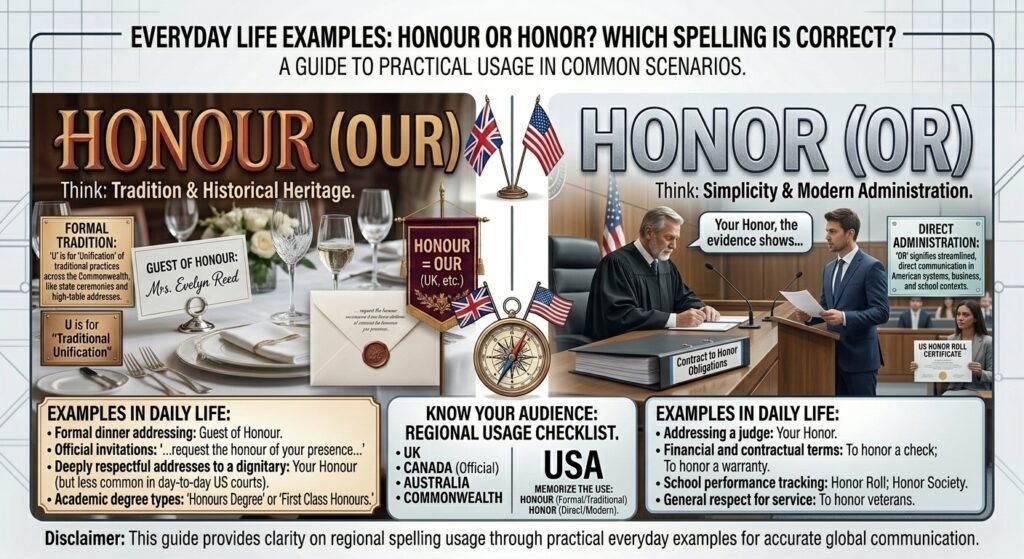
Everyday Life Examples
1. Honouring a Hero
People may recognize someone for their courage or service.
Example:
The town held a ceremony to honour the local hero.
- Primary keyword: honour
- Secondary keyword: honour a hero
2. Honoring a Teacher
Schools may recognize teachers for their contributions.
Example:
The school held a ceremony to honor its best teachers.
- Primary keyword: honor
- Secondary keyword: honor a teacher
3. Honouring a Tradition
Families often respect important cultural traditions.
Example:
Our family continues to honour this tradition every year.
- Primary keyword: honour
- Secondary keyword: honour a tradition
4. Honoring a Promise
A person can show integrity by keeping a promise.
Example:
He always tries to honor his promises.
- Primary keyword: honor
- Secondary keyword: honor a promise
5. Receiving an Honor
People can receive recognition for achievements.
Example:
She received a national honor for her work.
- Primary keyword: honor
- Secondary keyword: national honor
Related Keywords
Use these keyword variations naturally:
- honour or honor
- honour vs honor
- honor vs honour
- honour meaning
- honor meaning
- honour spelling
- honor spelling
- British spelling of honour
- American spelling of honor
- honour definition
- honor definition
Google Trends & Usage Data
Search interest for honour and honor varies by country and regional spelling habits.
The US strongly favors honor, while the UK strongly favors honour.
Australia, India, and Pakistan commonly use British-influenced spelling, including honour.
For SEO, match the spelling with your target audience and search market.
Usage Insight by Country
| Country | Preferred Spelling | SEO Insight |
|---|---|---|
| 🇺🇸 USA | Honor | Use American spelling |
| 🇬🇧 UK | Honour | Use British spelling |
| 🇦🇺 Australia | Honour | British-style spelling is common |
| 🇮🇳 India | Honour | British-influenced English is common |
| 🇵🇰 Pakistan | Honour | British-influenced English is common |
Key SEO Insight
Honor should be your main keyword for US-focused content.
Honour works better for UK and British-influenced audiences.
Both keywords can capture spelling-related searches.
Avoid mixing both forms randomly within one regional article.
📊 Comparison Table: Keyword Variations
| Keyword Variation | Search Intent | Best Content Angle |
|---|---|---|
| honour or honor | Comparison | Spelling guide |
| honour vs honor | Comparison | Difference article |
| honor vs honour | Comparison | Regional English guide |
| honour meaning | Informational | Definition |
| honor meaning | Informational | Definition |
| honour spelling | Spelling | British English guide |
| honor spelling | Spelling | American English guide |
| British spelling of honour | Informational | UK English |
| American spelling of honor | Informational | US English |
| honour definition | Informational | Vocabulary guide |
FAQ
1. Is “honour” a correct spelling?
Yes. Honour is the standard spelling in British English and other varieties that follow British conventions.
2. What is the difference between honour and honor?
There is no difference in meaning. Honour is British spelling, while honor is American spelling.
3. Which is more common, honour or honor?
It depends on the region. Honor is common in the United States. Honour is common in the UK and several other countries.
4. Is honour or honor more formal?
Both are equally formal. The appropriate spelling depends on your chosen English variety.
5. Why does the confusion between honour and honor exist?
British and American English developed different spelling conventions. The main difference is the extra u in honour.
Conclusion
Honour Or Honor is a common spelling difference between British and American English. Both words have the same meaning. They can describe respect, dignity, recognition, or personal integrity. The main difference is the letter u. British English uses honour, while American English uses honor. Other words follow the same pattern, including colour/color and favour/favor. Neither spelling is incorrect. Your target audience should determine your choice. Use honour for British English content. Use honor for American English content. The most important rule is consistency. Do not switch between regional spelling styles without a clear reason. Once you understand this simple difference, choosing between honour and honor becomes easy.

Daniel Foster is a comparison analyst and content strategist at Comparelly.com. He specializes in researching products, services, tools, and industry trends to create clear, unbiased comparison guides. With a focus on accuracy and practical insights, Daniel helps readers understand key differences and make informed decisions with confidence. His goal is to simplify complex choices through trustworthy, easy-to-understand content.