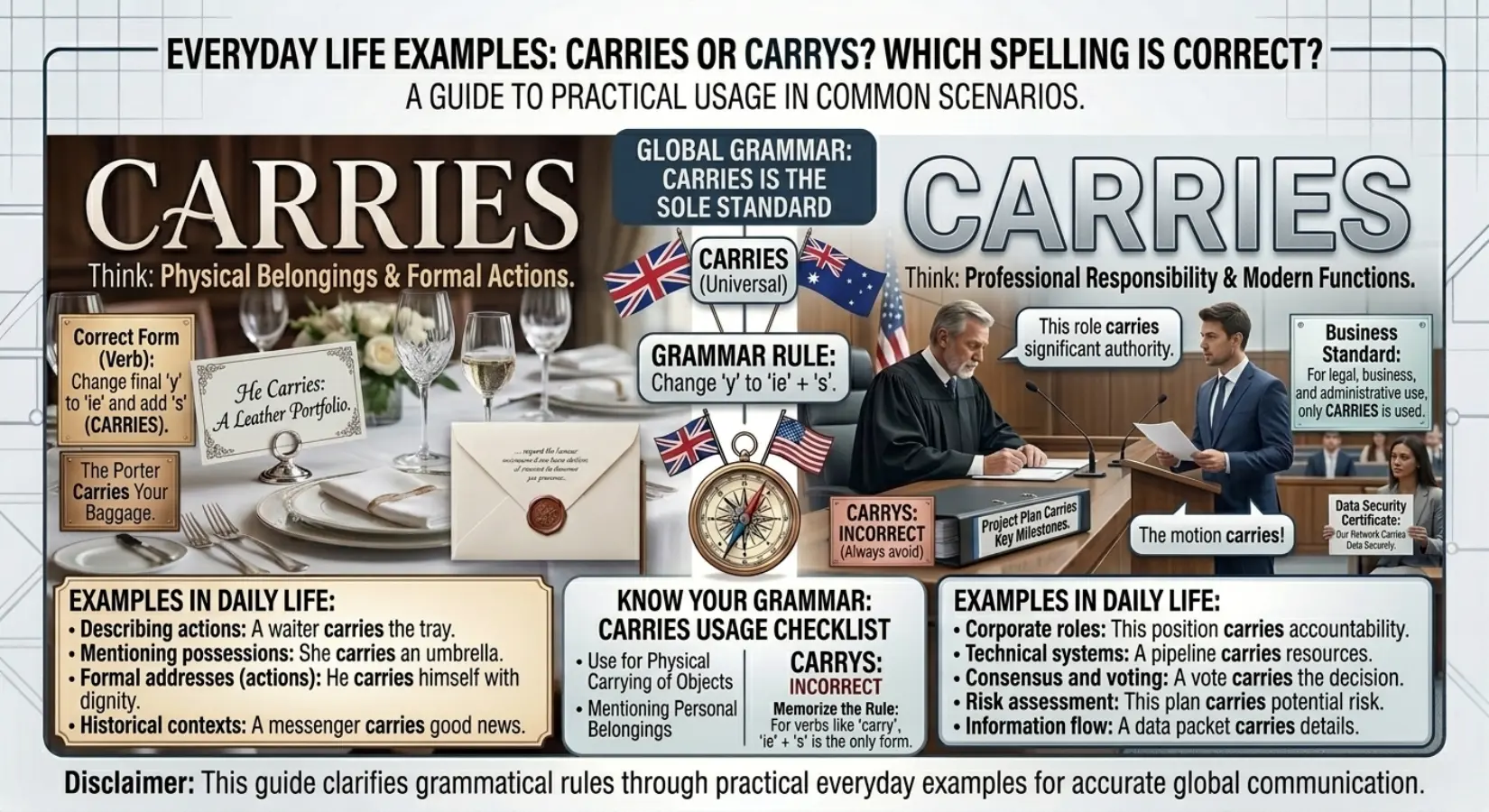
Carrys Or Carries is a common spelling confusion among English learners. The correct spelling is carries. Carrys is incorrect in standard English. The word carries is the third-person singular form of the verb carry.
We use it with he, she, it, or a singular noun. The spelling changes because carry ends with a consonant followed by y. When we add -s, the y changes to i, creating carries. This spelling rule also applies to many other English verbs.
For example, try becomes tries, and study becomes studies. Learning this simple rule can help you avoid similar mistakes. In this guide, we explain carrys vs carries, their meanings, grammar rules, examples, common errors, and usage. You will also learn an easy trick to remember the correct spelling.
Quick Answer (for Google snippet)
Carries is the correct spelling. Carrys is incorrect because verbs ending in consonant + y usually change y to i before adding -es.
Example: She carries a heavy bag to school.
Meaning of Carrys
Carrys is not a standard English word.
It is a common spelling mistake for carries.
Writers often make this mistake because they simply add -s to carry.
However, English grammar requires a spelling change.
❌ He carrys the box.
✅ He carries the box.
Why “Carrys” Is Incorrect
The base verb is:
carry
The correct third-person singular form is:
carries
The final y changes to i, and -es is added.
Meaning of Carries
Carries is the third-person singular form of carry.
It means holds, moves, transports, or supports something.
We use carries with singular subjects.
Examples
- She carries her books to class.
- The truck carries heavy equipment.
Other Meanings
Carries can have several meanings depending on context.
It can mean:
- holds something
- transports something
- supports weight
- takes something from one place to another
- communicates an idea
- has something available
More Examples
- The river carries water toward the sea.
- This store carries several popular brands.
- His voice carries across the room.
- The message carries an important meaning.
Key Differences: Carrys vs Carries
| Feature | Carrys | Carries |
|---|---|---|
| Meaning | No standard meaning | Third-person form of carry |
| Spelling | Incorrect | Correct |
| Grammar | Incorrect verb form | Correct verb form |
| Usage | Avoid | Standard English |
| Popularity | Used as a mistake | Very common |
| Example | ❌ He carrys it | ✅ He carries it |
The difference is simple.
Carrys is incorrect.
Carries is correct.
Origin & History
The verb carry entered English through Anglo-French and Old Northern French influences.
Over time, English developed regular spelling rules for verbs ending in consonant + y.
When these verbs take -es, the y changes to i.
For example:
- carry → carries
- marry → marries
- study → studies
- try → tries
- worry → worries
- hurry → hurries
This rule explains why carrys is incorrect.
Important Grammar Rule
For verbs ending in consonant + y:
y → i + es
Therefore:
carry → carries
However, verbs ending in vowel + y usually keep the y.
Examples:
- play → plays
- enjoy → enjoys
- stay → stays
- obey → obeys
🇬🇧 British English vs 🇺🇸 American English Spelling
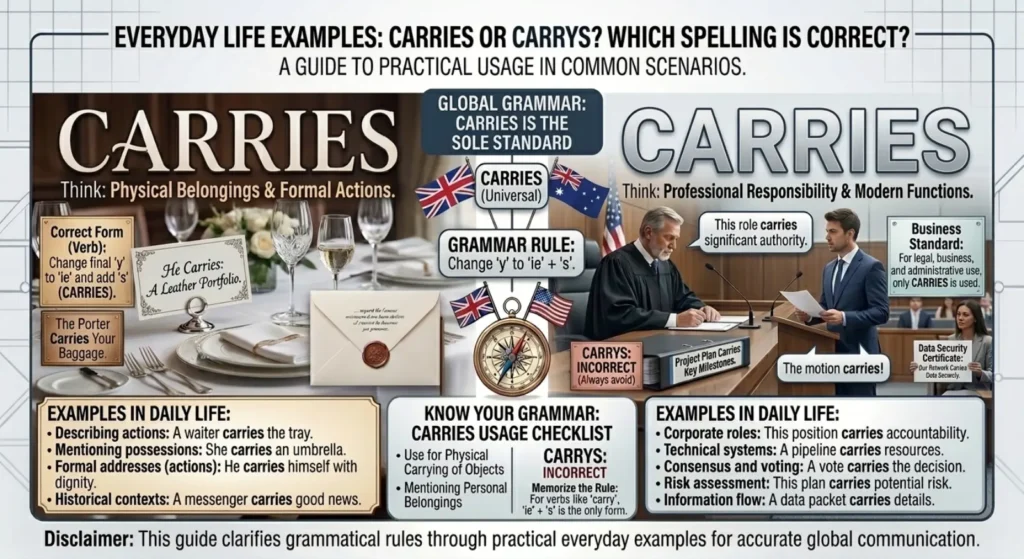
Carries is spelled the same way in British and American English.
Carrys remains incorrect in both varieties.
The grammar rule does not change between British and American English.
British vs American English Comparison
| Feature | British English | American English |
|---|---|---|
| Correct form | Carries | Carries |
| Incorrect form | Carrys | Carrys |
| Base verb | Carry | Carry |
| Third-person form | Carries | Carries |
| Spelling difference | None | None |
| Grammar rule | Same | Same |
When to Use Carrys
You should not use “carrys” in standard English.
It is a spelling error.
If you want the third-person singular form of carry, use carries.
Incorrect Examples
❌ He carrys the bag.
❌ The truck carrys heavy loads.
Correct Versions
✅ He carries the bag.
✅ The truck carries heavy loads.
When to Use Carries
Use carries with he, she, it, or a singular noun.
Examples
- She carries a small purse.
- He carries his laptop to work.
- The truck carries several boxes.
- The store carries fresh products.
- This bridge carries heavy traffic.
Sentence Pattern
Singular subject + carries + object
For example:
She + carries + a bag.
This pattern makes the correct form easy to identify.
Common Mistakes
Mistake 1: Adding Only “S”
❌ She carrys the books.
✅ She carries the books.
Change y to i and add -es.
Mistake 2: Using “Carrys” With He
❌ He carrys a backpack.
✅ He carries a backpack.
The subject requires the third-person form.
Mistake 3: Confusing Carry and Carries
❌ She carry her bag every day.
✅ She carries her bag every day.
Use carries with a singular third-person subject.
Mistake 4: Using Carries With I
❌ I carries my books.
✅ I carry my books.
Use the base form carry with I.
Mistake 5: Using Carries With They
❌ They carries heavy boxes.
✅ They carry heavy boxes.
Use carry with plural subjects.
Easy Trick to Remember
Use this simple rule:
Consonant + Y → IES
Think:
Carry → Carries
The Y changes to I.
Remember these examples:
- carry → carries
- try → tries
- study → studies
- worry → worries
But remember:
Vowel + Y → S
Examples:
- play → plays
- enjoy → enjoys
- stay → stays
So the easiest memory trick is:
Consonant + Y = IES
Vowel + Y = S
Everyday Life Examples
1. Carrying a School Bag
Students often carry books to school.
Example:
She carries her school bag every morning.
- Primary keyword: carries
- Secondary keyword: carries a bag
2. Carrying Groceries
People carry groceries after shopping.
Example:
He carries the groceries into the kitchen.
- Primary keyword: carries
- Secondary keyword: carries groceries
3. Transporting Goods
Trucks transport products between locations.
Example:
The truck carries goods across the country.
- Primary keyword: carries
- Secondary keyword: carries goods
4. Carrying a Phone
People often keep their phones with them.
Example:
She carries her phone everywhere.
- Primary keyword: carries
- Secondary keyword: carries a phone
5. Carrying an Important Message
Words can communicate an idea or meaning.
Example:
His speech carries an important message.
- Primary keyword: carries
- Secondary keyword: carries a message
Related Keywords
Use these keyword variations naturally:
- carrys or carries
- carrys vs carries
- carries meaning
- carry meaning
- is carrys a word
- is carries correct
- carry spelling
- carries spelling
- carry third person
- carry third person singular
- carrys spelling mistake
Google Trends & Usage Data
Search interest for carrys or carries mainly comes from spelling and grammar questions.
Carries is the standard form used in English writing worldwide.
Carrys appears mainly as a misspelling of the verb carry.
For SEO, target the spelling question while clearly explaining the correct grammatical form.
Usage Insight by Country
| Country | Correct Form | SEO Insight |
|---|---|---|
| 🇺🇸 USA | Carries | Standard English grammar |
| 🇬🇧 UK | Carries | Standard British English |
| 🇦🇺 Australia | Carries | Standard English usage |
| 🇮🇳 India | Carries | Common in English writing |
| 🇵🇰 Pakistan | Carries | Common grammar query |
Key SEO Insight
Carries should be the primary keyword for correct usage.
Carrys or carries captures users searching for spelling clarification.
Grammar-focused keywords can support the main topic.
Use related forms such as carry third-person singular naturally.
📊 Comparison Table: Keyword Variations
| Keyword Variation | Search Intent | Best Content Angle |
|---|---|---|
| carrys or carries | Spelling | Correct spelling |
| carrys vs carries | Comparison | Grammar explanation |
| carries meaning | Informational | Definition |
| carry meaning | Informational | Verb definition |
| is carrys a word | Spelling | Error explanation |
| is carries correct | Grammar | Correct usage |
| carry spelling | Spelling | Word guide |
| carries spelling | Spelling | Grammar guide |
| carry third person | Grammar | Verb forms |
| carry third person singular | Grammar | Detailed explanation |
FAQ
1. Is “carrys” a correct word?
No. Carrys is an incorrect spelling. The correct third-person singular form of carry is carries.
2. What is the difference between carrys and carries?
Carries is the correct grammatical form. Carrys is a spelling mistake.
3. Which is more common, carrys or carries?
Carries is overwhelmingly more common because it is the standard English form.
4. Is “carries” formal English?
Yes. Carries is standard English and works in both formal and informal writing.
5. Why does “carry” become “carries”?
The verb carry ends in a consonant followed by y. The y changes to i, and -es is added.
Conclusion
Carrys Or Carries is a common spelling question with a simple answer. Carries is the correct form, while carrys is incorrect. The word carries is the third-person singular form of carry. We use it with he, she, it, and singular nouns. The spelling changes because carry ends with a consonant and y. The y changes to i, and -es is added. This creates carries. The same rule applies to words like try, study, and worry. Remember the simple pattern: consonant + y becomes ies. Use carry with I, you, we, and they. Use carries with he, she, it, or one person or thing. This rule will help you avoid similar spelling errors.

Daniel Foster is a comparison analyst and content strategist at Comparelly.com. He specializes in researching products, services, tools, and industry trends to create clear, unbiased comparison guides. With a focus on accuracy and practical insights, Daniel helps readers understand key differences and make informed decisions with confidence. His goal is to simplify complex choices through trustworthy, easy-to-understand content.