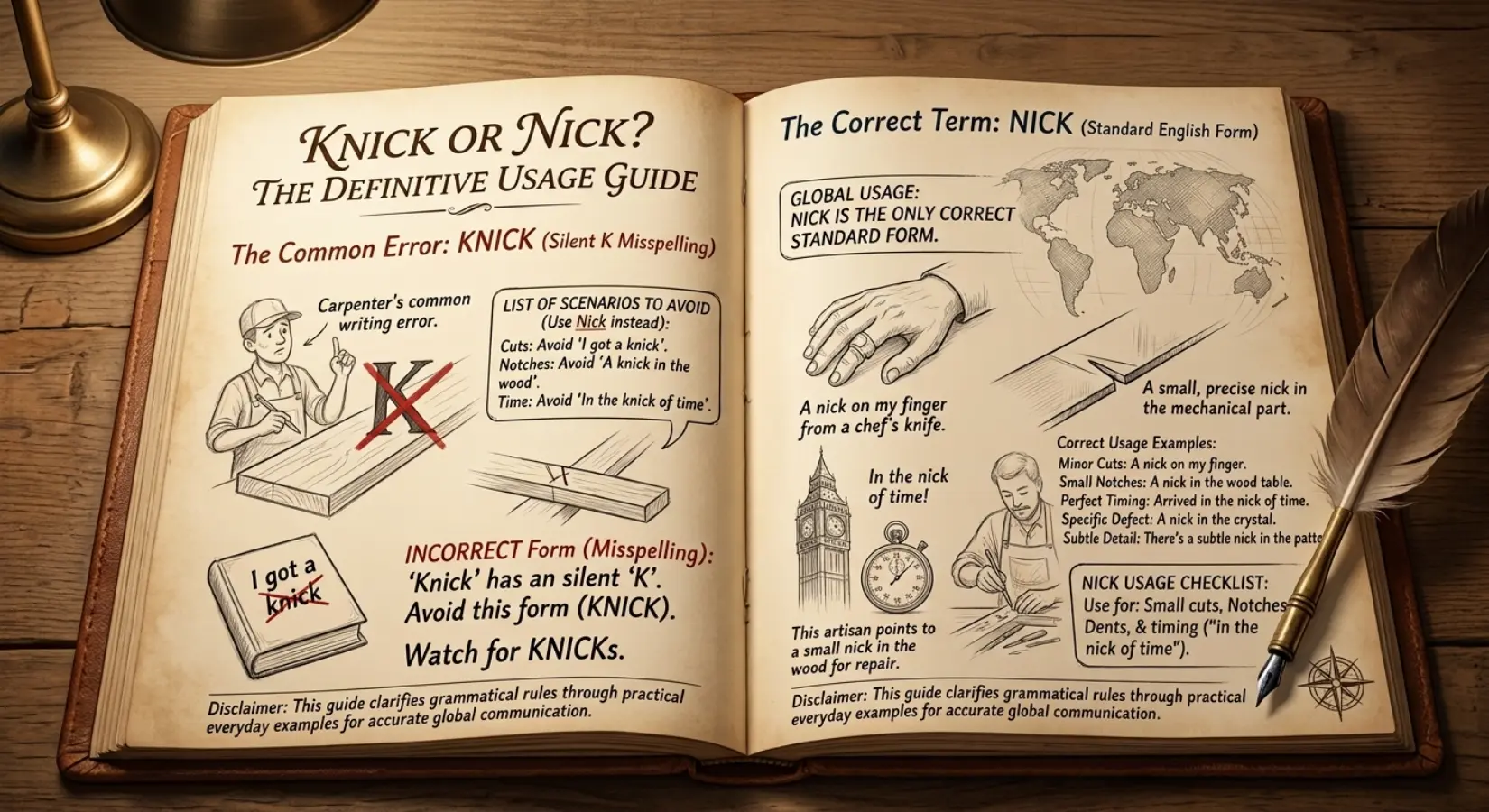
Knick Or Nick can be confusing because both words are real English terms. However, they do not always mean the same thing. Nick is a common English word with several meanings. It can mean a small cut, a small notch, or a short period of time.
It can also describe stealing something in informal English. Knick is less common and usually appears in specific words or phrases. The most familiar example is knick-knack, which means a small decorative object. Some people also use knick informally for a small notch or cut. However, nick is the standard choice for most everyday meanings.
Understanding the context helps you select the right word. This guide explains knick vs nick, their meanings, origins, spelling, usage, common mistakes, and everyday examples. It also explains British and American English usage.
Quick Answer (for Google snippet)
Nick is the standard word for a small cut, notch, or similar mark. Knick is less common and usually appears in compounds such as knick-knack.
Example: The knife left a small nick in the table.
Meaning of Knick
Knick is an uncommon English word.
It can refer to a small cut, notch, or mark in some informal usage.
However, knick is not the usual spelling for this meaning.
The word appears more commonly in the compound knick-knack.
Examples
- The shelf was covered with small knick-knacks.
- He collected decorative knick-knacks from different places.
Common Uses of Knick
- knick-knack
- knick-knacks
- small decorative object
- ornamental item
- little ornament
In everyday writing, knick-knack is much more common than standalone knick.
Meaning of Nick
Nick is a common English word with several meanings.
As a noun, it can mean a small cut, notch, or scratch.
It can also refer to a small indentation on an object.
Examples
- The knife made a nick in the wooden table.
- There is a small nick on the edge of the cup.
Other Meanings of Nick
Nick can also mean:
- a small cut
- a notch
- a small defect
- a short period of time
- a prison, in British informal English
- stealing something, in informal English
Examples
- The scissors left a nick in the paper.
- I found the tool in the nick of time.
- He was taken to the nick.
- Someone nicked my pen.
The correct meaning depends on context.
Key Differences: Knick vs Nick
| Feature | Knick | Nick |
|---|---|---|
| Meaning | Usually part of “knick-knack” | Small cut, notch, mark, or other meanings |
| Tone | Informal or specific | Common and flexible |
| Usage | Limited | Very common |
| Popularity | Less common | More common |
| Common phrase | Knick-knack | Nick of time |
| Example | A decorative knick-knack | A nick in the table |
The biggest difference is frequency and usage.
Nick works in many everyday contexts.
Knick appears mainly in specific expressions.
Origin & History
Nick has a long history in English.
Its meaning developed from older words connected with cutting, marking, or making a notch.
The noun later gained several figurative meanings.
For example, in the nick of time means just before it becomes too late.
Knick has Germanic connections and appears in words related to small cuts or notches.
The familiar compound knick-knack refers to a small decorative object.
Similar Word Examples
English has many short words that look or sound similar.
Examples include:
- nick / knack
- knick / knack
- nick / nock
- knot / not
- knight / night
- know / no
- knew / new
Context helps identify the correct word.
🇬🇧 British English vs 🇺🇸 American English Spelling
Nick is spelled the same in British and American English.
Knick also keeps the same spelling.
However, some meanings of nick are especially common in British informal English.
British vs American English Comparison
| Feature | British English | American English |
|---|---|---|
| Nick | Nick | Nick |
| Knick | Knick | Knick |
| Small cut | Nick | Nick |
| Knick-knack | Common | Common |
| “Prison” meaning | Nick | Less common |
| Spelling difference | None | None |
The main differences involve usage and meaning, not spelling.
When to Use Knick
Use knick mainly when it forms part of an established expression.
The best-known example is knick-knack.
Examples
- The room was filled with colorful knick-knacks.
- She bought a small knick-knack for her shelf.
- His desk contains several unusual knick-knacks.
Avoid using knick alone when you mean a small cut or notch.
For that meaning, nick is normally the better choice.
When to Use Nick
Use nick when describing a small cut, notch, scratch, or indentation.
Examples
- The knife left a nick in the counter.
- There is a nick on my phone case.
- The table has a small nick near the corner.
Use nick in common expressions too.
More Examples
- We arrived in the nick of time.
- He nicked my favorite pen.
- The police took him to the nick.
The last example uses nick as informal British English for prison.
Common Mistakes
Mistake 1: Using “Knick” for a Small Cut
❌ The knife left a knick in the table.
✅ The knife left a nick in the table.
Use nick for a small cut or notch.
Mistake 2: Spelling Knick-Knack as Nick-Nack
❌ She collects colorful nick-nacks.
✅ She collects colorful knick-knacks.
The standard spelling is knick-knack.
Mistake 3: Confusing “Nick” With “Niche”
❌ There is a niche on the table.
✅ There is a nick on the table.
A nick is a small cut or indentation.
A niche is a specialized position or recessed space.
Mistake 4: Assuming Knick Is More Common
❌ Knick is the usual word for a small cut.
✅ Nick is the usual word for a small cut.
Knick is much less common in this context.
Mistake 5: Confusing “Nick” With “Nock”
❌ The arrow made a nick in the bow.
✅ The arrow fits into the nock of the bow.
A nock is a specific part of an arrow or bow.
Easy Trick to Remember
Use this simple memory trick:
Nick = Notch
Both nick and notch describe a small mark or cut.
Think:
Nick → Notch → Small cut
For knick, remember:
Knick → Knick-knack → Small decoration
So:
Nick = mark or cut
Knick = usually knick-knack
This trick makes the difference easier to remember.
Everyday Life Examples
1. A Nick in a Table
A hard object can leave a small mark on furniture.
Example:
There is a tiny nick in the wooden table.
- Primary keyword: nick
- Secondary keyword: nick in wood
2. A Nick on a Phone
Phone cases and screens can develop small marks.
Example:
My phone case has a small nick on the corner.
- Primary keyword: nick
- Secondary keyword: small nick
3. A Decorative Knick-Knack
Small decorations often sit on shelves or desks.
Example:
She placed a colorful knick-knack on the shelf.
- Primary keyword: knick
- Secondary keyword: knick-knack
4. In the Nick of Time
This phrase means arriving just before something becomes too late.
Example:
We reached the station in the nick of time.
- Primary keyword: nick
- Secondary keyword: nick of time
5. Nick in British Informal English
In British English, nick can informally mean prison.
Example:
The thief was taken to the nick.
- Primary keyword: nick
- Secondary keyword: British slang nick
Related Keywords
Use these keyword variations naturally:
- knick or nick
- knick vs nick
- nick vs knick
- knick meaning
- nick meaning
- is knick a word
- is nick a word
- knick-knack meaning
- nick definition
- nick spelling
- knick spelling
- nick of time meaning
Google Trends & Usage Data
Search interest for nick is broader because the word has several meanings.
Knick has narrower search intent and often relates to knick-knack.
Country-level interest can vary based on local vocabulary and search habits.
For SEO, target nick for general vocabulary and knick-knack for decorative objects.
Usage Insight by Country
| Country | Common Usage | SEO Insight |
|---|---|---|
| 🇺🇸 USA | Nick | Focus on cuts, marks, and common phrases |
| 🇬🇧 UK | Nick | Include British informal meanings |
| 🇦🇺 Australia | Nick | General English usage is common |
| 🇮🇳 India | Nick | Focus on standard vocabulary |
| 🇵🇰 Pakistan | Nick | Focus on spelling and meaning |
Key SEO Insight
Nick has broader search intent than knick.
Knick-knack provides a useful secondary keyword.
The phrase knick or nick targets spelling confusion.
Related phrases can capture vocabulary-focused searches.
📊 Comparison Table: Keyword Variations
| Keyword Variation | Search Intent | Best Content Angle |
|---|---|---|
| knick or nick | Comparison | Spelling guide |
| knick vs nick | Comparison | Word difference |
| nick vs knick | Comparison | Vocabulary guide |
| knick meaning | Informational | Definition |
| nick meaning | Informational | Definition |
| is knick a word | Spelling | Word clarification |
| knick-knack meaning | Informational | Vocabulary |
| nick of time meaning | Informational | Idiom guide |
| nick spelling | Spelling | Grammar guide |
| nick definition | Informational | Dictionary-style guide |
FAQ
1. Is “knick” a correct word?
Yes, knick exists, but it is uncommon as a standalone word. It is much more familiar in knick-knack.
2. What is the difference between knick and nick?
Nick commonly means a small cut, notch, or mark. Knick usually appears in knick-knack, meaning a small decorative object.
3. Which is more common, knick or nick?
Nick is much more common in everyday English. Knick has more limited usage.
4. Is “nick” formal English?
Yes, nick is standard English when used for meanings such as a small cut or notch. Some other meanings are informal.
5. Why does confusion between knick and nick exist?
The words look very similar and differ by only one letter. Knick also appears in the familiar word knick-knack.
Conclusion
Knick Or Nick can create confusion because the words look almost identical. However, their common uses are different. Nick is the standard word for a small cut, notch, scratch, or indentation. It also appears in expressions such as in the nick of time. In British informal English, nick can also mean prison. Knick is less common as a standalone word. You will usually see it in knick-knack, which means a small decorative object. Remember the simple trick: Nick means notch, while knick connects with knick-knack. Both spellings can be correct in the right context. However, do not use knick when you mean a small cut. Choose nick for that meaning.

Daniel Foster is a comparison analyst and content strategist at Comparelly.com. He specializes in researching products, services, tools, and industry trends to create clear, unbiased comparison guides. With a focus on accuracy and practical insights, Daniel helps readers understand key differences and make informed decisions with confidence. His goal is to simplify complex choices through trustworthy, easy-to-understand content.